Open most vanity cabinets and you find the same scene: a plumbing trap in the middle, a graveyard of half-used bottles around it, and a front row of things that fall over every time you reach past them. The cabinet is not small so much as badly shaped, and standard storage assumes a rectangle you do not have.
Good bathroom cabinet organization starts by accepting the pipe. Ten ideas below for working with the shape rather than pretending it is a cabinet.
1. Empty it and sort by frequency, not by type
Take everything out onto a towel first. Sorting inside a cabinet, on your knees, with a pipe in your face, is how people give up twenty minutes in.
Then resist grouping by category. “Hair”, “skincare”, “cleaning” sounds tidy but it puts a bottle you use twice a year next to one you use every morning. Sort by how often you reach for something instead: daily, weekly, and rarely. The daily group is small, and it earns the easiest position in the cabinet. Everything in the rarely pile is a candidate for leaving the bathroom altogether.
Wipe the cabinet floor while it is empty. Old vanities almost always have a sticky ring under something, and it is far easier to clean before the new organizers go in.
2. Put the front row on pull-out drawers
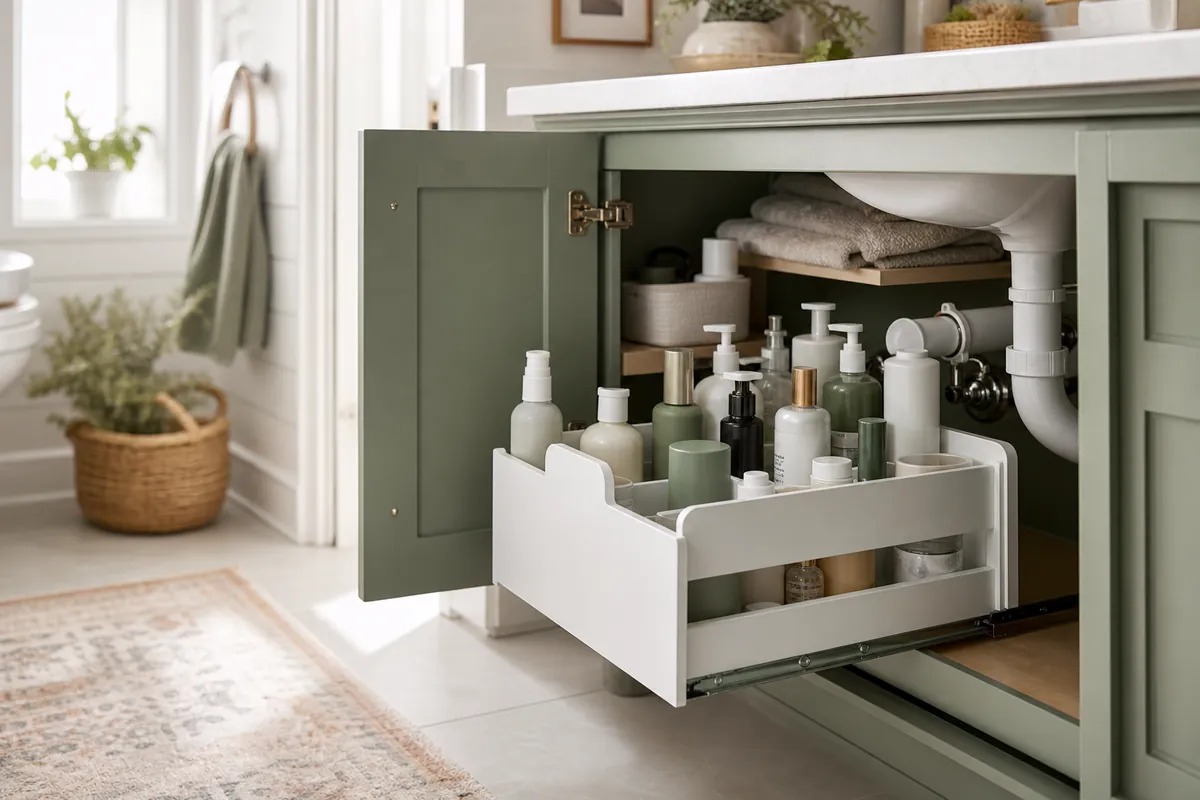
The single biggest problem in a deep vanity is that the back is unreachable, so the back becomes an archive and the front becomes a pile.
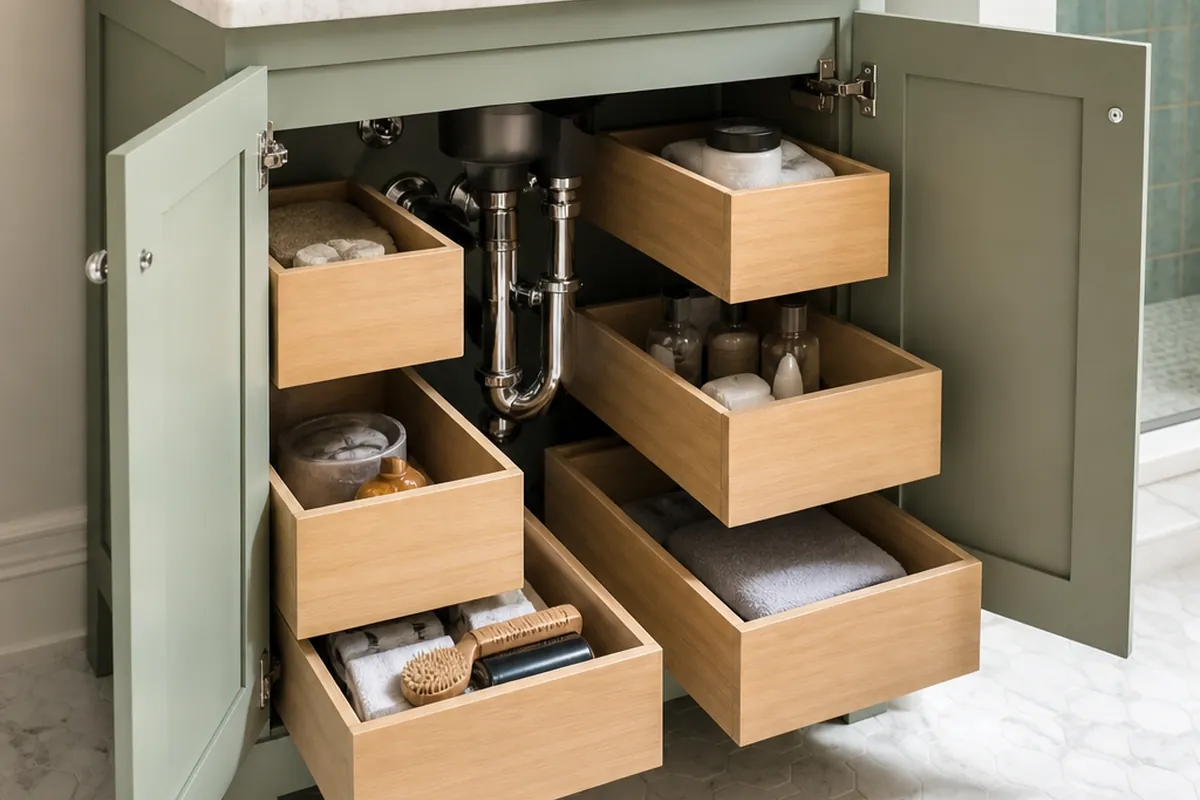
A pull-out under-sink organizer turns the full depth into usable space, because the whole tray slides toward you instead of you reaching into it. Nothing lives permanently out of sight, which is the actual fix.
Measure the cabinet opening rather than the interior, and check the door hinge does not intrude. Vanity doors often have a lip or a hinge plate that narrows the opening by an inch compared to the cabinet behind it, and that inch is exactly what stops a drawer sliding out.
3. Build a second level around the pipe
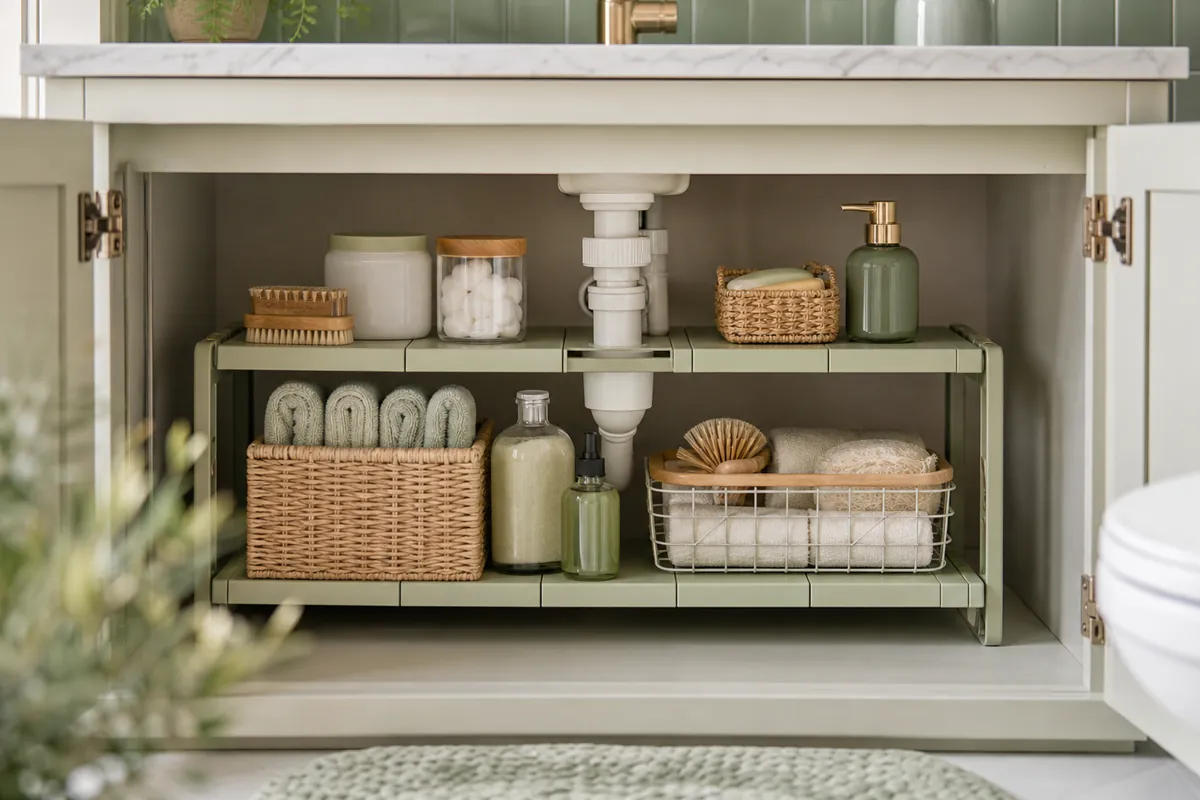
The vertical space in a vanity is mostly wasted. There is usually eight to twelve inches of air above whatever is standing on the cabinet floor.
A 2-tier under-sink shelf designed to straddle the trap gives you that level back. The pipe passes through the gap, the shelf sits over it, and you get a whole second surface where there was only air.
Look for an expandable model if your plumbing is off-center, which it usually is. Fixed-width shelves assume a symmetrical cabinet, and vanities are rarely built that way.
4. Corral the small things in clear drawers
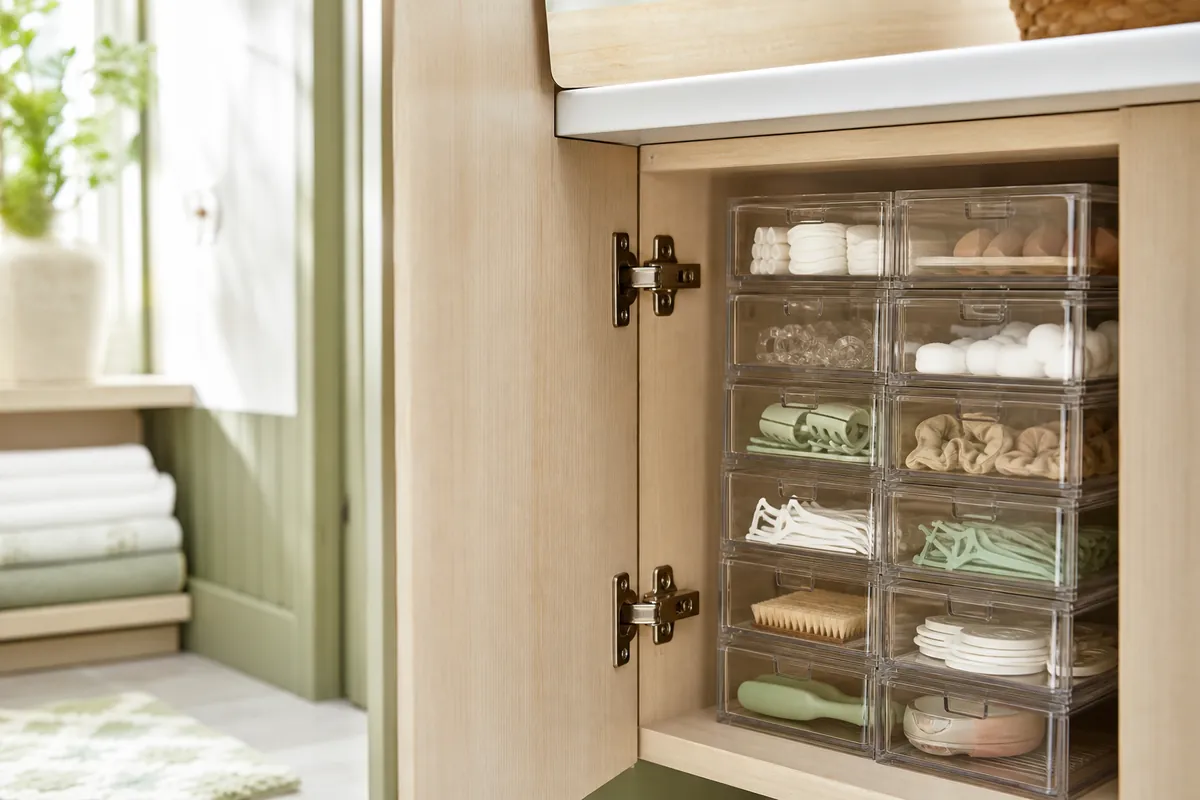
The reason a tidy cabinet reverts within two weeks is almost always the small items. Spare toothbrush heads, hair grips, cotton buds, sample sachets. Individually tiny, collectively chaos.
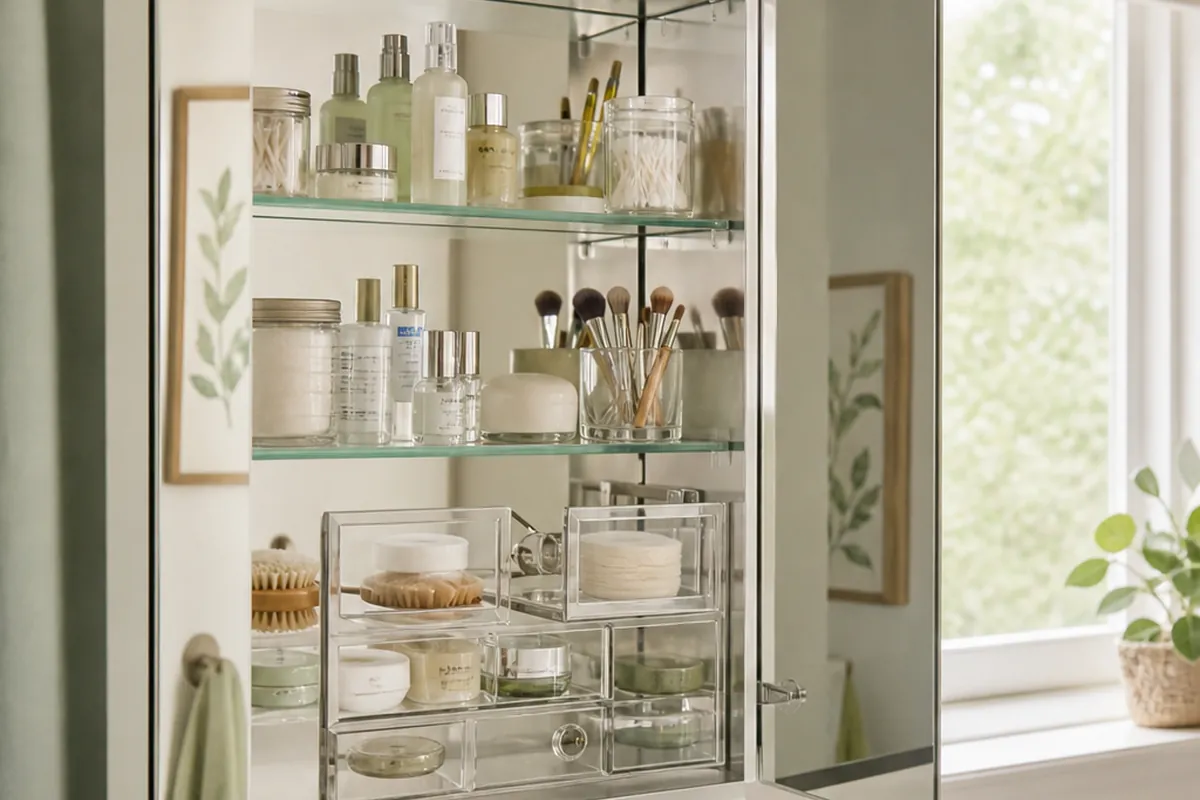
A clear drawer organizer set handles this properly, because each category gets a compartment with walls and you can see what is in it without opening anything. Keep the categories narrow. “Dental” beats “bathroom bits” every time.
The same principle carries out to the vanity drawers themselves, which is the whole idea behind bathroom drawer organization.
5. Give leak-prone things their own contained zone
Anything that can leak should be stored as though it will. Shampoo refills, bleach, and drain cleaner all eventually weep down a bottle side and glue themselves to whatever is underneath.
Put them together in a single lidded caddy or a shallow tray with a raised lip. When something does leak, it is contained in one washable container rather than soaking through a cardboard box of spare soap. It also means you can lift the whole cleaning group out in one movement when you need to clean the cabinet.
6. Store tall bottles behind the pipe, not beside it
The dead space directly behind the plumbing trap is the hardest to reach and the easiest to waste, and it happens to be tall.
That is the natural home for the things that are tall and infrequent: refill bottles, a spare bulk shampoo, the tall can of something you use monthly. They stand upright, they do not need reaching past, and they stop that pocket becoming a void that swallows small objects.
7. Mount a rack on the inside of the cabinet door
The door is a flat vertical surface that is doing nothing, and in a vanity it is usually the cleanest surface in the whole cabinet.
An adhesive or over-the-door caddy on the inside face takes flat, light things: a hairbrush, a spray bottle, cloths. Check the clearance carefully before you commit, because whatever hangs on the door has to clear the shelves and the pipe when the door swings shut. Hold the item in place and close the door slowly once before you stick anything down.
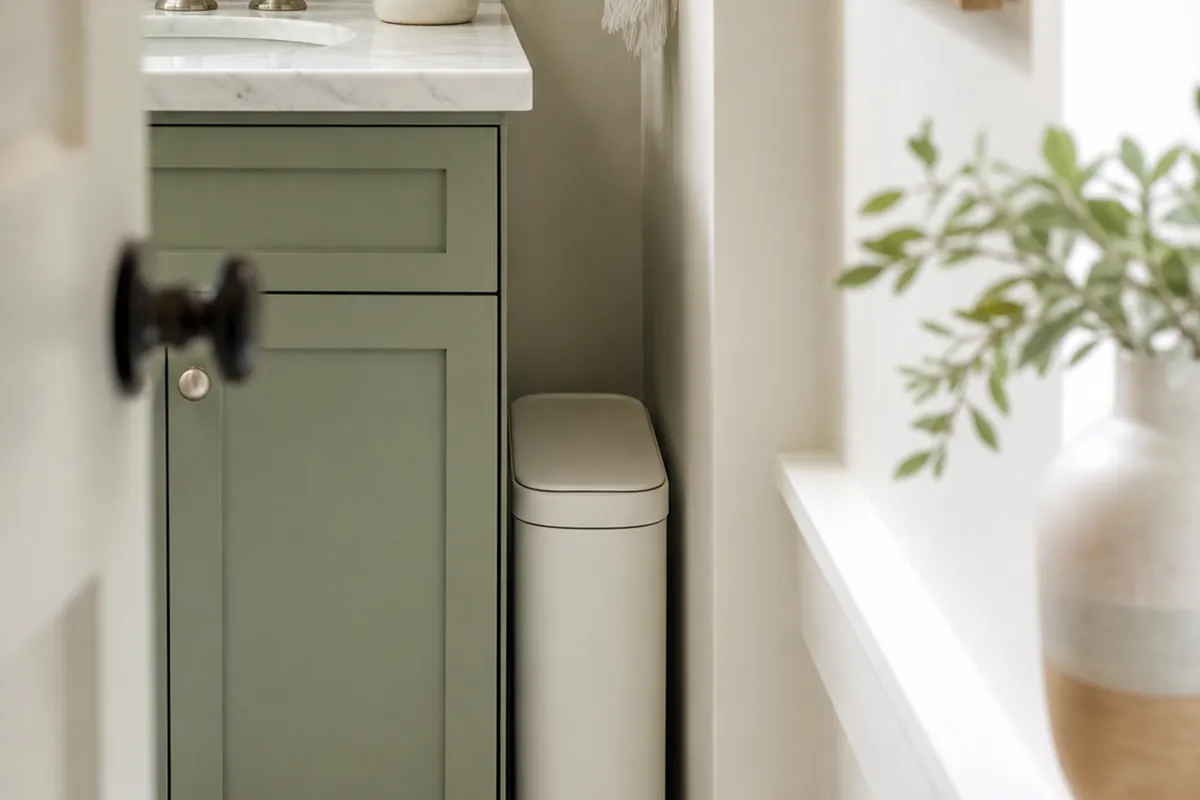
The door can also carry a small bin, which gets the trash can off the bathroom floor entirely. Trash can storage ideas for a small bathroom vanity covers the door-mounted and hidden options.
8. Keep a small landing space empty
A cabinet packed to capacity has no room to put something down while you reach for something else, so things end up on the floor or the counter.
Leave one small clear patch, roughly the footprint of a cereal bowl, near the front. It sounds like waste in a cabinet you are trying to maximise, but it is what stops the counter above collecting the overflow. If your counter is the real problem, bathroom counter organization tackles that side of it.
9. Move the backups out of the bathroom
Most vanity cabinets are storing a small shop. Three spare toothpastes, a bulk pack of soap, a second conditioner bought because the first one was hiding behind the pipe.
Refills and bulk buys do not need to be in the bathroom, and bathrooms are humid places that are unkind to cardboard packaging anyway. A bin in a hall closet or on top of an armoire holds the surplus, and the cabinet holds one of each thing in use. This usually reclaims more space than any organizer you can buy.
10. Label the zones once the layout settles
Wait until you have lived with the new arrangement for a week before labelling anything, because the first layout is never quite right.
Once it settles, a small label on each drawer front or bin edge is what makes the system survive other people. Labels are less about you remembering and more about anything you share a bathroom with putting things back in the same place. Keep them functional rather than decorative, and label the container rather than its contents so the label stays true when the specific product changes.
Bathroom cabinet organization that holds up
The sequence that works: empty it, sort by how often you reach for things, then buy for the shape you actually have. A pull-out under-sink organizer solves the unreachable depth, a 2-tier under-sink shelf reclaims the height around the trap, and a clear drawer organizer set stops the small things scattering.
After that it is mostly restraint. Keep only one of each thing in use, contain anything that might leak, and leave a small empty patch so the cabinet has somewhere to breathe. If the room has no cabinet worth organizing in the first place, the ideas in bathroom storage with no cabinet start from scratch instead.