A coffee station is one of the few bits of kitchen organizing that pays you back every single morning, which is why it is worth doing properly even in a kitchen with almost no counter.
The mistake is treating it as a decorating project: a tray, some matching jars, a neon sign. What makes a station actually work is duller and more useful, and it comes down to where it sits, how far you have to reach, and whether it can be wiped down in ten seconds.
1. Work out the footprint before you claim the counter
A coffee station does not need the two feet of countertop people usually give it.
What it needs is the machine’s own footprint plus roughly six inches of clear space in front, which is where the mug sits and where the grounds land. Everything else in the ritual, the beans, the pods, the sugar, the spare mugs, does not have to be on the counter at all. It has to be within reach of it.
Getting that distinction right is what separates a station from a pile of coffee things occupying a third of a small kitchen.
2. Put it where the power and the water already are
This is the constraint that beats every aesthetic choice, and it is the one people plan around last.
A coffee machine needs a socket, and it needs refilling from the faucet once or twice a day. Site the station across the kitchen from the sink and every morning includes carrying a full water tank past the hob. Site it away from a socket and you are running an extension lead along a wet counter, which is worse than untidy.
Find the spot where a socket and the sink are both within a step, and build there even if it is not the prettiest corner. Worth checking at the same time: what is directly above. A station under a wall cabinet gets a shelf and hanging space for free, while one on an open stretch of counter has nowhere to go but sideways, which is the direction you cannot afford.
3. Use the one arm’s reach test
Stand where you would stand to make a cup and do not move your feet. Everything needed for one ordinary coffee should be reachable: machine, mug, beans or pods, spoon, and whatever goes in it.
Anything that fails the test either moves closer or is not part of the daily station. The second cup a week, the cafetiere for visitors, the flavoured syrups nobody finished, those go in a cabinet.
Most cluttered coffee corners are cluttered because they store the occasional alongside the daily. Separating the two usually frees half the surface without buying anything, which is the same principle behind kitchen counter organization when you have no counter space.
If two people in the house drink different things, run the test twice. A station that works for filter coffee and fails for tea will quietly grow a second, messier station beside it within a month.
4. Build upward into the dead air above the counter
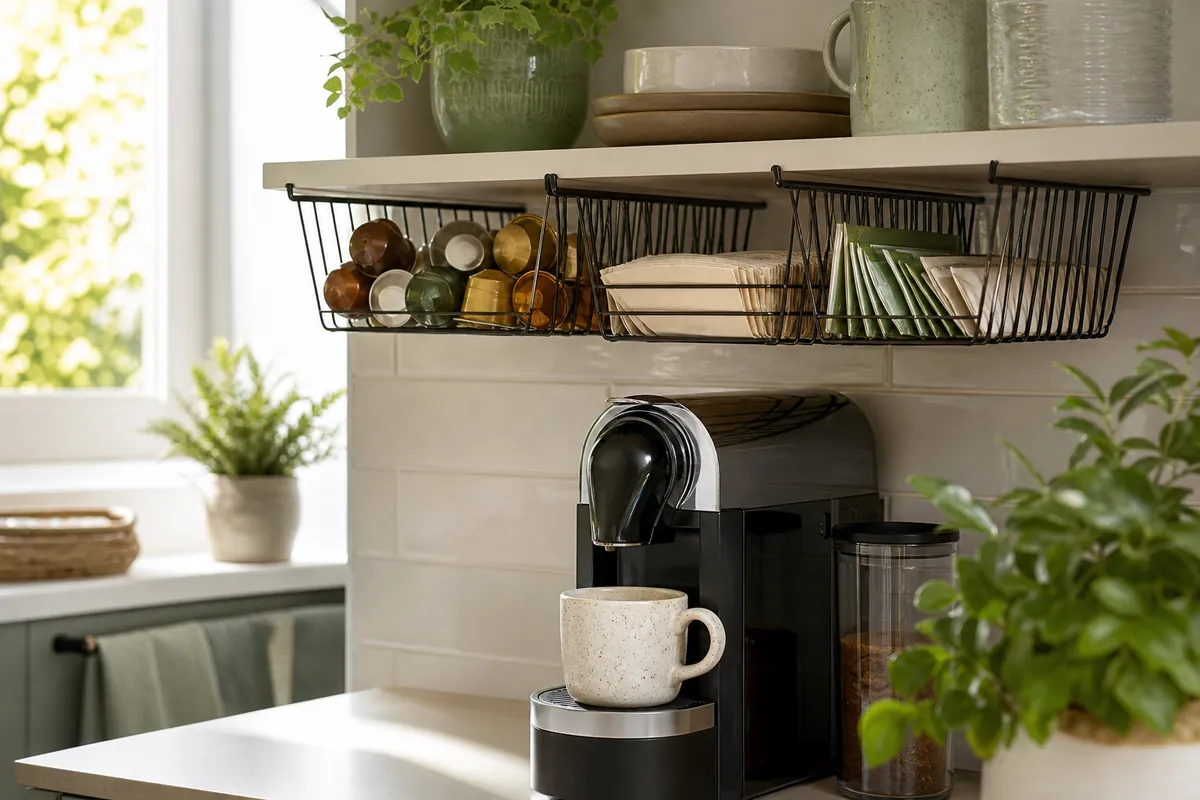
In almost every kitchen there is a band of wasted air between what is on a shelf and the shelf above it, and it sits directly over the coffee machine.
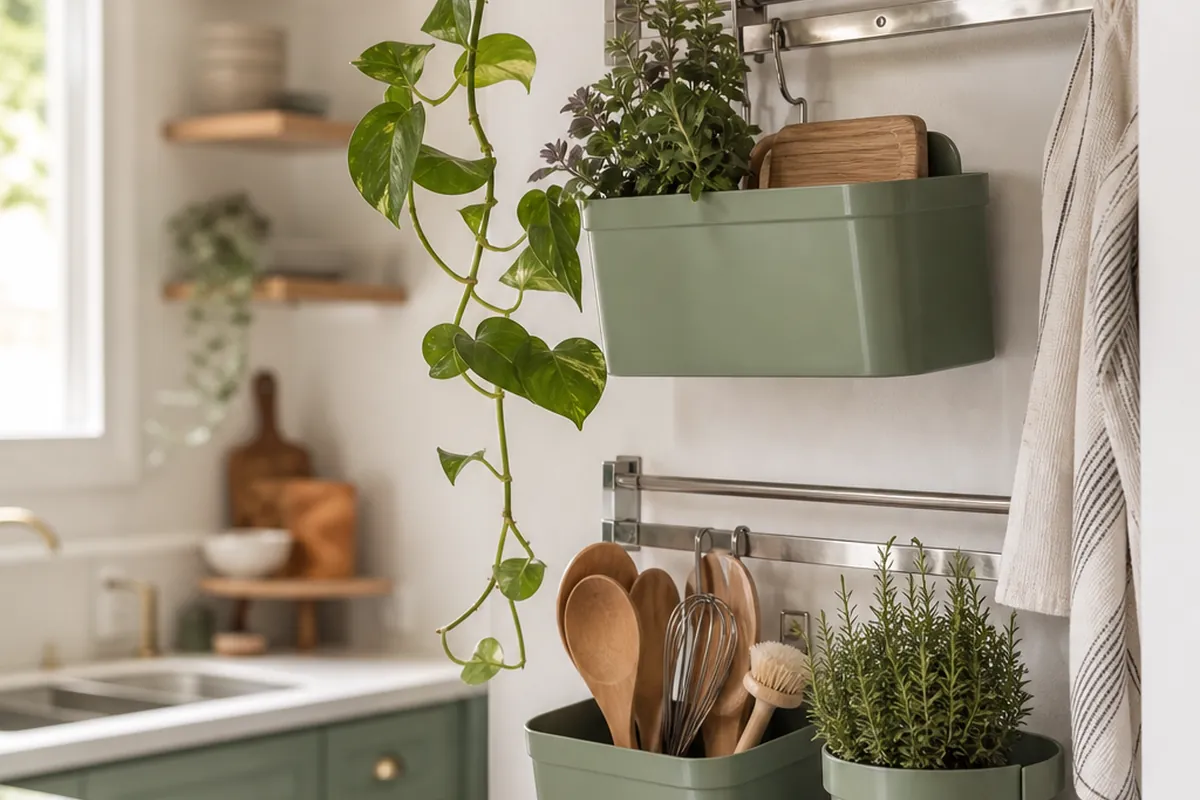
Under-shelf hanging baskets hook straight over an existing shelf and claim it. Each is about 13 inches long and just over 6 inches deep, which is right for filters, pods, sachets and the small packets that otherwise migrate across the counter. They need no fixings and come out when you move, which matters in a rented kitchen.
Check the shelf thickness before ordering, since these clamp over a board rather than a wire rack, and hang them over the counter rather than over the hob.
5. Put a turntable behind the machine
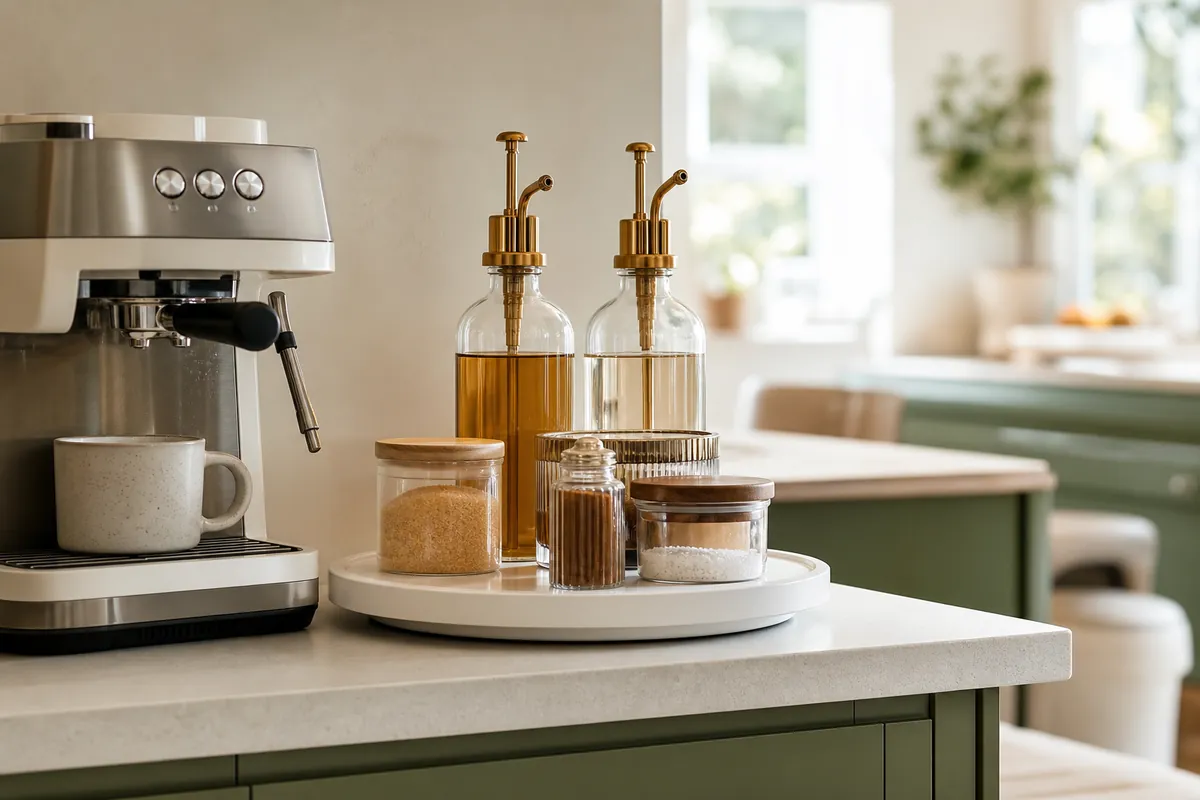
The depth behind a coffee machine is real storage, and it is almost always wasted because anything put there is unreachable behind the machine.
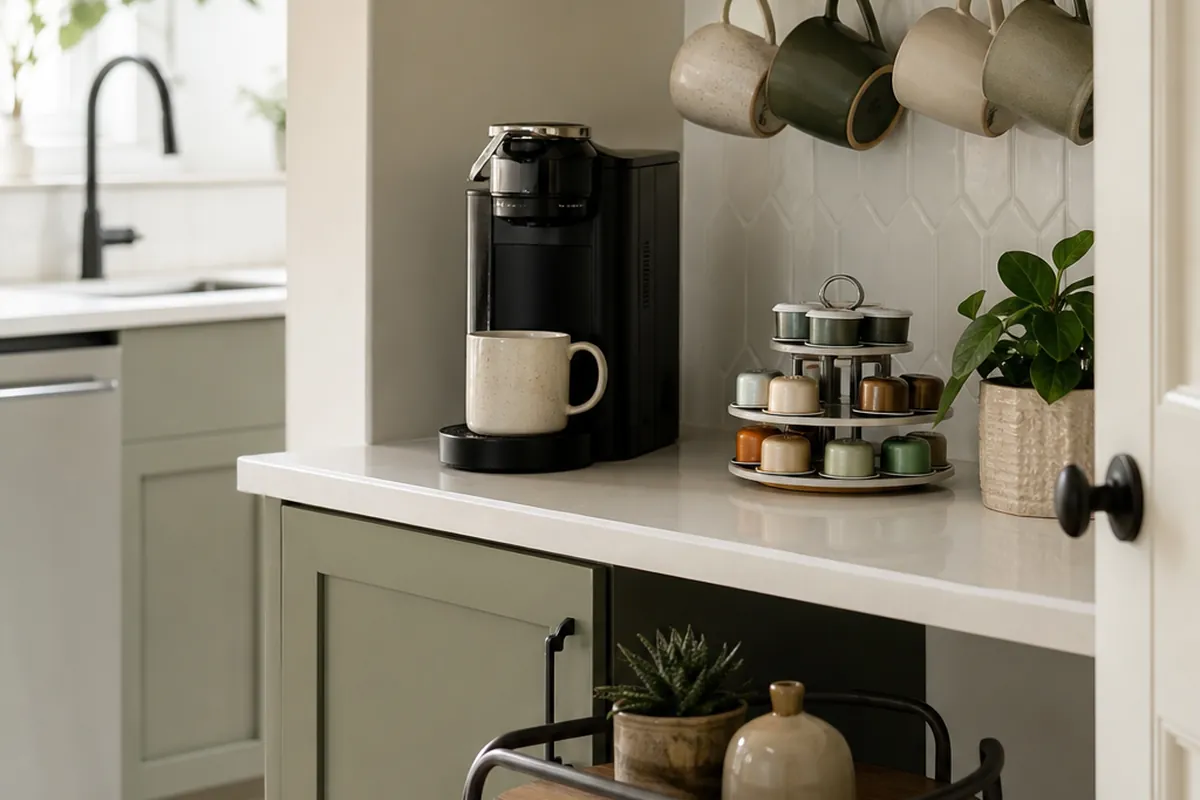
A turntable organizer fixes exactly that: the back row spins to the front instead of being excavated. These come as a set of four 10 inch turntables, which is more than the station needs, so put one behind the machine and use the others in the cabinet above for sauces and tins.
Ten inches is the useful size for this. Much larger and it fouls the machine when it turns, much smaller and it holds three things and a sense of disappointment.
6. Use a rolling cart when there is genuinely no counter
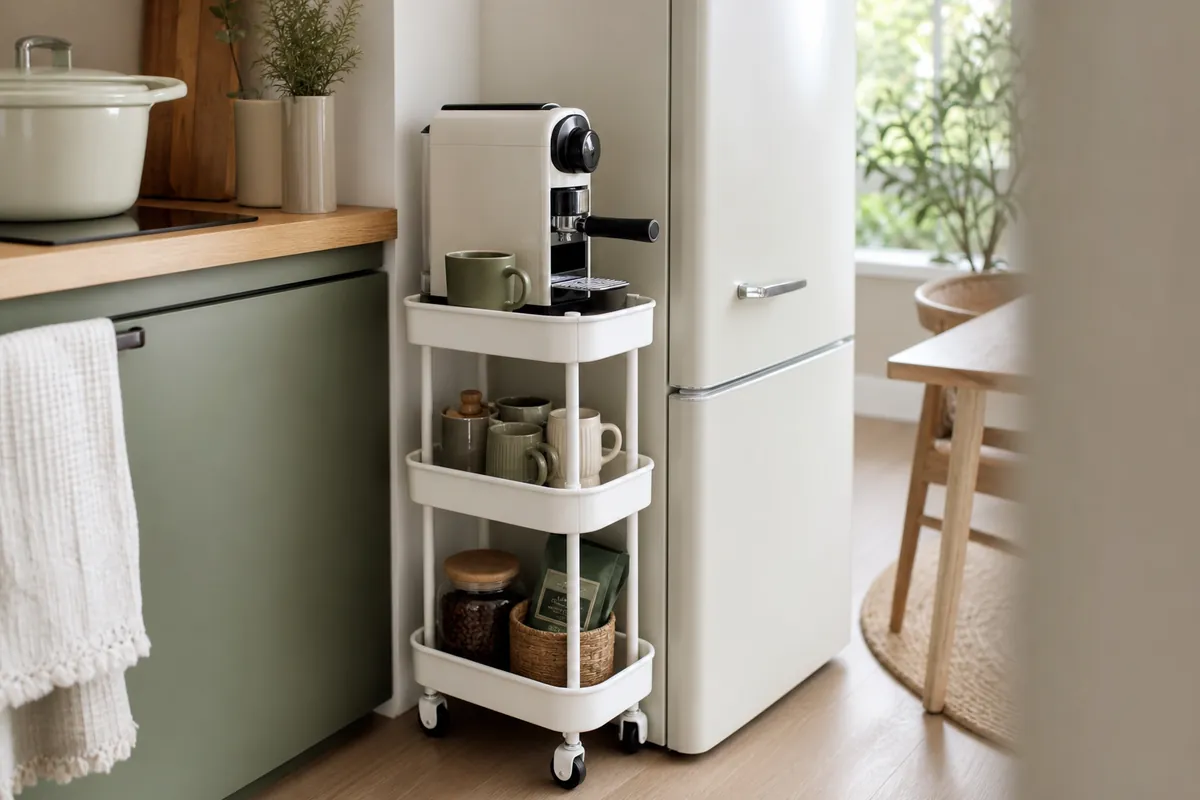
Some kitchens simply have no spare countertop, and the honest answer is to stop trying to find some and to give the coffee its own furniture instead.
A 3-tier rolling cart works because of its proportions rather than its capacity. At about 10 inches wide it fits the dead gap beside a fridge or at the end of a run, at 30 inches tall it sits below the counter line so it does not close the room in, and the three tiers separate the machine, the mugs and the supplies without any of them touching.
The wheels are the underrated part. Being able to roll the whole station out means you can clean behind it, which is the thing that never happens with a machine parked against a wall. Two of the wheels lock, so it stays put while you are actually pulling a shot.
7. Be honest about decanting into pretty jars
Matching glass jars are most of what makes a coffee station photograph well, and they are mildly bad for the coffee.
Light and oxygen are what turn beans stale, and a clear jar on a bright counter gives them both. Coffee bags have a one way valve for a reason. The practical compromise: keep the working stock in its bag with a clip inside a cabinet, and if you want the jars, use them for the things that do not care, so sugar, chocolate powder, biscuits.
Nobody has to choose between a nice looking counter and drinkable coffee. They just should not store the beans in the ornament.
8. Get the mugs off the counter
Mugs are the bulkiest part of the ritual and the part most often left sitting out, usually four of them clustered round the machine.
Hooks under a wall cabinet, a rail on the wall, or a dedicated shelf all work, and all of them turn a horizontal sprawl into a vertical line. If the mugs have to stay in a cabinet, put the two you actually use at the front of the shelf nearest the machine rather than stacking all eight together, which is the sort of small reordering that makes cramped cabinets usable again.
Two mugs at the station, the rest stored properly. A station is not a display cabinet.
If the cabinet cannot take them either, mug storage ideas for a kitchen with no cabinet space covers hooks, rails and under-shelf racks that keep them by the machine.
9. Solve the daily waste before it solves itself
A coffee station generates trash every single day: grounds, pucks, pods, filters. If there is nowhere obvious for it, the answer becomes a saucer on the counter, and that becomes permanent.
Options in order of how well they work in a small kitchen: a small lidded caddy at the station emptied into the food waste every couple of days, a knock box if you use an espresso machine, or simply siting the station within a pace of the bin so nothing has to be put down on the way.
Spent grounds also stain, so whatever holds them wants to be something you are happy to rinse.
Pods are the harder case, because the used ones are wet, and a bowl of them on the counter is exactly the sort of thing that stops a station looking cared for. A small lidded container is the difference, and emptying it is a job you do on the way past the bin rather than a job in itself.
10. Make the wipe down a ten second job
Every coffee station gets milk splash, grounds and limescale rings. The one that survives is the one where cleaning it is trivial.
That means a surface you can sweep a cloth across in one pass, which means not too many small objects standing directly on the counter. It is another argument for the turntable and the baskets, since both lift the clutter off the working surface into something you can pick up in one movement.
A tray under the machine does the same job. Lift the tray, wipe the counter, put it back, done in the time the kettle takes. That habit is what keeps a small kitchen from silently degrading, the same way it does in any tiny kitchen with no counter space.
The station is a zone, not a shelf of props
A coffee station in a small kitchen works when it is sited near power and water, when one cup is makeable without moving your feet, and when everything that is not part of the daily cup has been moved out of the way.
Do that, then add the tray and the jars if you want them. Done in the other order you get a very attractive corner that makes coffee slightly harder to make than it was before.