Hats are the one thing in an entryway that storage actively damages. A coat squashed on a hook is still a coat. A felt hat left under two others for a winter comes out with a flattened crown and a brim that has taken on a permanent wave, and no amount of hanging it up afterwards brings the shape back.
That is why hat storage is a different problem from coat storage, even though they end up in the same three square feet by the door. The goal is not fitting them in. It is keeping weight off the parts that hold a shape, in a space that has no room to spare.
1. Split them by what actually deforms
Before buying anything, put your hats in three piles, because they need genuinely different things.
Structured brimmed hats, meaning felt, wool and straw, are the fragile ones. Caps have a curved brim that flattens but a crown that does not care. Knit hats have no shape to lose at all but a band that stretches.
Almost every hat storage mistake is applying the right method to the wrong pile. Hooks are excellent for caps and slowly ruin knit hats. A bin is right for knit hats and wrong for a felt fedora.
2. Store brimmed hats resting on the crown
This is the one piece of hat advice that sounds wrong and matters most.
A brimmed hat left sitting on its brim puts the whole weight of the hat onto the edge that gives it its shape, and over a season that edge flattens or curls. Turn it upside down so it rests on the crown, brim in the air, and nothing is pressing on the part you care about.
It looks odd on a shelf. It is also what hat shops do, and it is free.
3. Give caps a hook rail rather than a shelf
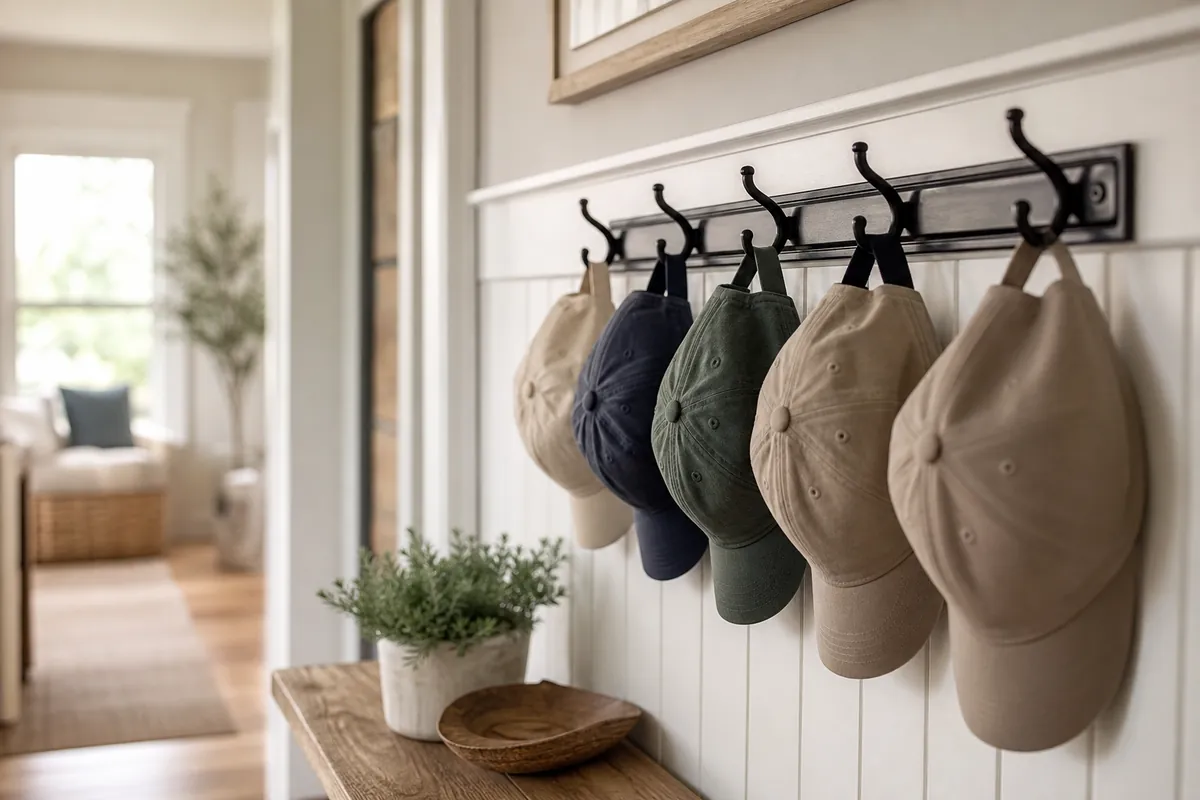
Caps are the high volume problem in most homes, and a shelf is the worst place for them because a shelf invites stacking.
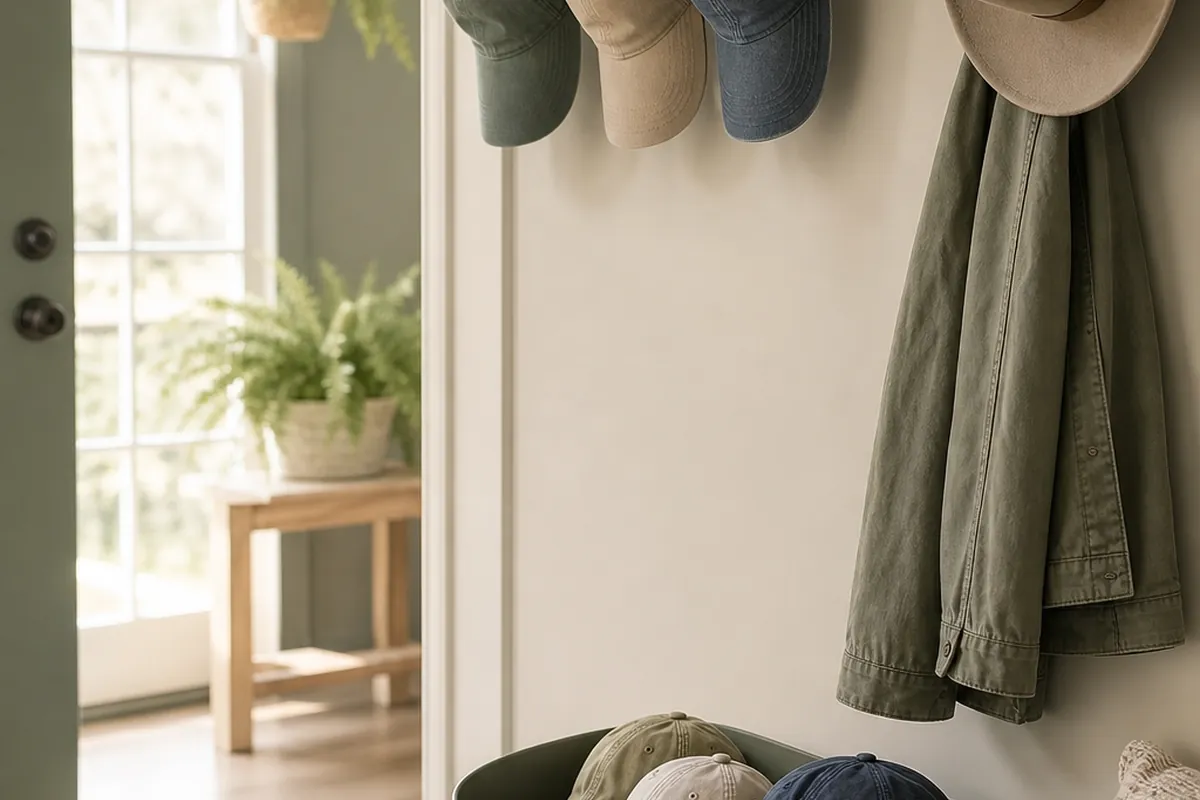
A heavy-duty wall hook rack gives every cap its own hook, hung by the back strap so nothing rests on the brim. A rail of six hooks takes a strip of wall about sixty centimetres wide and no floor at all, which in a narrow hallway is the whole argument.
Fix it into studs or use proper anchors. A rail loaded with a dozen caps is heavier than it looks, and a rail that pulls out of plasterboard takes a chunk of the wall with it, which is a bad trade in a rental.
4. Use the back of a door when there is no free wall

Plenty of small entryways have no wall to give up, either because it is all doorway and radiator or because drilling is not allowed.
An over-the-door hook hanger uses the one surface nobody competes for, needs no tools, and comes off cleanly when you move. Hung on the inside of a coat closet door it keeps the caps out of sight entirely.
Two honest limits. It stops the door sitting flush, which matters if the door is already tight against a frame, and hats on the outside face of a door get knocked every time someone walks past. Inside face only.
5. Give knit hats a shallow bin, not a hook
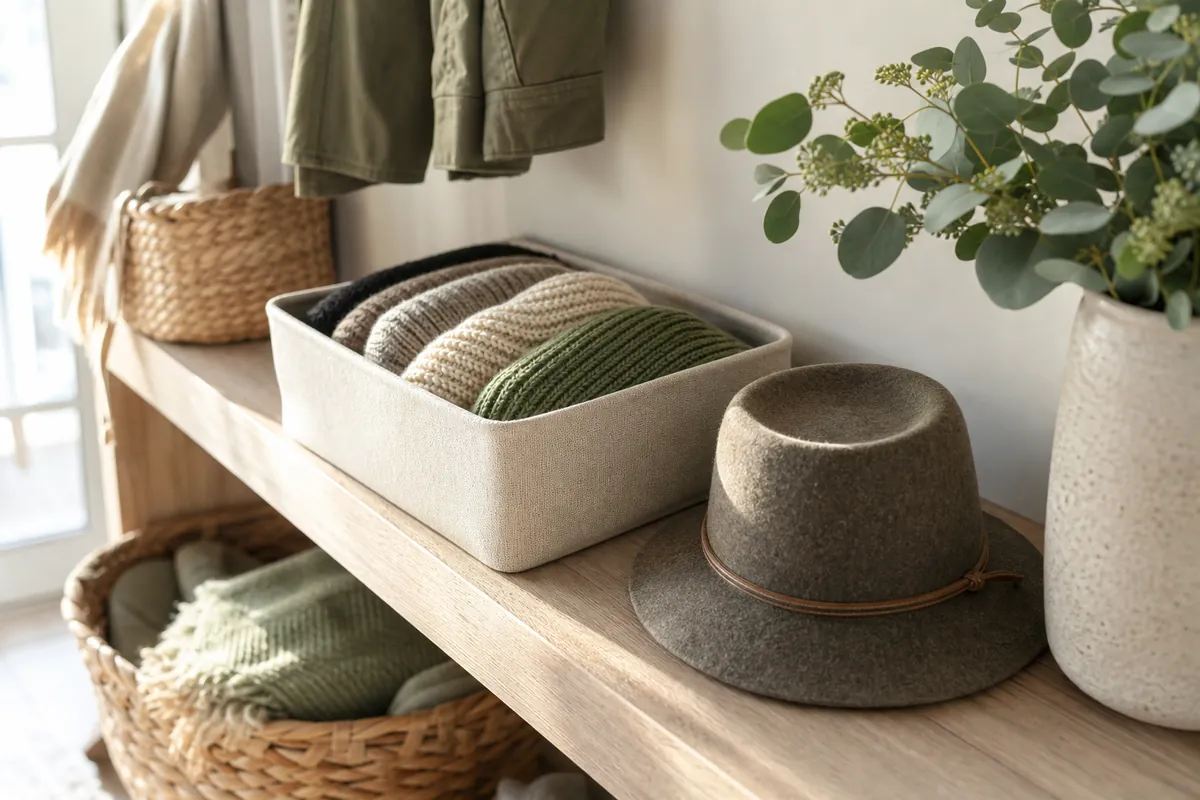
Knit hats are the pile people get wrong, because hooks are right there and a beanie hangs on one perfectly well.
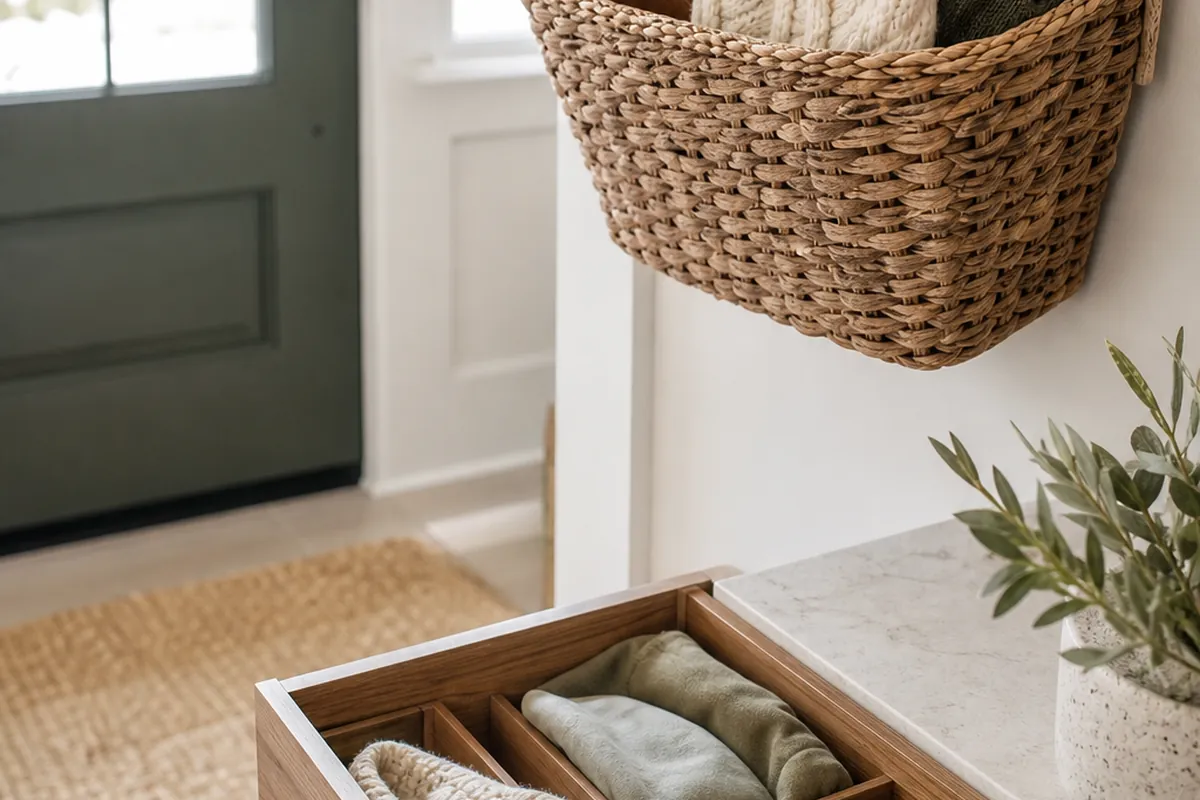
The problem is slow. Hanging a knit hat from a hook puts all its weight on one point of the band, and the band is the part that has to grip your head. Over a couple of winters it stretches out. Folded flat in a fabric storage bin with handles, nothing pulls on anything.
Shallow is the operative word. A deep bin becomes a hole you dig in, and the hat at the bottom is one you stop wearing. One layer, or two at most.
6. File caps upright in a row instead of stacking
If hooks are not an option and caps have to live in a bin or on a shelf, do not nest them.
Stand them on their brims in a row, all facing the same way, so each cap braces the next one and you can see every front panel at once. It is the same principle as filing folded clothes upright rather than piling them, and it works here for the extra reason that a stack of eight caps puts eight caps of pressure on the bottom brim.
A shoe box on its side, or a bin narrow enough that the row cannot fall over, is all the structure this needs.
7. Stuff the crown of anything stored more than a season
For hats going into storage rather than rotation, the crown needs something inside it or it will slowly settle.
Loosely crumpled tissue paper is enough. Not newspaper, which transfers ink onto pale straw and felt, and not tightly packed, which stretches the crown from the inside rather than supporting it.
This is only worth doing for structured hats. A cap does not need it and a beanie has nothing to hold up.
8. Keep one hat at the door and the rest somewhere else
An entryway can hold about one hat per person before it stops looking like storage and starts looking like a pile.
Give the daily hat a hook by the door and move the rest to a closet shelf or a bin elsewhere. This is the same discipline that makes the rest of a small entryway work, covered in entryway storage for a hallway with no closet, and hats are the category where it pays off fastest, because they are bulky, visible, and the least likely to be worn on any given day.
9. Keep them off the radiator and out of direct sun
The two things that quietly wreck hats in an entryway are heat and light, and entryways have plenty of both.
A hook above a radiator dries out felt and leather sweatbands. A hat left in a sunny hallway for a summer fades on one side only, which is more noticeable than fading all over. Straw is worst affected by both.
If the only free wall is the one above the radiator, that is the wall for coats, and the hats go on the back of the door instead.
10. Split the collection by season and swap it twice a year
Nobody wears a wool beanie and a straw sun hat in the same month, so nothing is gained by having both by the door.
Store the off season half properly, meaning crowns stuffed and nothing stacked, and keep the current half on the rail. The rail stays short enough to be useful, and the twice yearly swap is when you notice the three caps you have not worn in two years. The coat closet approach uses the same seasonal split for the same reason.
Hats that still fit next year
Hat storage is not really a space problem. It is a pressure problem, and almost all of it comes down to two rules: nothing rests on a brim, and nothing rests on another hat.
Hooks handle caps, a shallow bin handles knit hats, upside down on a shelf handles anything with a brim worth keeping, and the off season half lives somewhere other than your entryway. That is a strip of wall, one bin, and a decision about which hat you actually wear.
Done once, it is also the rare organizing job that stays done, because hats do not multiply the way most entryway clutter does.