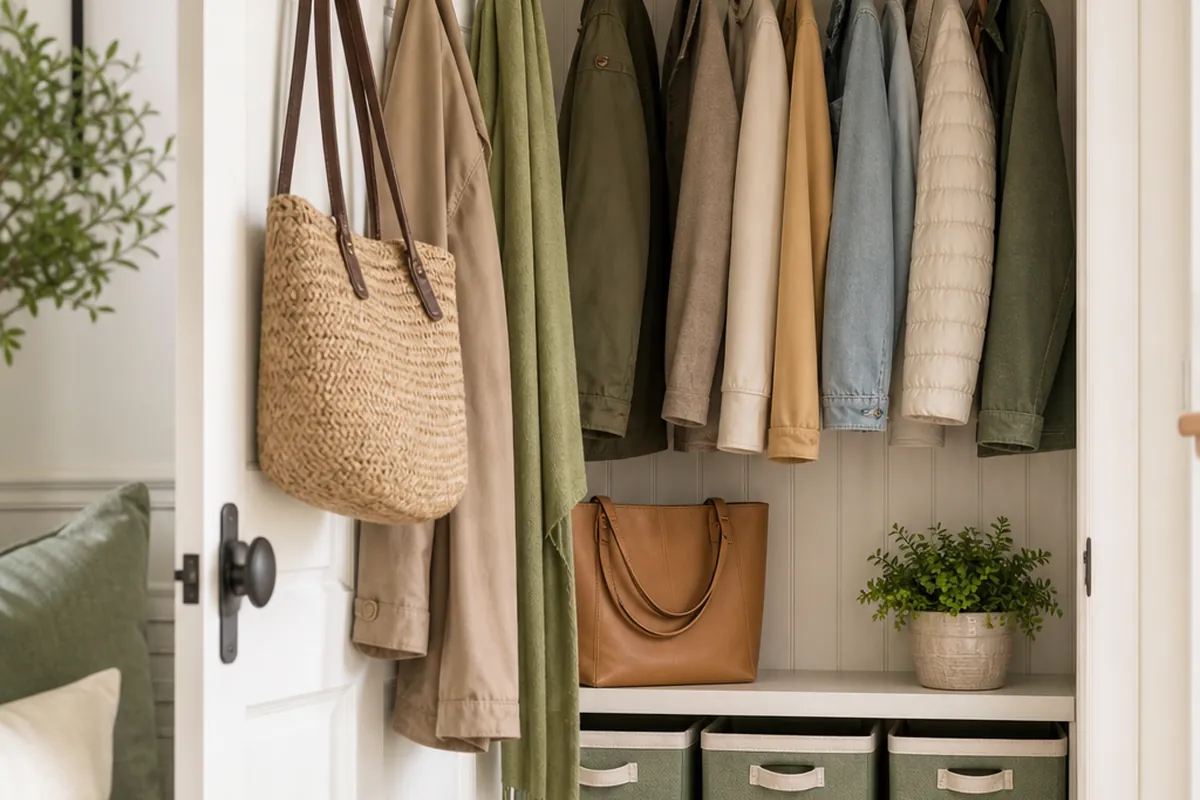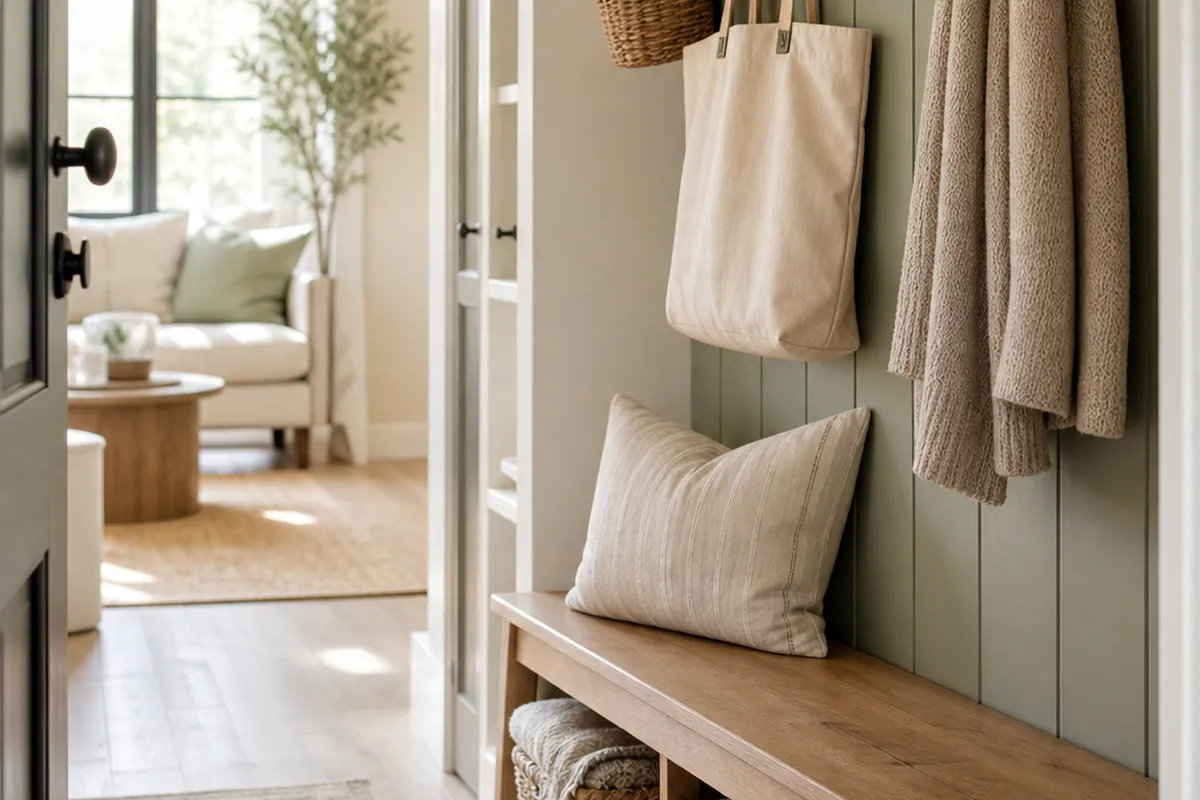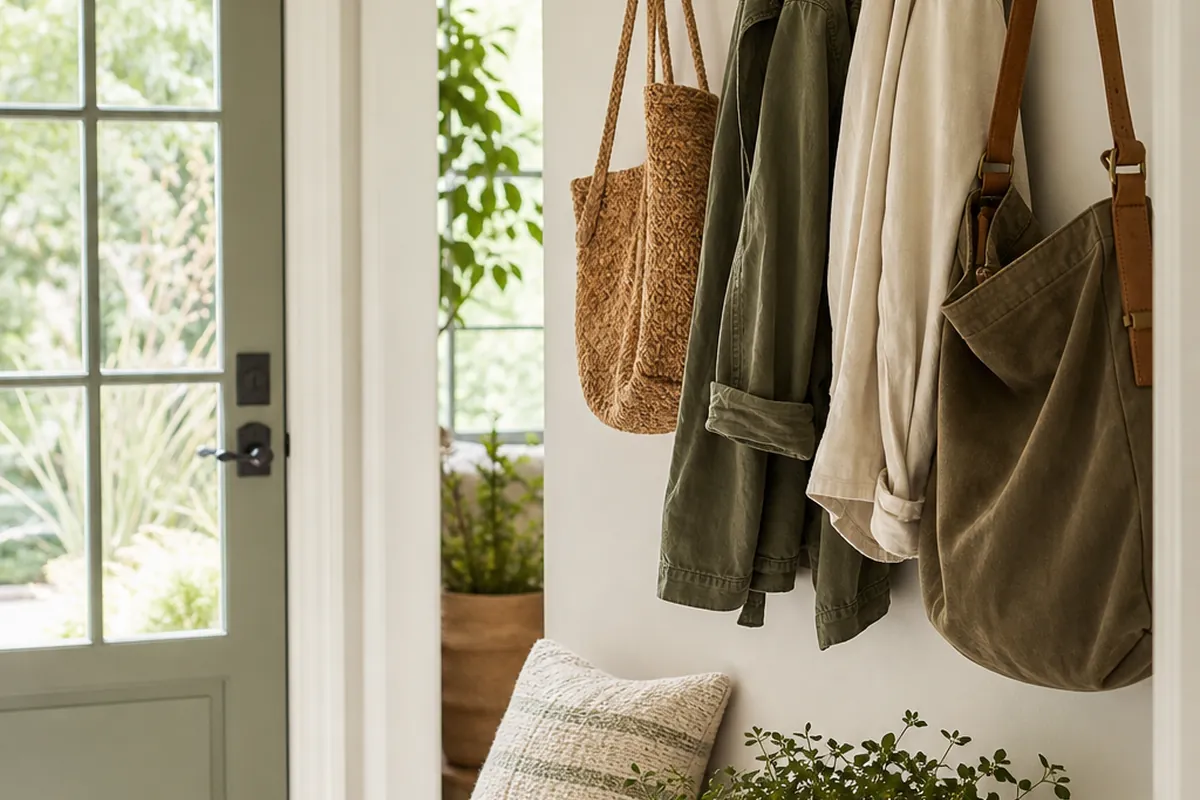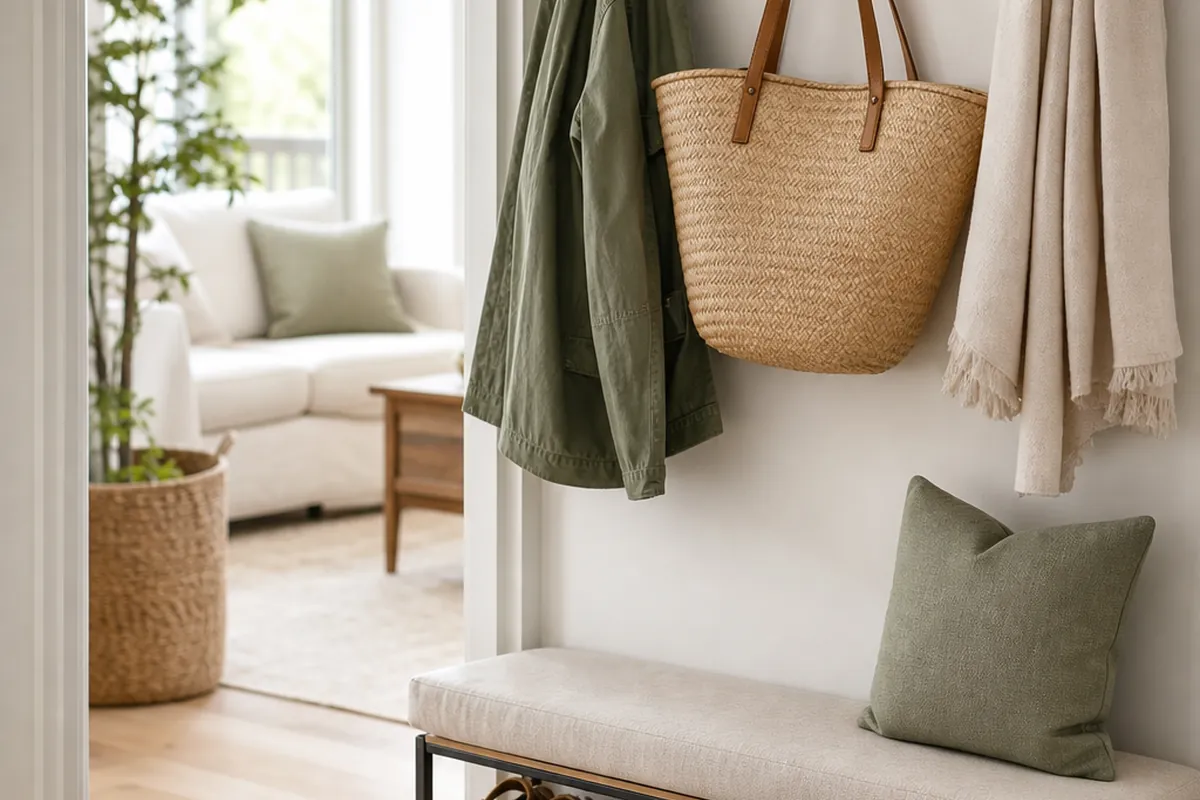
Four coats on one doorknob. Sneakers drifting into the door swing. Keys that live somewhere new every single day. A hall with no closet does this to a household within about a week of moving in, and it is exactly why entryway storage in a closet-less hallway has to be planned rather than bought piece by piece. Layer the wall properly and a strip barely wider than the door will swallow everything a busy front hall deals with.
Here are eleven ideas, ordered the way I would actually install them. Skip around if you want, but the first three decide whether the rest holds together.
Entryway storage starts with a tape measure, not a shopping cart
Stand in the hall and write down three numbers: the width of your clearest wall, the depth you can give up before the walkway feels mean, and the ceiling height.
That middle number is the one everybody fudges. People need roughly 30 inches of clear walking width to pass without turning sideways, so in a hallway around 36 to 40 inches across, anything deeper than 12 to 14 inches becomes a shin magnet by day three. I would take a shallow 10-inch bench that fits over a gorgeous 18-inch console that bruises hips, every time. Measuring first also rules out about half the furniture you had saved, which saves you a return trip.
Ceiling height matters because a closet-less hall has nowhere to grow but up. Coats at shoulder height, shoes at ankle height, rarely-touched things above your reach. For the full zone-by-zone version of this planning process, the real plan for small entryway organization in an apartment breaks it down.
Idea 1: assign the wall before you assign the products. Sketch the wall as three horizontal bands. Top band for anything you touch weekly or less, middle band for hooks and small items, bottom band for shoes and bags. Now every purchase has a designated home instead of landing wherever there is a gap, which is the whole difference between a hall that works and a hall with random hooks in it.
The three-layer entryway storage wall
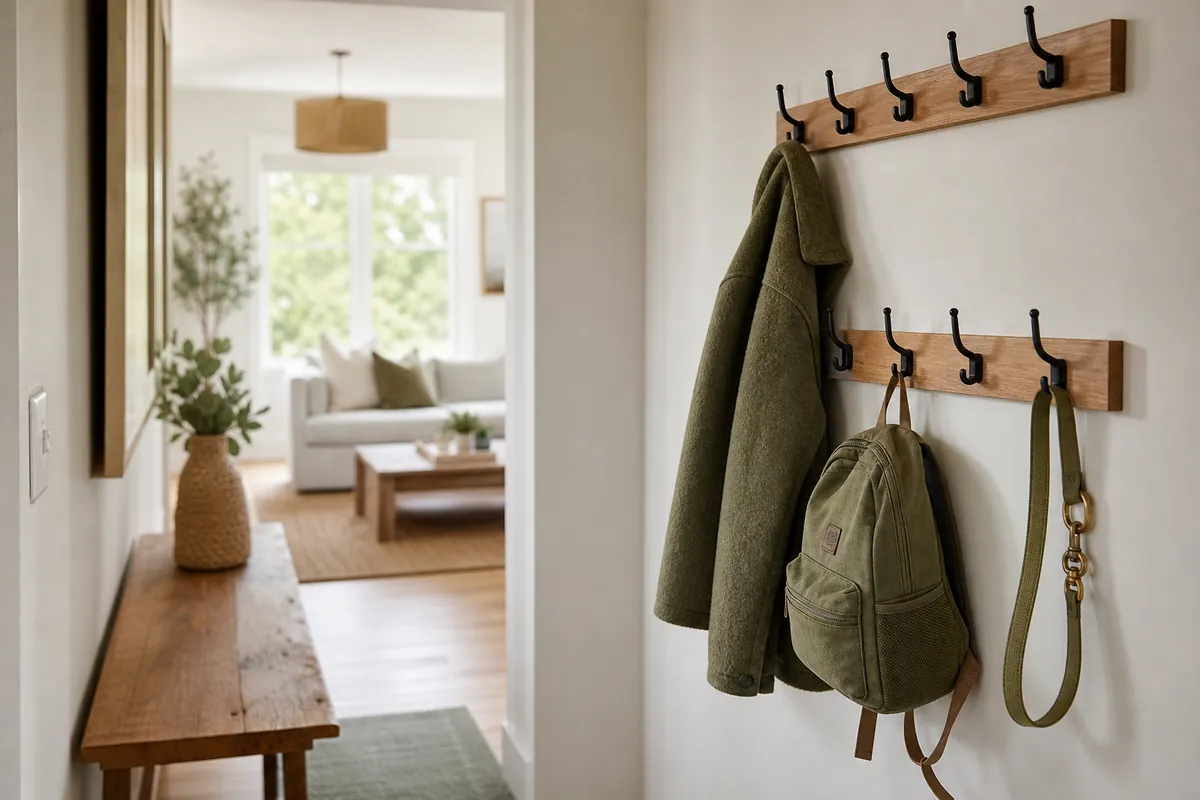
Layer one: hooks, at two heights
Idea 2: mount a proper hook rail around five feet up. One hook per person is wishful thinking. Budget two per adult, coat plus bag, and set the rail high enough that a long wool coat clears the bench seat below. If the hem puddles on the seat, nobody sits there and the bench quietly becomes a shelf.
Idea 3: add a second row near three and a half feet. This lower row is the one that changes behavior. Kids can reach it without an adult, the dog leash gets a permanent spot, and the tote you grab daily stops wrestling with coats. Ten hooks across two rows in a two-foot strip of wall beats a coat tree comfortably, and it costs you zero floor.
Idea 4: use the door itself. An over-the-door coat rack is the answer when drilling is off the table or the only clear vertical surface is the back of the entry door. It hooks over the top edge, needs no anchors, and converts dead space into four or five hanging spots. Two warnings. Keep heavy winter coats on the wall rail, because a loaded door rack makes the door swing like a vault. And check the hook height, since coats bunched near the frame will stop the door closing properly.
Layer two: the small-stuff station
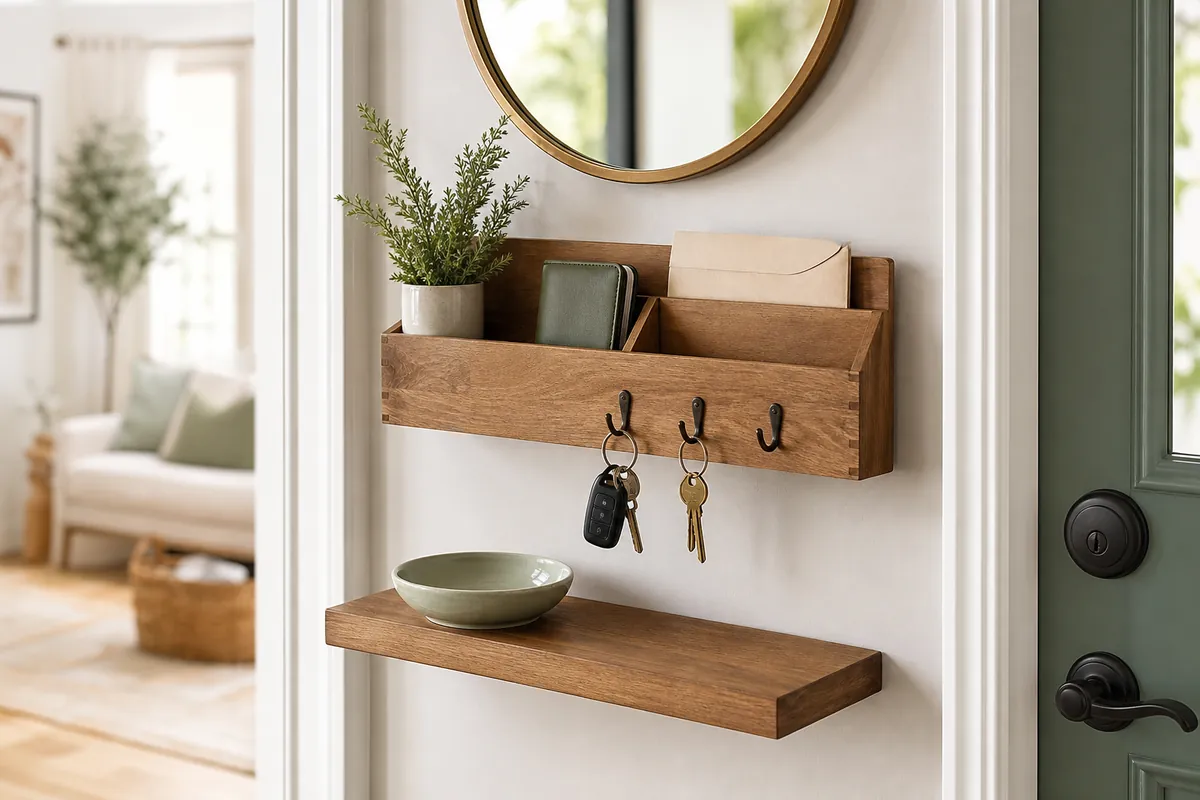
Idea 5: give keys and mail a vertical home at eye level. Almost every failed hall fails right here. Keys, letters, sunglasses and delivery slips are small and homeless, so they colonize the nearest flat surface and breed. A wall-mounted key and mail organizer solves it on two counts: it is vertical, so it costs nothing in walkway inches, and it is the first thing your hand meets. Put it on the latch side of the door at about four and a half feet, so you can drop keys without pivoting.
Idea 6: choose a slim floating shelf over a console table. A six-inch-deep shelf at hip height does everything a table does in a narrow hall without forcing people to shuffle past. One shallow bowl or small basket on top for pocket contents is enough. Resist going deeper, because flat surfaces collect clutter in direct proportion to their square inches.
Idea 7: hang a mirror above the shelf. This is not really decoration. A mirror is the reason someone pauses at that spot, and pausing is what makes them hang the coat instead of hauling it to the sofa. Bonus: it throws light down a windowless hallway.
Layer three: the shelf nobody thinks to add
Idea 8: send seasonal gear up. Above the hook rail, a single high shelf or a pair of lidded baskets on brackets takes hats, gloves, spare umbrellas and the beach bag. My rule is simple: anything touched less than once a week belongs above eye level. Label the baskets if more than one person raids them, and swap the contents twice a year rather than trying to keep all four seasons within arm’s reach.
Shoes are the real problem, so solve them properly
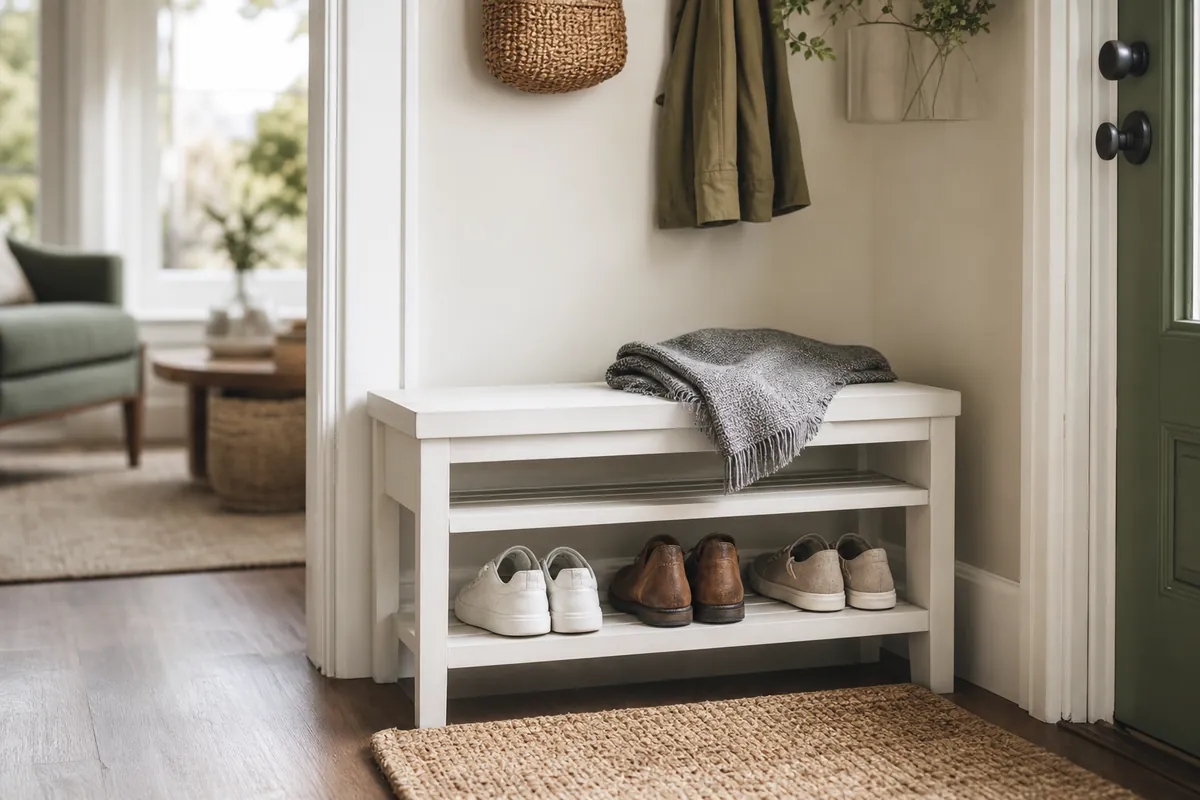
Shoes are why closet-less halls look chaotic. Bulky, dirty, and they multiply overnight. Three moves handle nearly every case.
Idea 9: make an entryway bench with shoe storage the anchor. If you buy one thing for a hall with no closet, buy this. You get a seat for boot wrangling, cubbies or shelves underneath for the current week’s shoes, and, most importantly, a defined footprint that stops shoes creeping along the baseboard. Look for a model that sits flush to the wall and stays shallow front to back, and be realistic about capacity, because a two-tier bench holds roughly double what a single open shelf does for the same floor space.
Idea 10: fill awkward gaps with an expandable 3-tier shoe rack. An expandable 3-tier shoe rack earns its keep because it stretches to whatever odd space you have, the 20 inches between a doorway and a radiator, or the narrow run beside the bench. Three tiers gives you real capacity in about a foot of depth. Load the top tier with daily shoes and the bottom with seasonal pairs, since bending down is precisely why bottom shelves stay empty.
Idea 11: park a boot tray at the end of the run, never the middle. Wet boots need a tray with a raised lip, positioned at the far end of the storage wall where nobody has to step over it in the dark. A textured mat just inside the door catches grit; the tray catches meltwater. Split those two jobs and your floor survives February.
Renter-friendly ways to mount entryway storage
Fear of drywall damage is what leaves most halls hookless, so here is the hierarchy I would follow.
Start with what touches nothing: an over-the-door coat rack, a freestanding bench with shoe storage, an expandable 3-tier shoe rack. Between them, those three cover coats, seating and shoes without a single hole in the wall.
When the wall is unavoidable, drill deliberately. Two screws into a stud will hold a loaded hook rail for years and leave holes you can fill with a dab of spackle in two minutes on move-out day. Compare that with a dozen adhesive strips that let go in a humid hallway and take a chunk of paint with them. My line is firm: adhesive is fine for a lightweight key and mail organizer or a small mirror, and it is not fine for anything that will carry a soaked winter coat.
One trick worth the extra ten minutes. Screw your hooks into a length of board first, then fix the board to the wall through two studs. You get a finished, built-in look, you can reposition hooks later without new holes, and the load spreads across the board instead of hanging off eight inches of drywall.
Make it hold up past week one
A closet-less hall stays tidy only when capacity matches reality. Count the outerwear actually in circulation right now. Fourteen jackets and ten hooks means the system fails no matter how handsome the hooks are, so shift off-season coats somewhere else entirely, under a bed or into a wardrobe, and keep only what this month needs by the door.
Everyone gets one hook and one bin at minimum. Ownership beats communal storage every time, mostly because nobody has ever tidied a shared basket voluntarily.
Then there is the thirty-second reset. Coat on the hook, keys in the organizer, shoes on the bench shelf. That is the entire routine, and it only survives contact with a rushed Tuesday because each of those three things has an obvious destination within arm’s reach of the door. If you want the setup to behave more like a proper mudroom, small hallway storage that fakes one covers the next layer.
Build upward, keep everything shallow, and let the bench define where shoes are allowed to exist. Three feet of wall can handle a whole family’s coming and going, closet or not.