The sink is the busiest square metre in any kitchen, and in a tiny one it is usually also the only clear counter. That combination is why it ends up carrying a bottle of dishes liquid, a hand soap, a sponge, a scrubbing brush, a dish rack, and whatever was rinsed an hour ago and never put away.
None of those things are wrong to own. The problem is that the sink surround is doing two jobs at once, storage and workspace, and in a small kitchen it cannot do both. Almost all of this is about deciding which job it has.
1. Take everything off the surround and only put three things back
Clear the whole area, including the windowsill if there is one. Then put back the three items you touch every single day, which for most people is dishes liquid, a sponge and hand soap.
Everything else goes under the sink or in a cabinet. Not because it is clutter, but because the surround is the only place you can put a chopping board down, and every object standing on it is permanently borrowing that space.
Three is not an arbitrary number. It is roughly what fits along the back edge without intruding on the working area in front of the faucet.
2. Group the daily bottles on one turntable
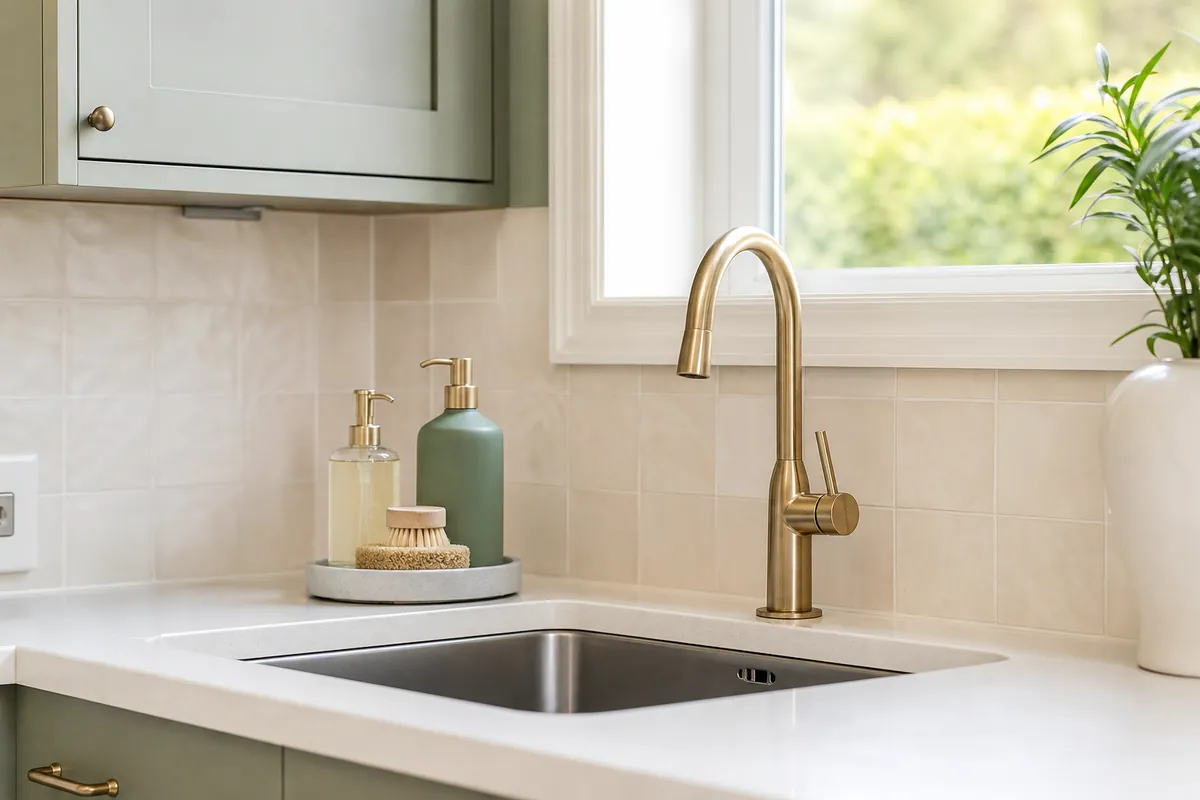
Even three bottles standing separately look like clutter, because your eye reads three objects rather than one.
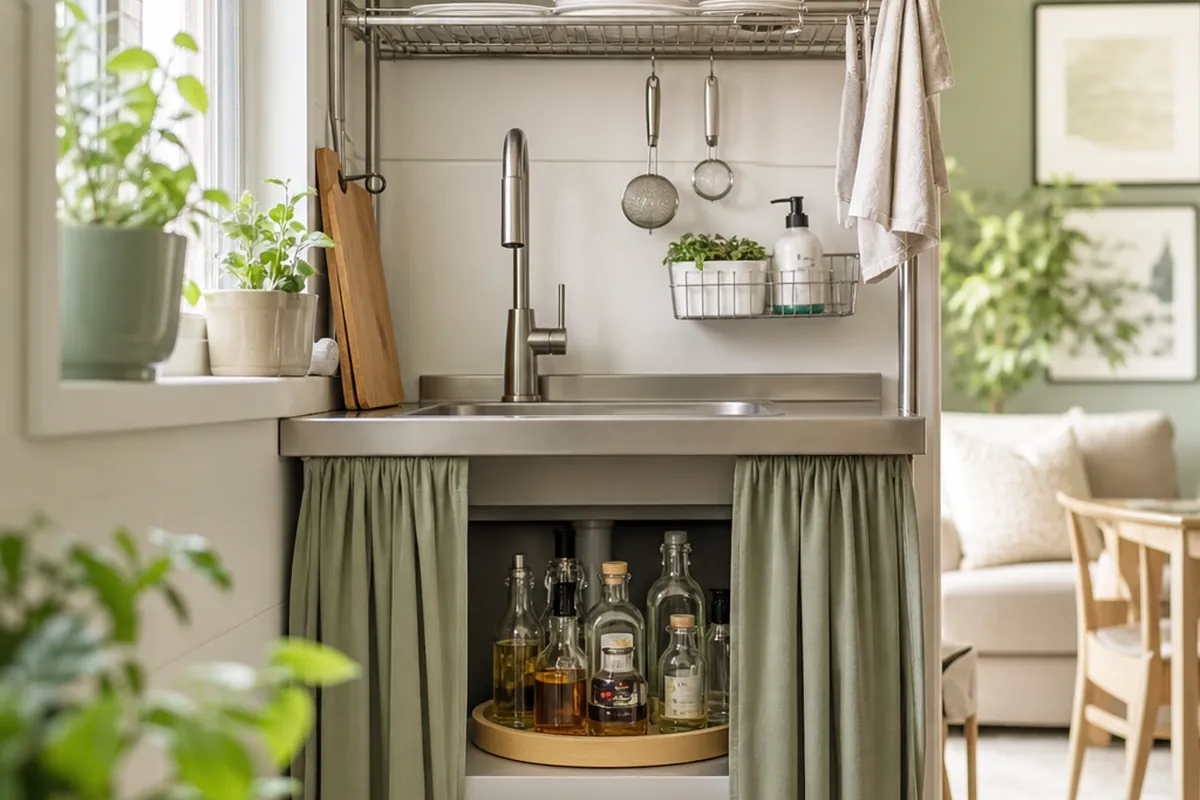
A small turntable gathers them into a single thing you can lift aside with one hand when you need the counter, and slide back after. The rotation matters less than the grouping, though it does mean you stop knocking the back bottle over reaching for the front one.
Choose one small enough to sit behind the faucet rather than beside it. A large turntable on a small surround just relocates the problem.
3. Use the space above the basin
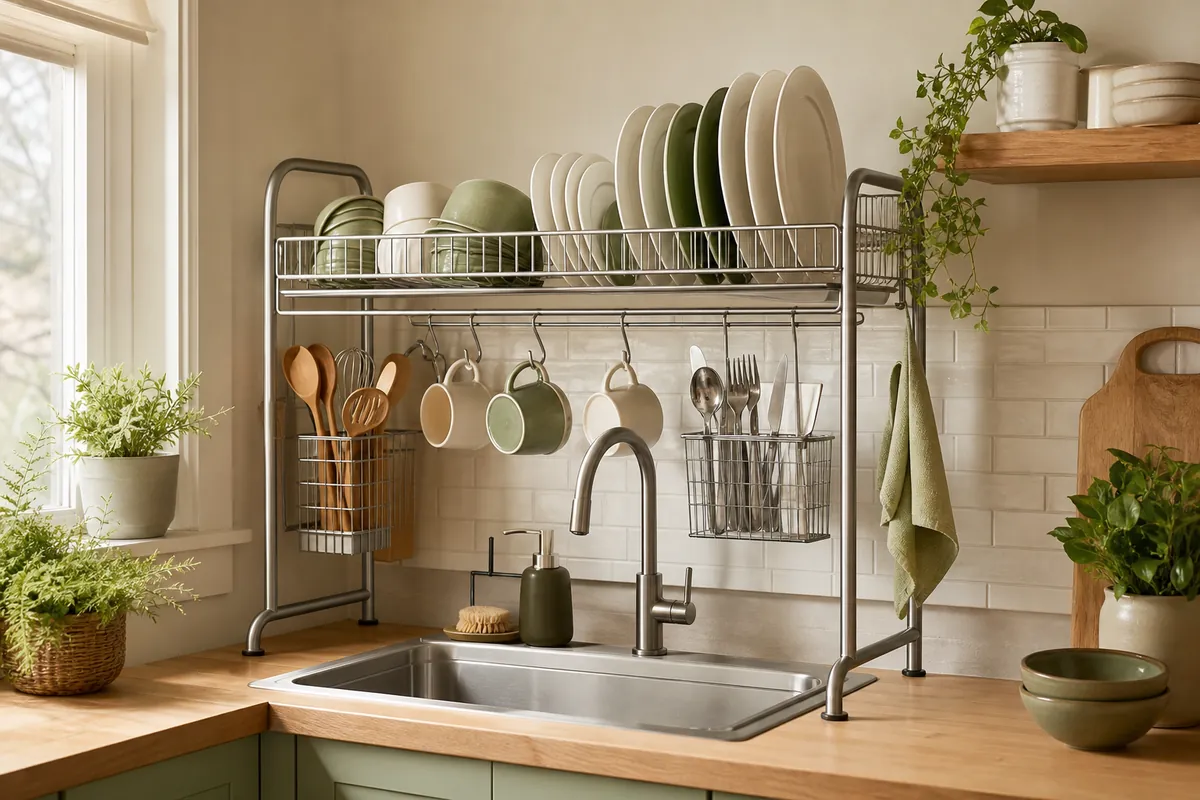
The volume directly above a sink is dead air. Nothing is stored there because nothing can stand there.
An over-the-sink dish rack bridges the basin and drains straight down into it, which means it needs no drip tray and takes no counter at all. In a kitchen with one small drainer this is usually the single biggest change available.
Measure before buying. It costs overhead clearance, so check the gap to a window, a shelf or the wall cabinets above, and check the rack’s span against your basin rather than your counter.
4. Treat under the sink as the worst storage in the kitchen
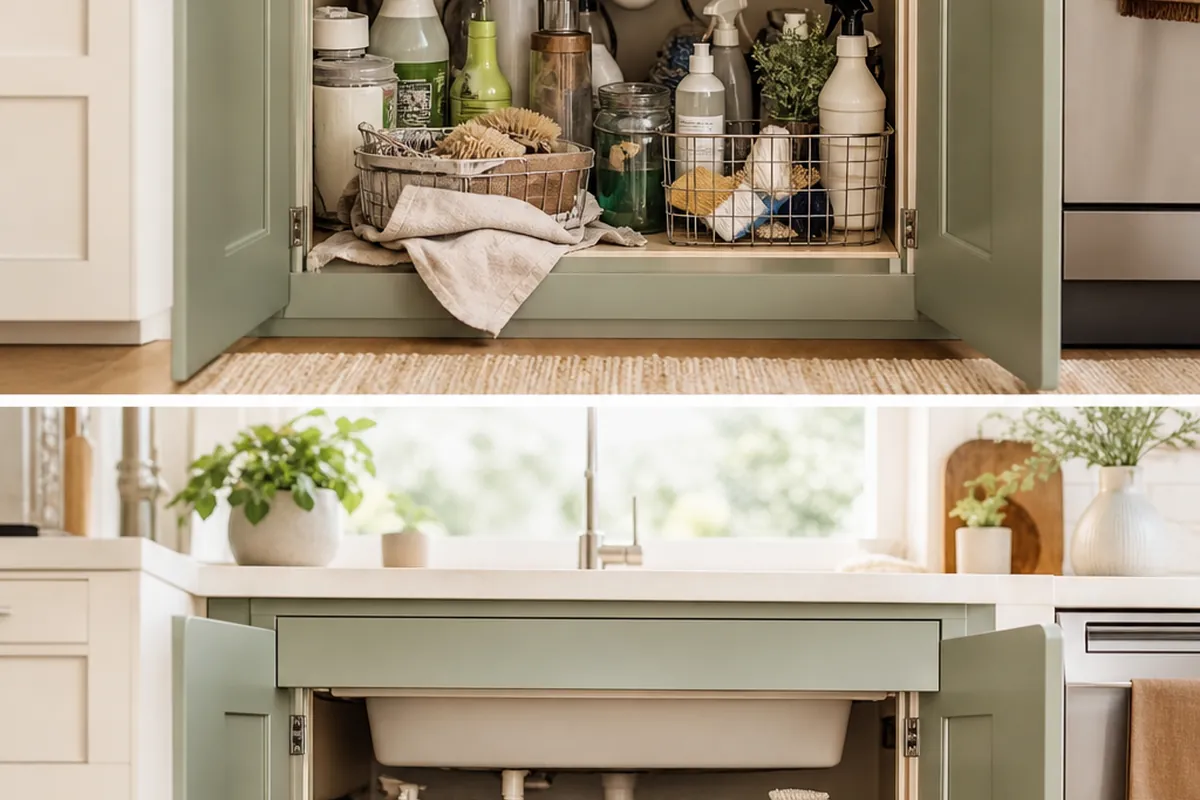
The cabinet under a sink is damp, has a waste pipe through the middle of it, and is the one place a slow leak will go unnoticed for weeks.
So put only things there that can survive that: cleaning supplies, trash bags, spare sponges, rubber gloves. No food, no small appliances, no paper. It is worth being deliberate about this once, because the default behaviour is to use it as general overflow and then discover the damage later.
5. Build around the waste pipe rather than ignoring it
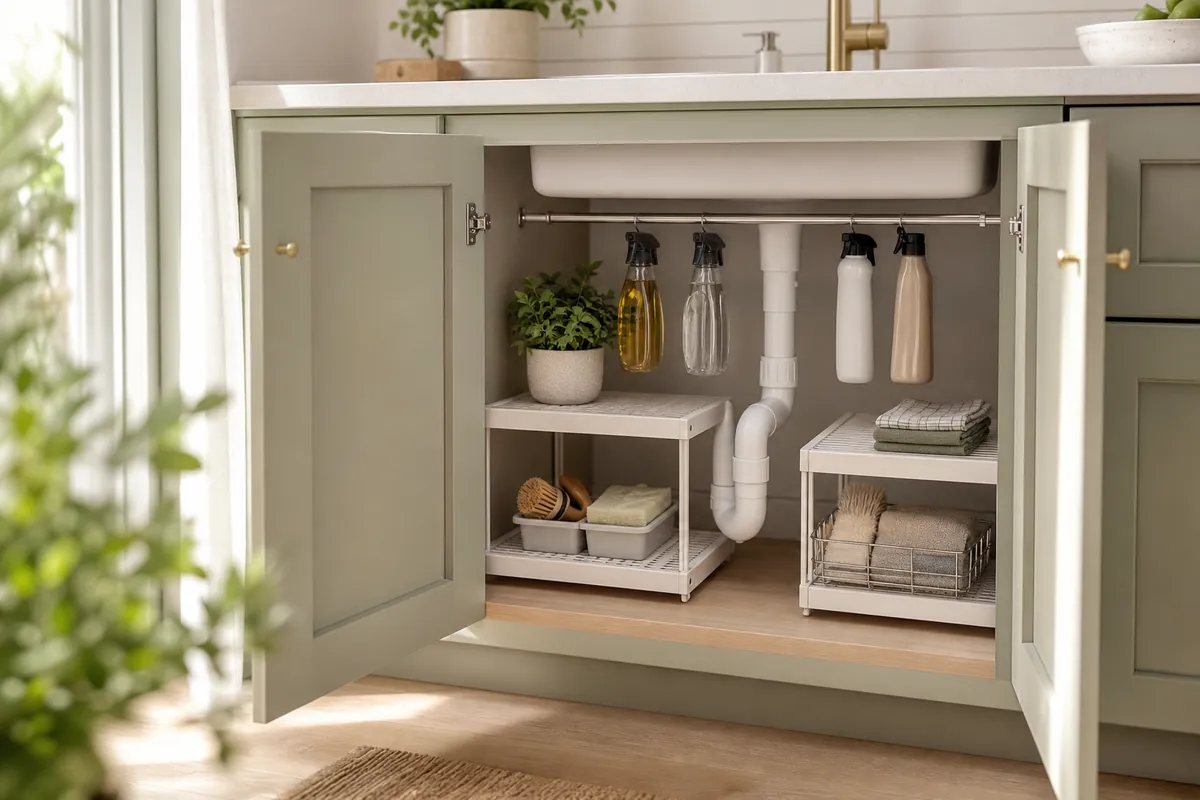
The pipe is why the cabinet feels unusable. A flat stack of anything hits it, so the space either side goes to waste.
A 2-tier expandable under-sink shelf is built for exactly this, with legs that sit either side of the pipe and a shelf that spans over it. It converts one awkward floor into two usable levels without needing the cabinet to be a normal shape.
Expandable is the important word. Under-sink cabinets vary wildly and a fixed-width shelf is the one that comes straight back out of the box and into the return pile.
6. Put cleaning bottles on the door, not the floor
Tall spray bottles are what makes an under-sink cabinet unnavigable, because they are the only thing that cannot lie down and they block everything behind them.
Hang them instead. A tension rod across the cabinet lets every spray bottle hang by its trigger, clearing the entire floor beneath them, and it costs nothing. The same approach is covered in more depth in cleaning supply storage for a tiny utility closet.
7. Give the sponge somewhere to drain
A wet sponge on a flat surround leaves a ring of water that never dries, and that ring is most of what makes a sink area look grubby.
Anything that raises it and lets air underneath will do: a small draining caddy, a suction holder on the basin wall, or the corner of the dish rack. The point is airflow, not tidiness. A sponge that dries between uses also lasts longer and smells less.
8. Keep the windowsill clear if the sink has one
A sill above a sink is tempting because it looks like free storage, and it is the one surface guaranteed to be seen from the doorway.
Give it one thing, or nothing. It is shallow, so anything on it is precarious over a hard basin, and it is the only source of daylight in a lot of small kitchens. A row of bottles on a sill costs you light in the exact spot you need it.
9. Move the dishes bowl out of the argument
A bowl inside the basin permanently occupies half the sink, and in a small kitchen the sink is also where you fill pots, rinse boards and hand wash things that do not fit a machine.
If you use one, store it on its side under the sink between washes rather than leaving it in place. If you never actually use it, that is a whole basin recovered for free, which is a better result than any organizer on this list.
10. Decide where wet things go before they are wet
Every sink area has a pile of things that are clean but still drying, and if there is nowhere for them they stay on the surround until the next time you need the space.
Give them one destination: the dish rack, a drying mat that rolls up, or a tea towel you actually put away. It sounds trivial and it is the thing that decides whether the other nine ideas hold for more than a week. The same logic applies to the counters either side, covered in kitchen counter organization with no counter space.
The one wet workspace you have
A tiny kitchen sink is not short of storage so much as asked to be storage and workspace at the same time. Everything above is a way of picking workspace and putting the storage somewhere less contested.
Three things on the surround, the daily bottles grouped, the air above the basin used, and the cabinet below built around its pipe rather than in spite of it. That is a sink you can actually work at, which in a small kitchen matters more than a sink that photographs well.