A wet room takes away the one thing every bathroom storage guide quietly assumes you have: a screen. There is no enclosure, no tray lip, no dry side. The floor falls to a drain, the walls are tanked behind the tile, and the whole room is the shower. That is exactly why it feels so open in a small bathroom, and it is also why storage that works fine in an ordinary bathroom starts rusting, sagging, or falling off the wall within a couple of months.
Two things do all the damage. Water now reaches places it never used to, and the waterproof membrane behind your tiles, which is the only thing keeping that water out of the floor structure, can be ruined by one wall plug.
Ten ideas below, starting with the one that costs the most to get wrong.
1. Find out where the tanking is before you drill anything
A wet room is not waterproof because of the tile. It is waterproof because of a continuous membrane bonded to the walls and floor underneath the tile, usually taken up the shower wall to around shoulder height or higher and lapped into the floor. Tile and grout are both porous. The membrane is the actual barrier.
Drill into it and you put a hole in that barrier. Nothing happens on the day. Water works its way behind the tile, moves sideways along the substrate, and turns up weeks or months later as a stain on the ceiling below or a patch of soft plasterboard nowhere near the hole. By then the repair is not a shelf, it is a floor.
So the working rule for anything inside the showering area is that you do not drill. If a fixing genuinely has to go there, it is done with the hole sealed before the screw goes in, and that is a job to ask your installer about rather than a Saturday afternoon with a masonry bit. Everything else in this list is no-drill for exactly that reason.
2. Work out where the water actually lands
Without a screen, spray carries a lot further than people expect, and it bounces. Before you decide where anything goes, run the shower at your normal pressure and normal head angle for a minute, then walk in and look at what is wet. In most small wet rooms the honest answer is most of the room.
That wet map is your rule from then on. Anything that hates water lives outside it. Anything inside it has to be rustproof and has to drain.
Worth being realistic about the second half of this, too. Even well outside the spray, a wet room is a steam room with a door on it. Humidity gets everywhere, and it is humidity rather than direct splashing that ruins most of what goes wrong in here.
3. Take the corner with a floor-to-ceiling tension pole
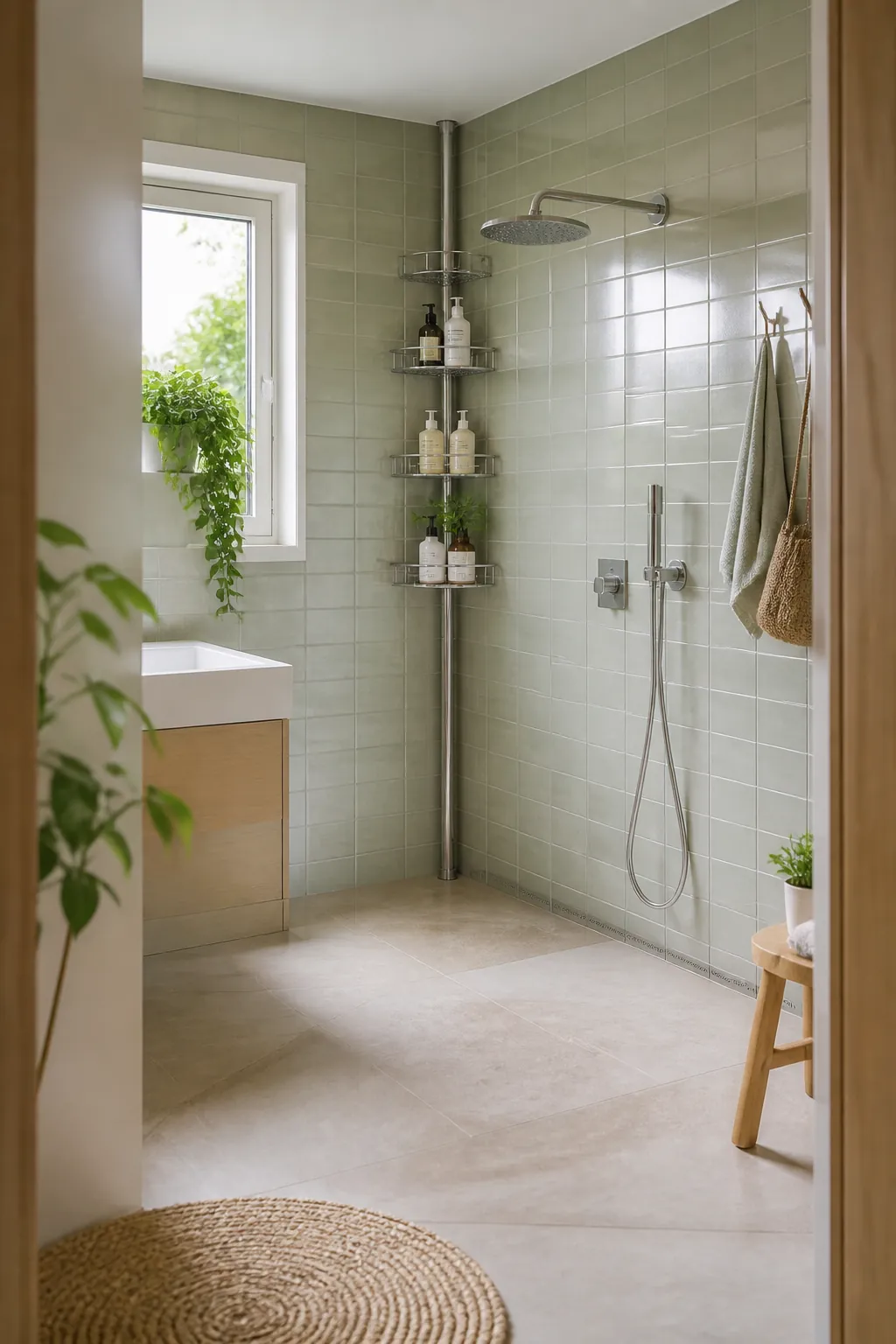
The corner is the least useful floor space in a small wet room and the best storage space, because it is out of the traffic path and you can build upwards in it without losing anything you were using.
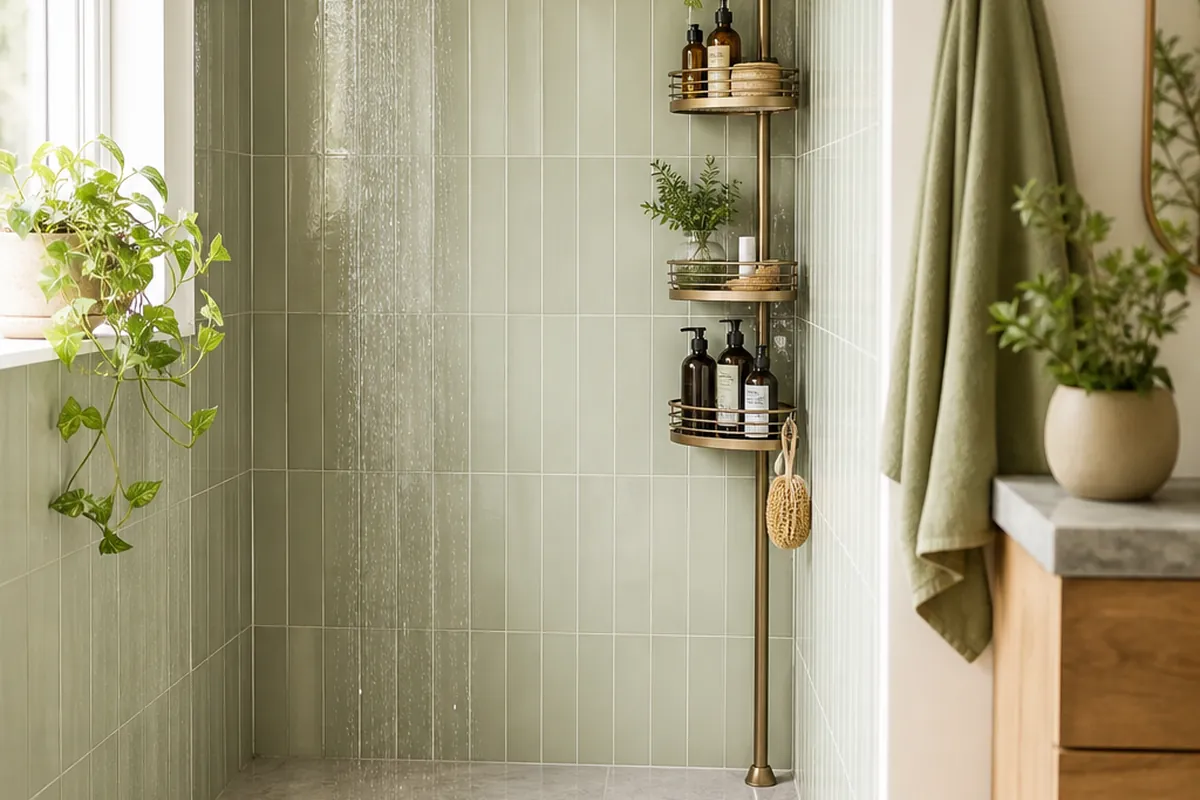
A tension pole braces between the floor and the ceiling and holds itself there under spring pressure. No fixings, no wall plugs, nothing through the membrane, and four tiers of storage in a footprint of a few inches. In a room where drilling is off the table, that combination is hard to beat. A tension pole corner shower caddy in stainless steel gives you adjustable baskets, a couple of hooks, and usually a towel bar, and the baskets slide up and down the pole so you can set the gaps around your actual bottles rather than the other way round.
Three things decide whether it stays up. It needs a flat ceiling, so sloped and vaulted ceilings are out. The tension has to be genuinely tight rather than merely snug, and it is worth re-tightening after the first couple of weeks once everything has settled. And it has to be stainless or properly coated, because plain metal in a room like this will bleed rust down your grout. There is more on getting corners working in the guide to shower corner storage when there is no niche.
4. Use adhesive shelves where a pole will not fit
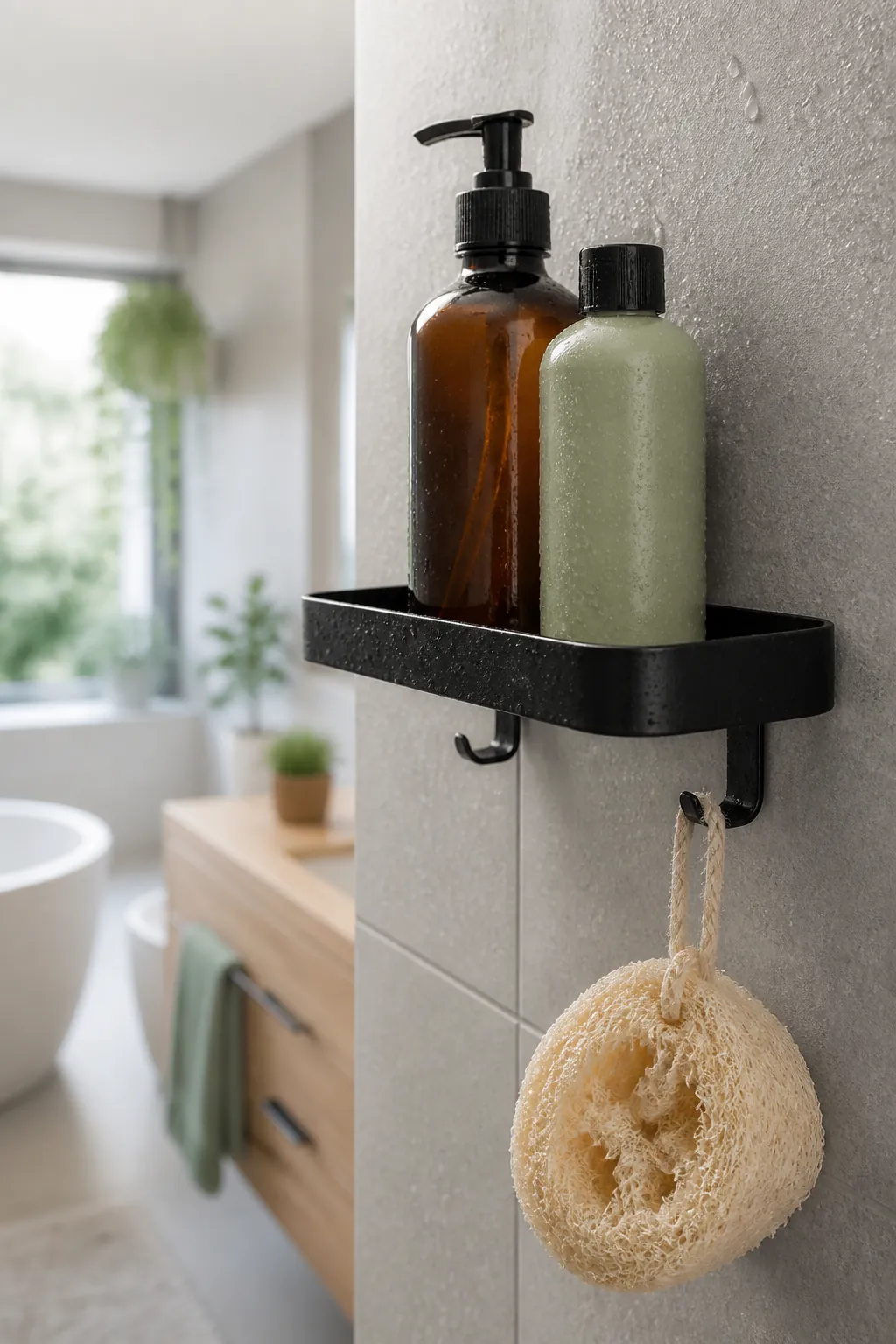
Poles need a corner and a ceiling. If yours is rounded, sloped, or already occupied, adhesive is the next best thing, and it beats suction comfortably. Suction needs a flat, non-porous, completely unbroken surface, which describes almost no real wet room wall once you account for grout lines and texture. Adhesive pads spread their grip over a much larger area and do not care about a bit of surface variation.
A corner adhesive shower caddy in 304 stainless will take a surprising amount of weight once it is on properly, and hooks underneath give the loofah and the razor somewhere to hang. Getting it on properly is the whole job: wipe the tile with rubbing alcohol and let it dry, press hard for a good thirty seconds, then leave it completely empty for twenty four hours before you load it. Almost every failure story is someone who hung shampoo on it the same evening. Note that adhesive wants a square corner and smooth tile, so rounded corners and heavily textured stone are still a no.
5. Keep the floor completely clear
In a normal bathroom a basket on the floor is untidy. In a wet room it is a drainage problem. The floor is laid to fall towards the drain, and anything standing on it interrupts that fall, holds a puddle underneath itself, and leaves a limescale outline you will be scrubbing at for months.
There is a practical reason too. Most wet rooms get squeegeed or mopped towards the drain after use, and that takes about fifteen seconds in an empty room and several minutes in one with four things to lift. Wall-mounted or pole-mounted storage is not a style choice in here, it is what makes the room quick to keep.
6. Move the towels out of the room, or onto the door
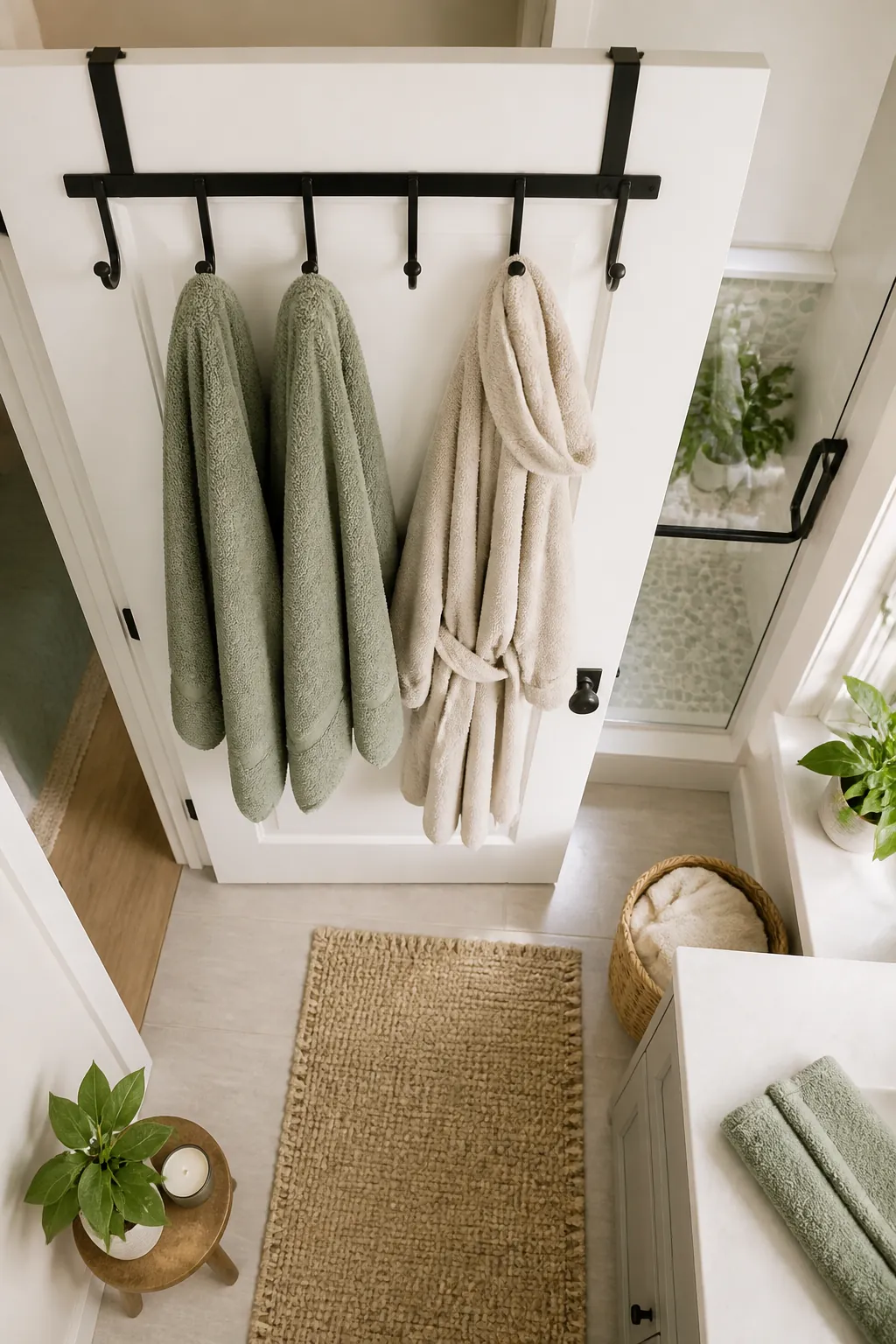
Towels are the hardest thing to solve in a wet room, because they do not need to be splashed to be ruined. Ambient steam is enough to leave them permanently half damp and eventually musty, and a small wet room generates a lot of steam with nowhere for it to go.
The genuinely correct answer, if you can manage it, is that towels do not live in there. Keep the working set on a hook or shelf just outside the door and carry one in. When that is not possible, the back of the door is the driest vertical surface in the room and it costs you no floor or wall space at all.
An over-the-door hook hanger hangs over the top edge with no fixings and takes a robe and a couple of towels. Two things worth knowing before you buy. Check the gap above your door first, because a bracket that is too thick stops the door closing cleanly. And if your wet room really steams up, put the hooks on the outside face of the door instead, which keeps the towels out of the humid air and works just as well. The wider question of how many towels the room should hold is covered in the towel storage guide for small bathrooms.
7. Give paper and cardboard a door of their own
Toilet roll, cotton pads, boxed medicines, and anything in a cardboard carton will go soft in a wet room without a single drop landing on them. Steam alone does it.
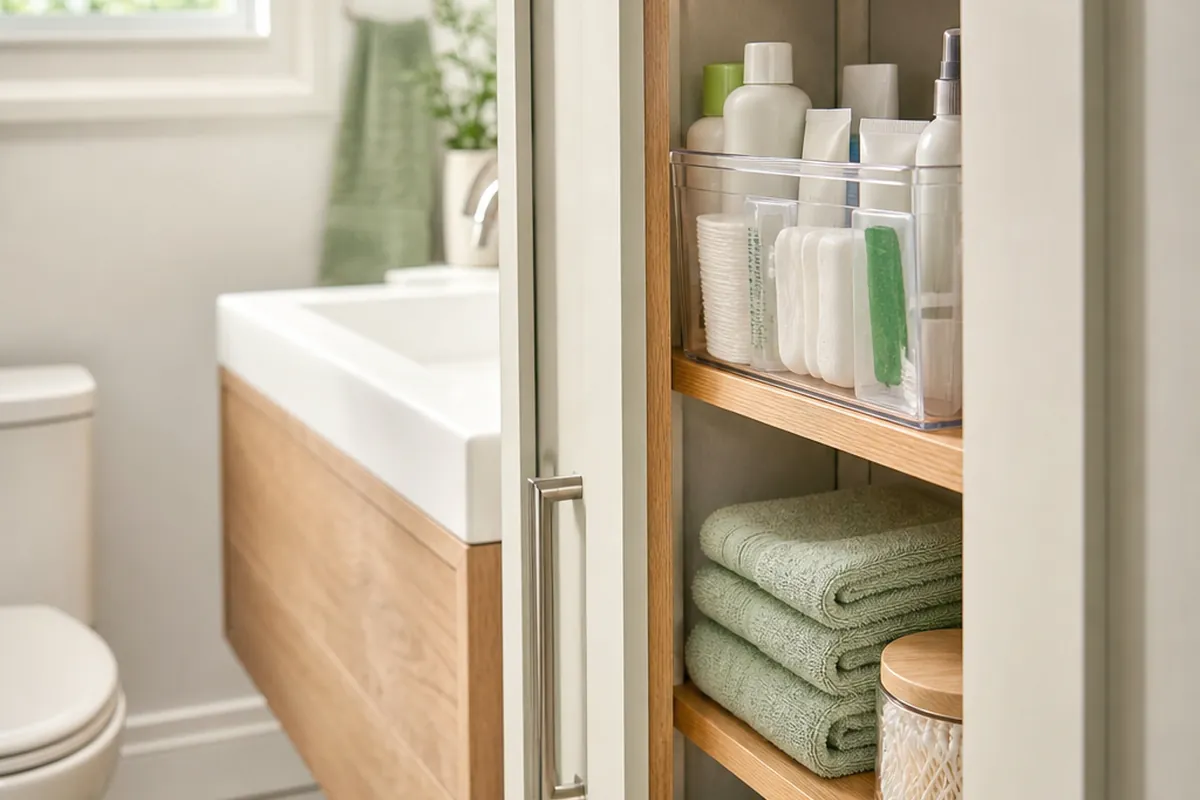
Keep one roll in a covered holder within reach and put the rest behind a door. A closed cabinet works, and so does a shelf unit outside the splash zone with doors or baskets rather than open shelves. If your only free wall is above the toilet, that is usually the driest spot in the room and the over-the-toilet storage options will fit a small footprint.
8. Buy for the water, not for the look
The material matters more here than anywhere else in the house. Grade 304 stainless or a well-coated equivalent will last. Chrome-plated mild steel looks identical in the photograph and starts weeping orange at the joints within a season, because the plating only has to fail in one spot. Untreated bamboo and wood swell and blacken. And avoid anything built from hollow tubes with open ends, which fill with water, hold it, and rust from the inside where you cannot see it.
Cheap is fine. Cheap and plain steel is not, because you will be buying it twice and cleaning rust stains out of grout in between.
9. Decant down to the bottles you actually use
Every bottle in the room is one more thing to shelter, drip on, and clean around. Most wet rooms are storing a collection rather than a working set: the conditioner someone did not like, three quarters of a body wash from last year, a travel shampoo from a hotel.
Take everything out, use the room for a week, and only put back what you reached for. Two bottles on a shelf dry between showers. Eight bottles on the same shelf trap water between them and stay wet all day. This is the only idea here that costs nothing and it usually frees more room than anything you can buy.
10. Make everything drain
Whatever ends up inside the wet zone, check that water has an obvious way out of it. Open wire baskets beat solid trays. A soap dish with holes beats a moulded dish that holds a gray puddle. Angle shelves very slightly so water runs off the front rather than pooling at the back.
Same for the things hanging on them. A loofah on a hook dries. A loofah resting in the bottom of a basket sits in its own water and gets slimy. Razors go on hooks head down. It is a small habit and it is the difference between storage you clean occasionally and storage you have to scrub.
Where to start
If you do one thing, run the shower and look at what gets wet, because everything else follows from that map.
Then work in this order: clear the floor completely, put one tension pole or adhesive shelf in the corner for the bottles you actually use, and get the towels onto the door or out of the room. That is most of the problem solved without a single hole in the tanking, which is the whole point.