The entryway closet is the smallest storage in most homes and the one that gets asked to do the most. It holds coats for four seasons, everybody’s shoes, the vacuum, a bag of things destined for the charity shop, and at least one racket. It is also the first thing you open when guests arrive, which is why so many people have stopped opening it.
Entryway closet organization comes down to one uncomfortable decision and then some geometry. Ten ideas below, and the first one is the uncomfortable part.
1. Decide it holds the current season only
An entryway closet cannot hold every coat you own, and trying is why it fails.
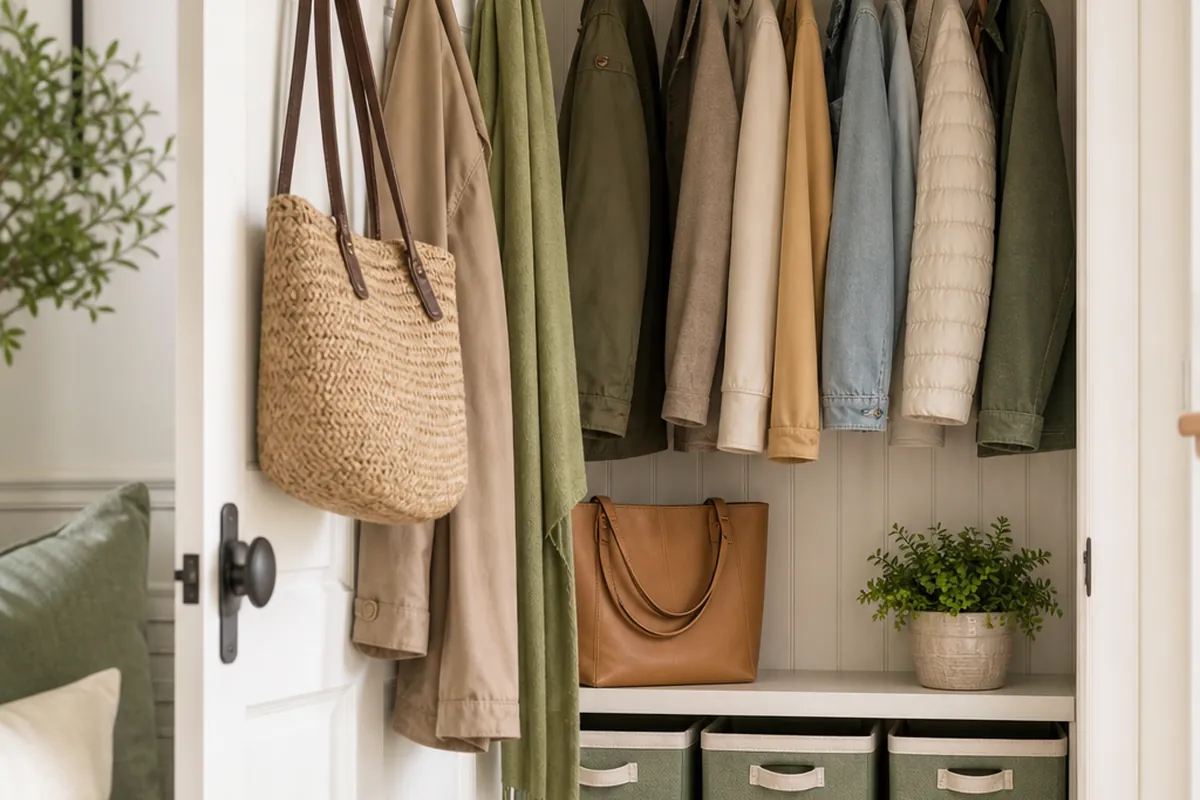
One or two coats per person, for the weather that is actually happening. Winter parkas in July and raincoats in a dry spell belong in a bedroom closet or under a bed. This is not a tidying preference, it is arithmetic: a hallway closet has perhaps three feet of rail, and four seasons of outerwear needs eight.
Rotate twice a year with the clocks so you never have to remember. Everything else in this list only works once this is done.
2. Swap to slim hangers

The fastest space gain available to you, and the cheapest.
Velvet slim hangers are around a third the thickness of chunky plastic ones, so the same rail holds noticeably more, and the flocking stops coats sliding off onto the floor. In a closet where the rail is the constraint, this alone can be the difference between a closet that closes and one that does not.
Use matching hangers throughout. It sounds like an aesthetic point and it is actually structural: mismatched hangers sit at different heights and waste the gaps between them.
3. Divide the shelf above the rail
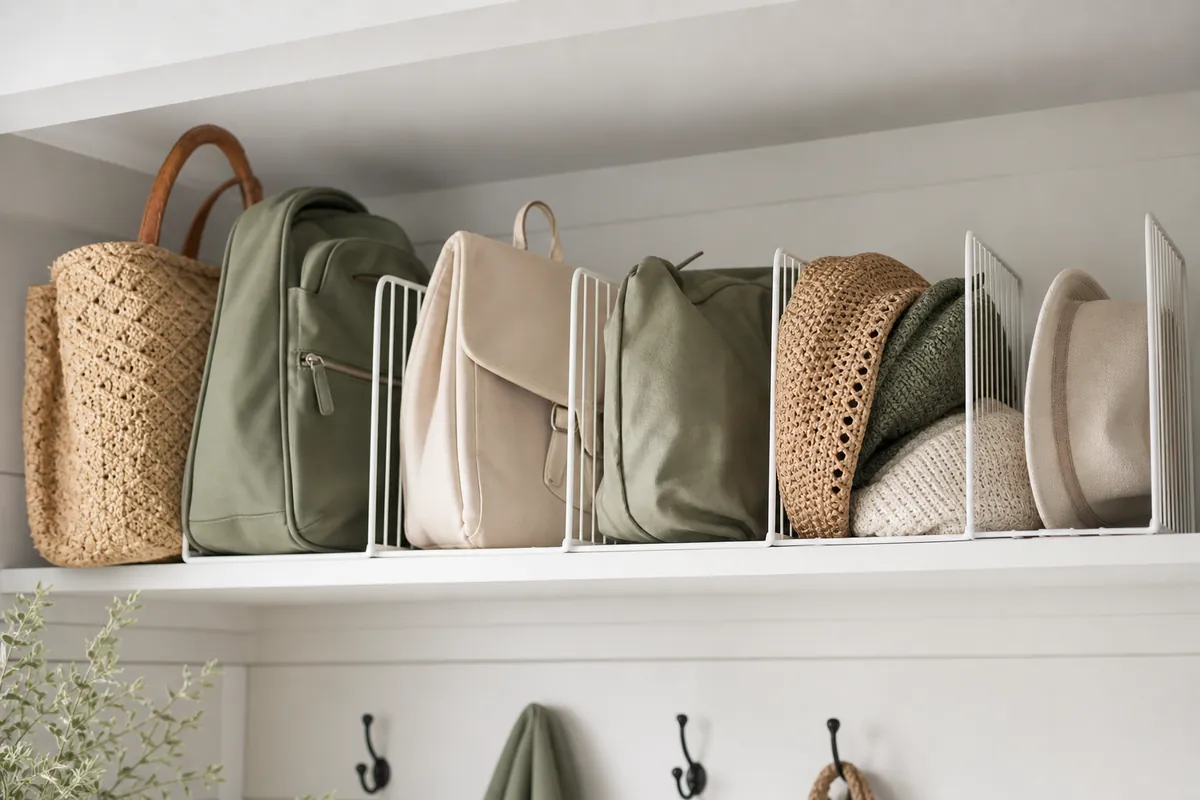
Every entryway closet has a high shelf, and in every entryway closet it is a leaning heap of hats, bags, and one shoebox.
Wire shelf dividers turn that heap into vertical slots that hold their shape when you pull something out one-handed, which is how you will always be using it. Slots also let you use the full height of the shelf rather than the first eight inches.
Put the things you need weekly at the end nearest the door, since a high shelf is hardest to reach at the back corners.
4. Put the inside of the door to work
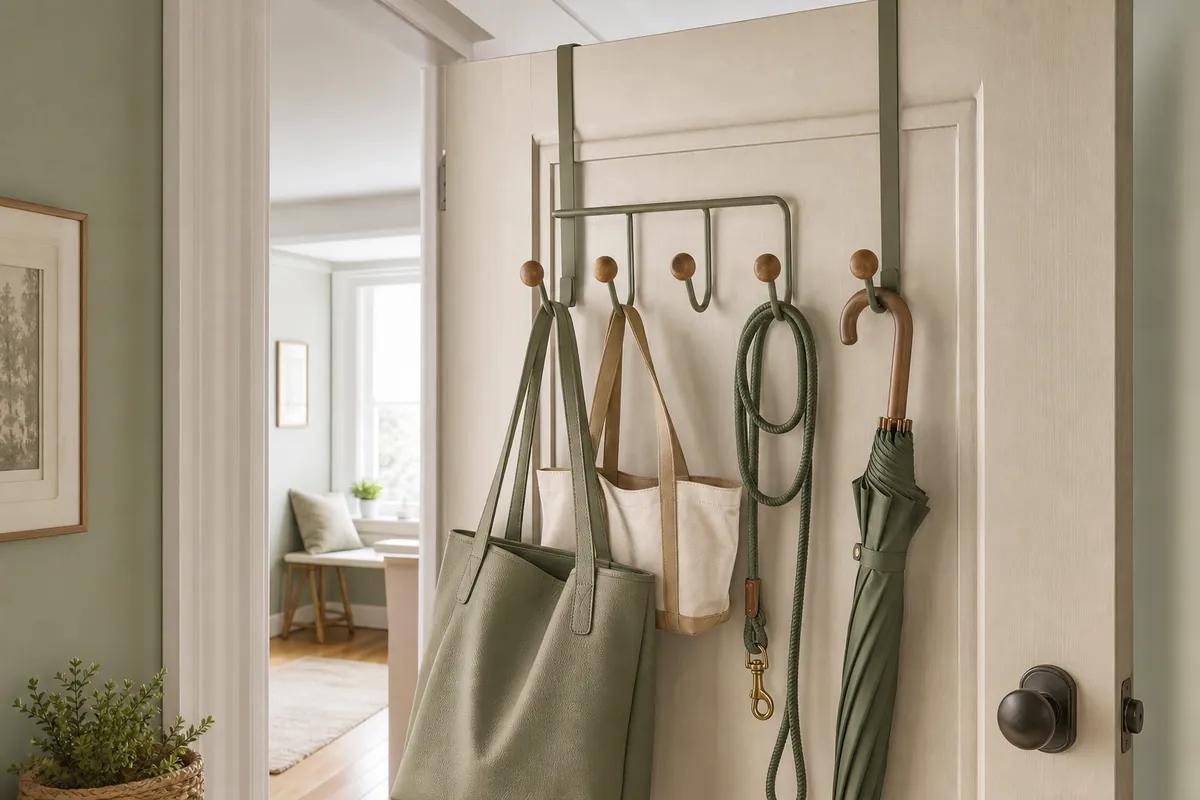
The door is a full sheet of vertical surface doing nothing, and in a hallway closet it is often the only surface not already committed.
An over-the-door hook hanger takes bags, dog leads, umbrellas, and the scarf that never makes it back to a shelf. No drilling, and it lifts off when you move.
Check the door closes cleanly with the hanger fitted and something hanging on it. Entryway closet doors are often tight against the frame, and a hanger bracket plus a coat is thicker than people expect.
5. Hang the hard-to-hang things instead of shelving them
Bags, hats and gloves fight shelves because they collapse, roll, or slide.
A hanging shelf tower on the rail gives them soft-sided compartments at eye level and takes almost no rail width. It is also where a small basket of gloves and hats can live in winter and be lifted out entirely in summer, which makes the seasonal swap a one-movement job.
Hats deserve their own note here, because a hook crushes a brim over a season. Hat storage ideas that keep their shape has the options that do not.
6. Give shoes a defined zone and a hard cap
Shoes expand to fill whatever floor they are given, and entryway floor is the most contested space in the house.
Decide how many pairs live here, which is usually the pairs in genuine rotation, and give them a tray or a low rack that fits that number. Everything else goes to a bedroom. The cap is what does the work; the rack just makes the cap visible. If shoes are the whole problem rather than part of it, entryway shoe storage goes deeper.
7. Keep a small landing zone at eye level
There needs to be somewhere for keys, mail, and the thing you are carrying when you open the door with one hand.
A small basket or shelf at eye height, near the front of the closet, catches all of it. Without one, those items land on the floor of the closet or on whatever surface is nearest, which is how the hallway table becomes a dumping ground.
8. Store the bulky utilities at the back, not the front
The vacuum, the ironing board, the spare trash bags: they belong here, and they should not be what you meet first.
Push them to the back or one side and keep the front third of the closet clear for daily use. A closet you have to reach past a vacuum to use is a closet that gradually stops being used.
9. Do not let it become the staging area
Every entryway closet accumulates a bag for the charity shop, a parcel to return, and something borrowed. These are all legitimately temporary and collectively permanent.
Give them one defined container with a limit, and empty it on a schedule. The problem is never that these things exist, it is that without a boundary they spread across the floor and take the space coats need.
10. Rotate with the seasons, not when it overflows
The maintenance is the seasonal swap, and doing it on a date rather than a trigger is what keeps the closet working.
Twice a year, move the outgoing season out and bring the incoming one in. Twenty minutes, and it resets everything above. If your hallway has no closet at all to work with, entryway storage for a hallway with no closet builds one from scratch instead.
Entryway closet organization that holds
The order: cut it to the current season, swap to velvet slim hangers to reclaim rail, then divide the high shelf with wire shelf dividers so it stops being a heap. An over-the-door hook hanger absorbs the bags and leads that never fit anywhere.
After that it is boundaries rather than storage. Cap the shoes, keep a landing spot for keys, put the vacuum at the back, and give the charity-shop bag a container with a limit. The closet fails when everything is allowed in, not when it runs out of space.