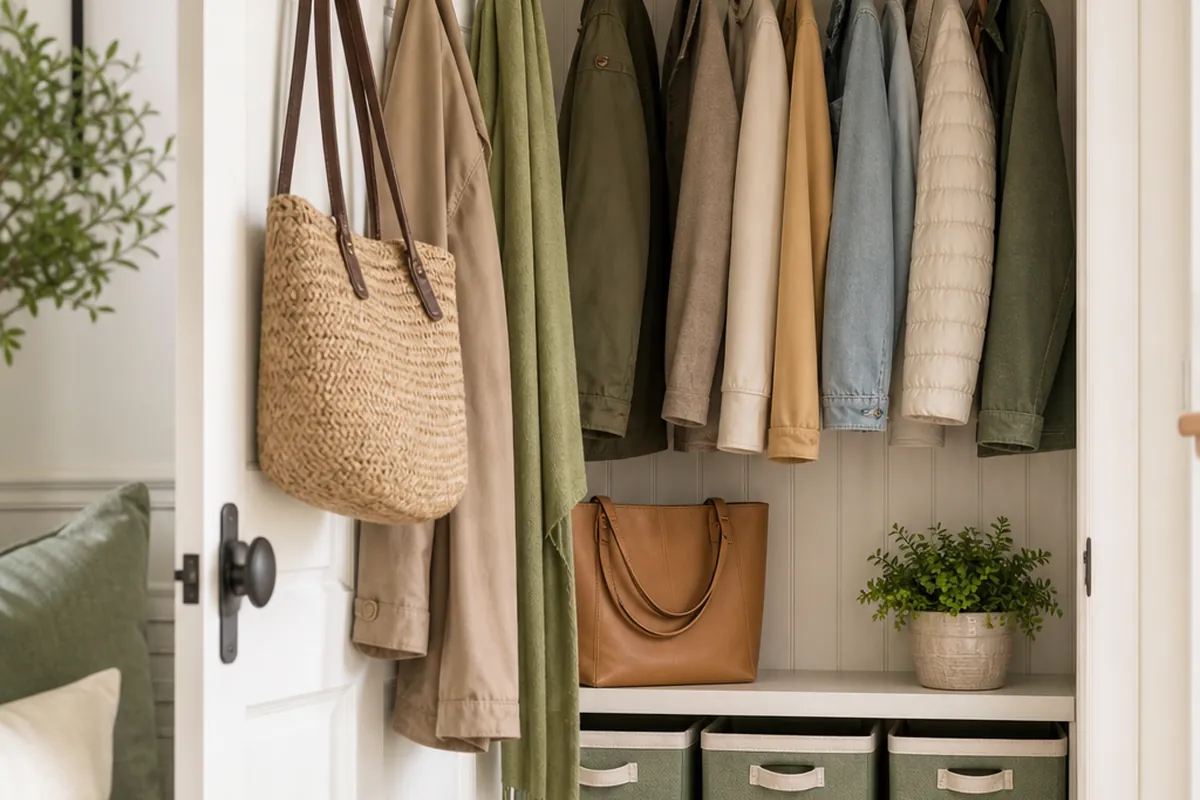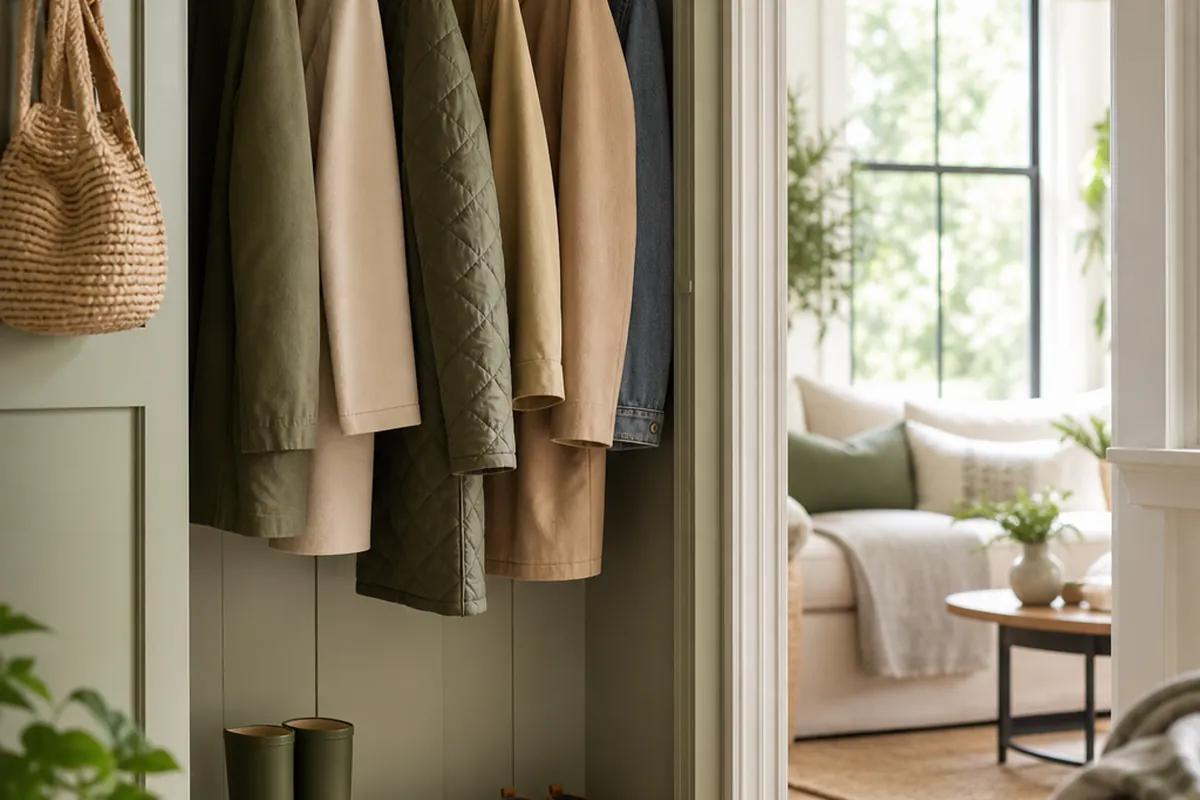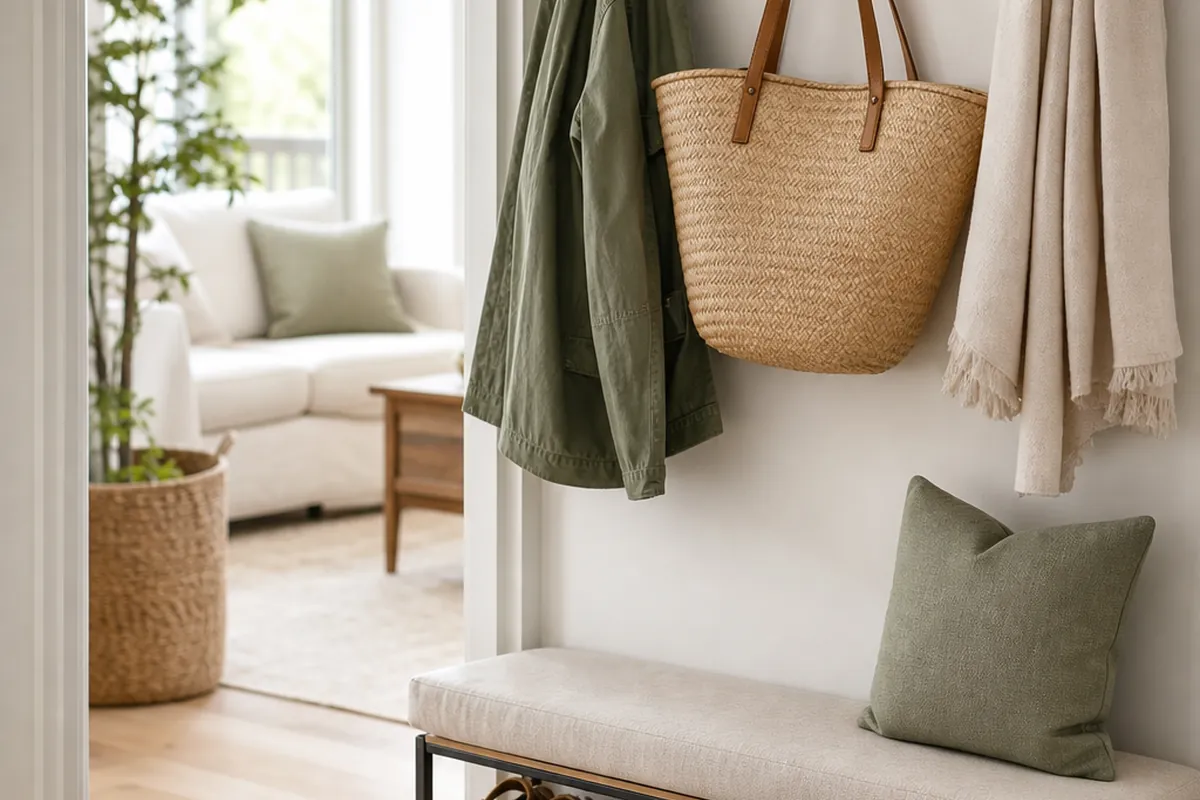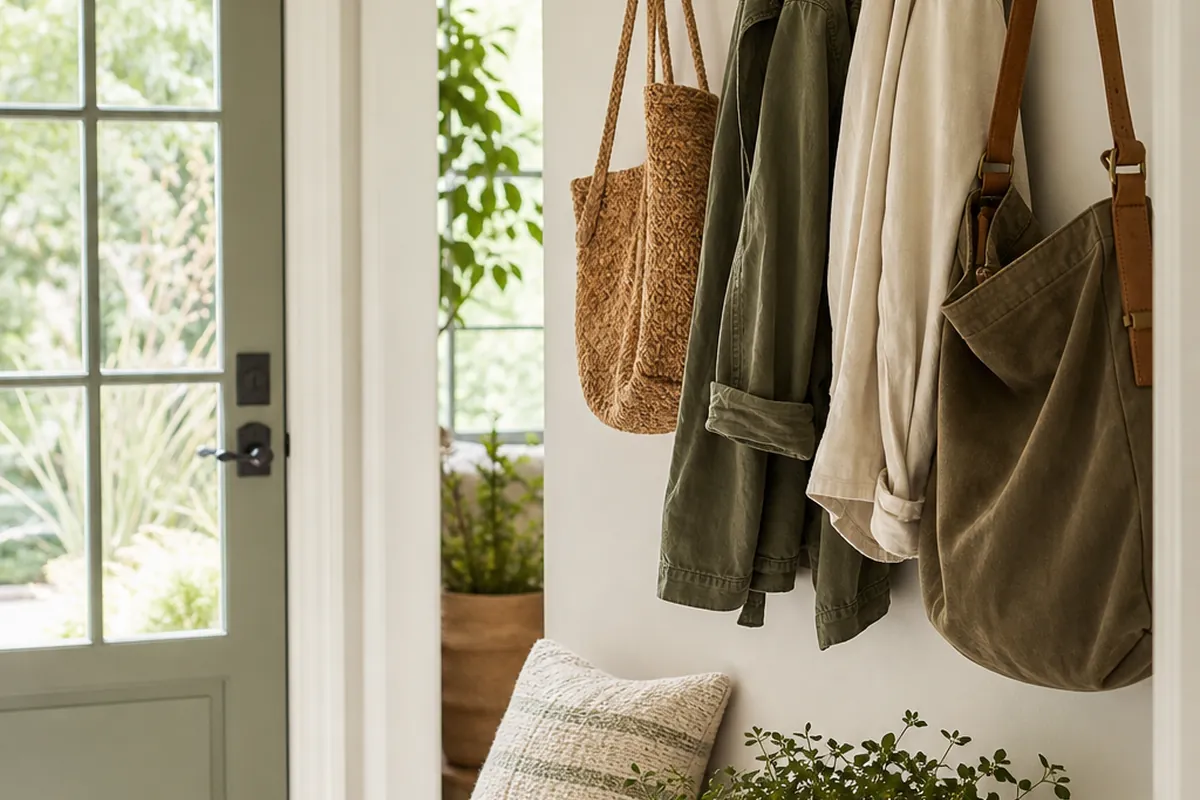
An entryway without a closet fails in a specific and predictable way. Coats end up over the back of a dining chair, bags end up on the floor by the door, and within a week there is a soft pile that everyone steps around and nobody owns.
The instinct is to buy something with a lot of storage in it. That is usually the wrong move, because the problem is not capacity. A household of two owns maybe six coats and three bags, which is not a lot of stuff. The problem is that there is nowhere to put a coat in the two seconds available while you are also holding keys, a phone and a bag of shopping.
Everything below is about making the correct action take one hand and one motion. Get that right and the pile does not form.
1. Count what actually lives at the door
Before buying anything, separate the coats in daily use from the coats in seasonal storage.
An entryway needs to hold the current season and nothing else. Four people times one coat each is four hooks, not sixteen. The winter parkas in July and the raincoats in January belong wherever bulk clothing goes in your home, which is almost never the hallway.
If that place is a small bedroom closet, storing out of season coats in a small closet covers how to pack them so they come out in shape next winter.
This one edit halves the problem for free, and it is the step people skip on the way to buying a bigger rack.
Do the same for bags. Most households have one bag per person in daily use and a further four that are kept for particular occasions. Only the daily ones have earned a place at the door.
In winter the count doubles with gloves, hats and scarves, and glove and mitten storage ideas for a small entryway gives the small things a home before they fill the bench.
2. Hooks beat hangers when there is no closet
In a closet, hangers win. In an open entryway, hooks win, and it is not close.
A hook takes a coat one handed in about a second. A hanger needs two hands, a shoulder threaded through each side, and somewhere to put down whatever else you are carrying. People do the one second version and skip the ten second version, so the rail of hangers stays empty and the chair collects the coats.
Photographs of entryways favour rails because they look calmer. Households favour hooks because they work. Choose for the household.
The exception is a coat that creases badly, a wool overcoat or a suit jacket. Those genuinely want a hanger, and one hanger on the end of a hook rail is a reasonable compromise for the one or two garments that need it.
3. Hang the rail at two heights, not one
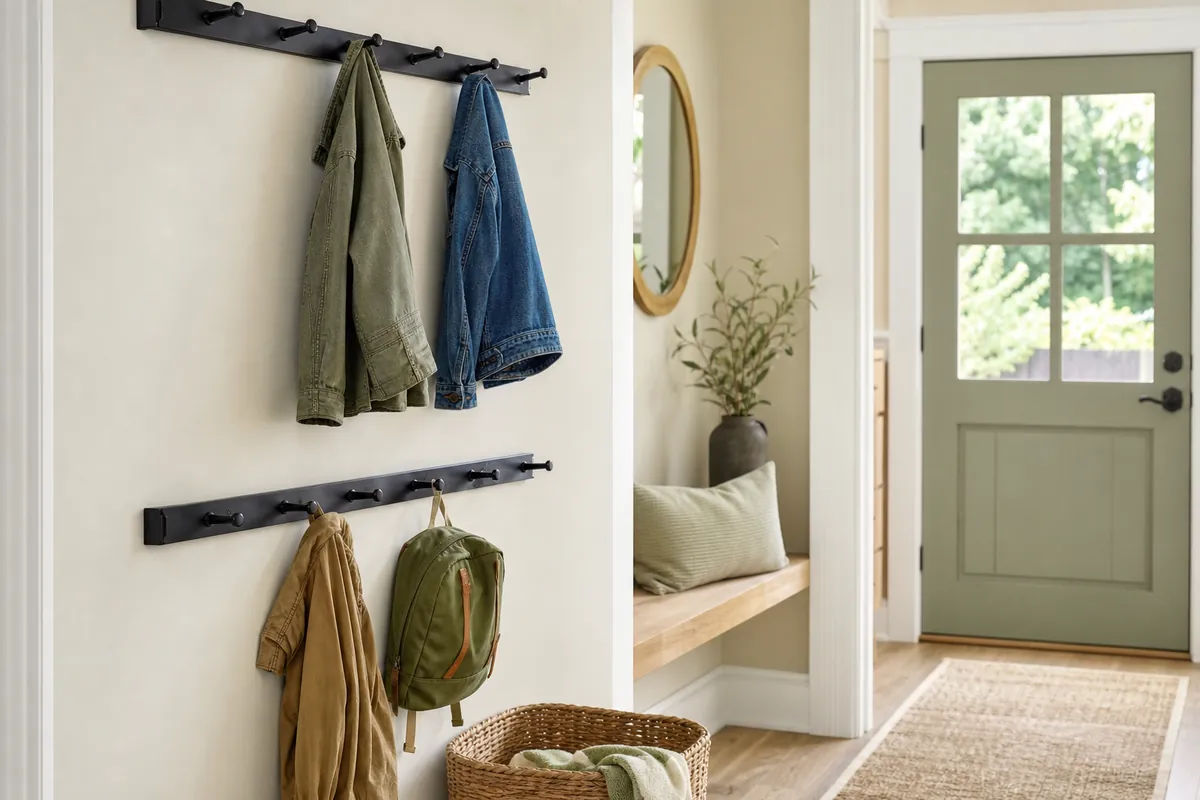
Adults want a hook around 60 to 65 inches from the floor. Children want one nearer 40. A single row at a compromise height fails both, because an adult coat hung at 48 inches trails on the floor and a child who cannot reach a hook drops the coat under it.
A wall-mounted coat rail with hooks at about 17 inches long is the right size for most narrow entryways. It carries a few adult coats without turning the wall into a closet, and a second identical rail lower down gives the children their own row for the price of a second small object.
Fix it into studs or use proper anchors. A wet wool coat is heavier than a dry one by a surprising margin, and hook rails come off walls in winter rather than in summer.
4. Keep the rail off the swing of the door
The most common mounting mistake is putting the rail where the door lands.
Open your front door fully and mark where the edge stops. Anything hung inside that arc gets knocked every time somebody comes in, and a coat hanging there will hold the door open a few inches all winter.
The wall opposite the hinge is usually right. If the only free wall is the one the door swings against, mount higher than the handle so the door passes underneath the coats rather than into them.
Check the depth as well as the arc. A loaded hook projects six or seven inches from the wall once a coat is on it, which is enough to narrow a tight hallway into a squeeze. In a corridor under about a metre wide, a rail on the wall you walk along will be brushed past constantly, so the end wall is worth the extra steps.
5. A freestanding rack when you cannot drill
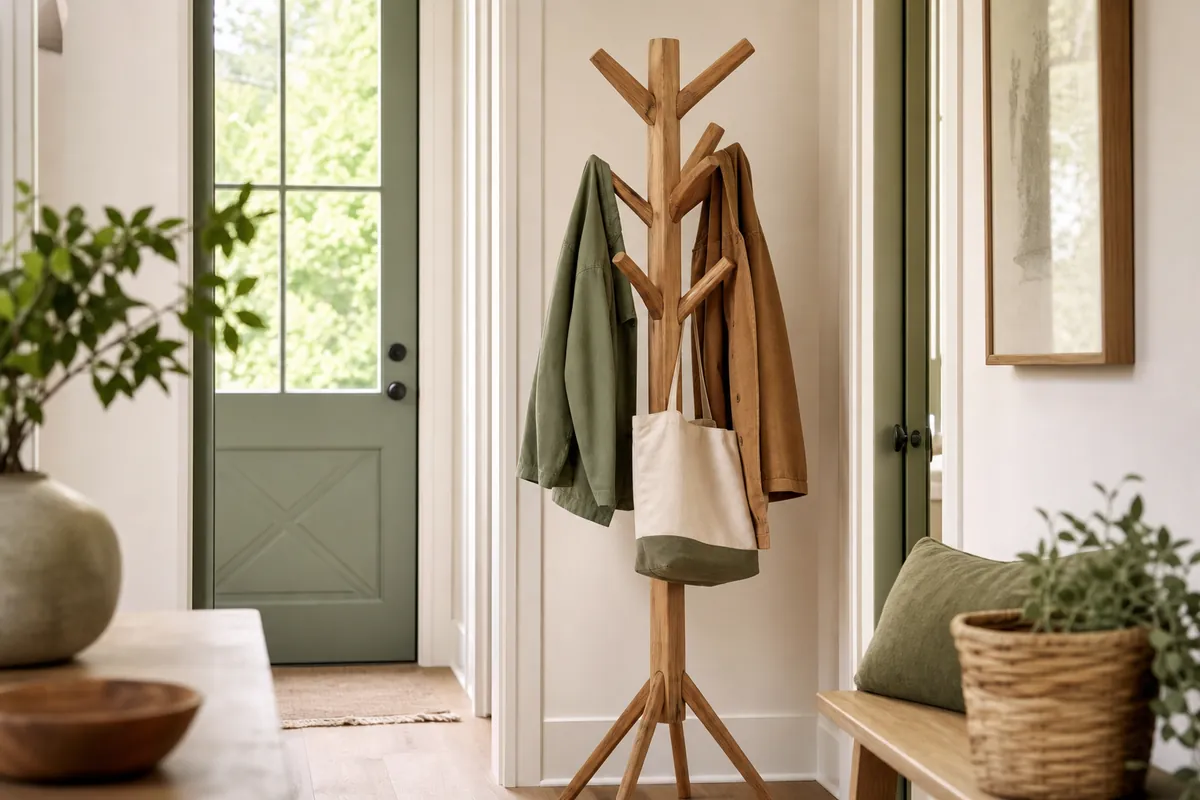
Renting, plaster in poor condition, or a landlord who counts holes all point the same way.
A freestanding coat rack with eight hooks holds a family’s worth of coats on a footprint about the size of a dinner plate, and the adjustable height versions let you set it low for a child or tall for adult coats to hang clear of the floor.
The honest tradeoff is stability. A tree rack loaded on one side will tip, so spread the coats around it and put the heaviest thing on the hook nearest a wall. Standing it in a corner rather than mid wall solves most of this, since two walls stop it going anywhere.
It also leaves with you, which a rail screwed to a rented wall does not.
6. Use the back of the door for overflow
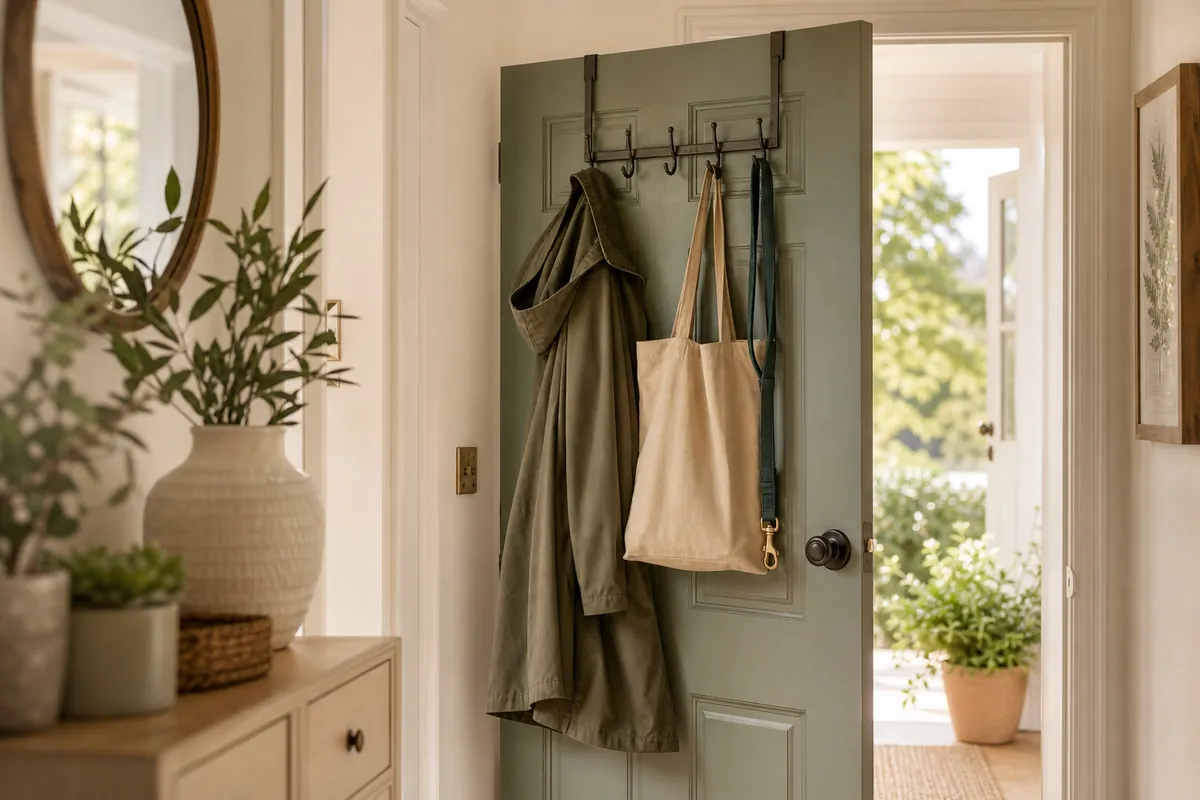
The back of the front door is a full sheet of vertical space that belongs to nobody and usually holds nothing.
An over the door hook set with six hooks fits it without a single fixing, hangs over the top edge and lifts straight off when you move. It is the right home for the things that are not quite coats: the dog lead, the shopping bag, the umbrella, the hoodie that lives by the door in every season.
Check the door thickness before buying, since these are sized for a standard interior door and a thicker front door can be a tight fit. Rubber coated hooks are worth the small extra, because bare metal on a painted door leaves marks in about a season.
7. Give bags their own height
Bags and coats fight when they share a rail. A loaded tote hung among coats crushes whatever is behind it, and a coat draped over a bag hides the bag entirely.
Put bags lower and to one side. Low is easier to lift a heavy bag onto, and separating the two means you can see both. This is the same logic behind backpack storage in an entryway, where a school bag needs a spot at the height of the person carrying it rather than a spare adult hook.
Two hooks a foot apart hold a bag better than one, because the straps sit level and the bag keeps its shape instead of folding around a single point.
8. Give the everyday bag a landing spot rather than a hook
The bag you carry daily is not really being stored. It is being put down for twelve hours and picked up again.
That bag wants a surface, not a hook: the seat of a bench, a shelf at hip height, the top of a shoe cabinet. Hanging it takes effort that nobody spends at the end of a working day, which is why it ends up on the floor in the exact spot it always ends up.
Put the surface where the bag already lands. Fighting the habit is much harder than moving the furniture two feet.
9. Add a bench only if the floor can spare it
A bench is the default entryway purchase and the one most likely to make a narrow hallway worse.
Measure the corridor. If you are left with less than about 30 inches of walkway once the bench is in, the bench will be shuffled past, knocked into and eventually moved. In that case a narrow shelf at hip height does the landing spot job with none of the floor cost.
Where a bench does fit, it earns its keep by giving somewhere to sit while removing boots, which is the one thing a hook cannot do. The layout tradeoffs are the same ones covered in entryway storage ideas for a hallway with no closet.
For the bench itself, entryway bench storage ideas for a narrow hallway covers the depth to buy and how to stop the baskets under it filling up.
10. Leave one hook deliberately empty
The last one costs nothing and decides whether the system survives.
An entryway with every hook full has no capacity for a visitor’s coat, a delivery, or the extra jacket on a cold morning. The first thing without a home goes on the chair, and once one thing is on the chair the pile restarts.
Keep one hook clear and treat it as unavailable. If you find yourself using it every day, that is the signal you need one more hook rather than a bigger rack. When the coats do get a closet again, coat closet organization picks up where this leaves off.
The pile forms where the system takes two hands
An entryway without a closet does not need a lot of storage. It needs the right action to be the easy one.
Hooks at two heights, bags lower than coats, a surface where the daily bag already lands, and one hook kept free. Fix those and the chair goes back to being a chair.