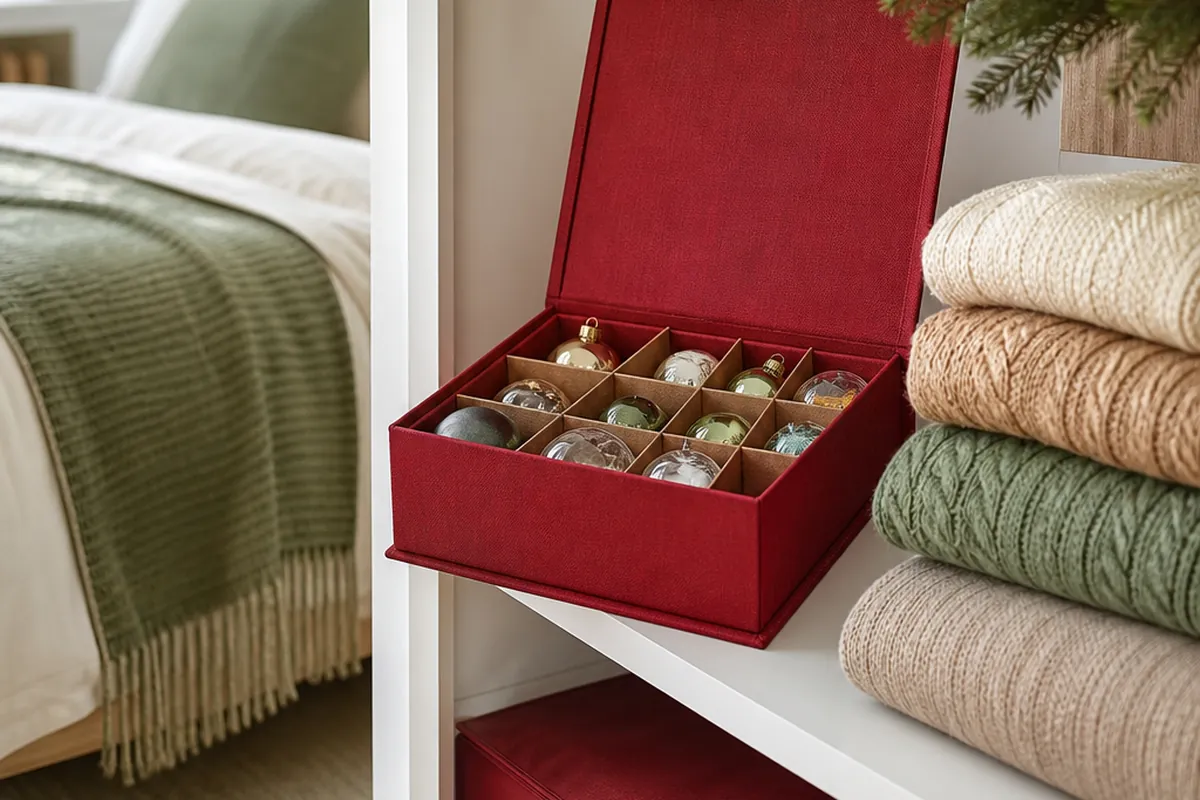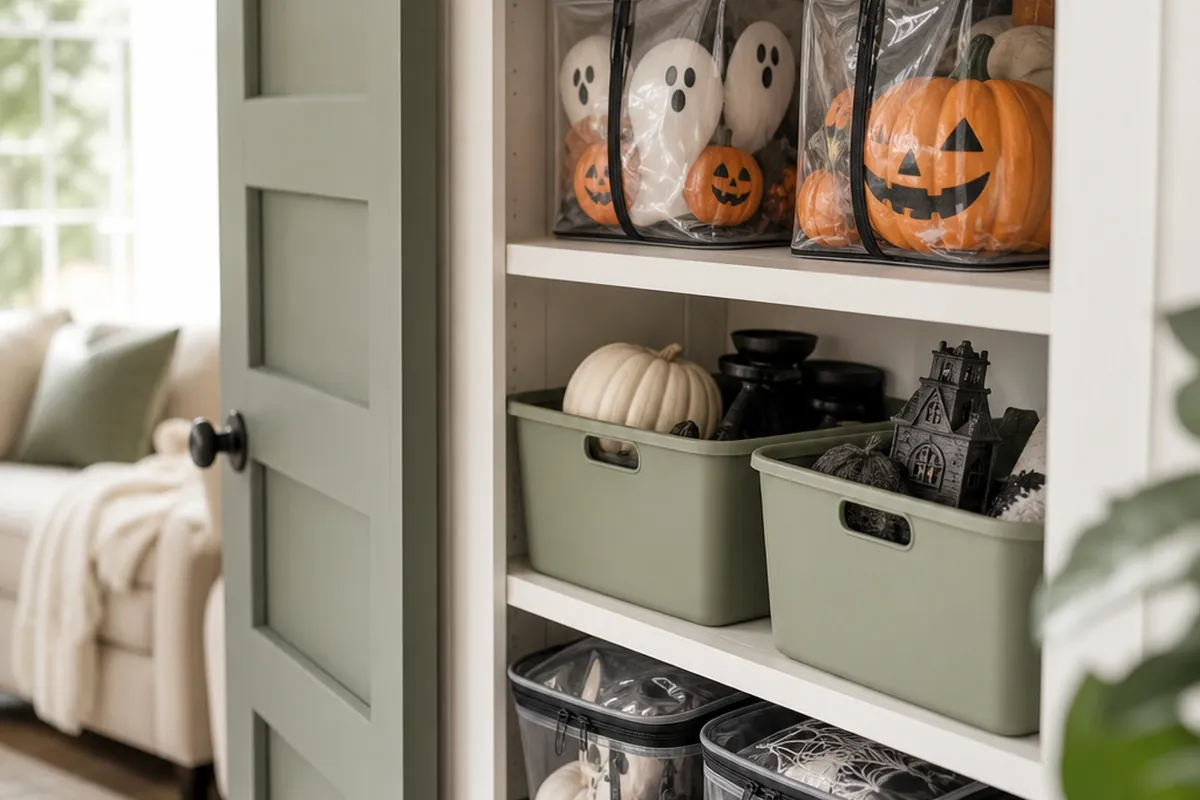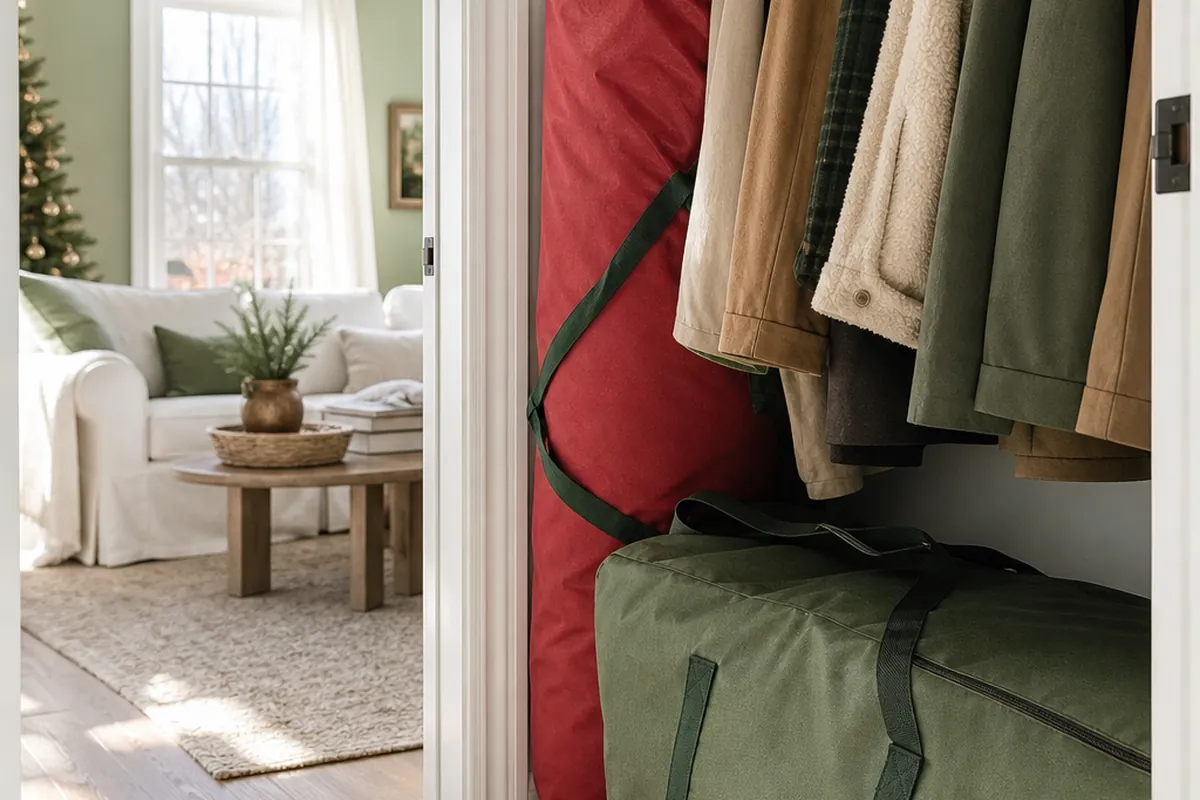
An artificial Christmas tree is the largest single object most apartments ever have to store, and it is the one thing every storage guide skips past with “put it in the garage.” A seven and a half foot tree compresses to about four feet long and a foot and a half across, which is bigger than any shelf you own, and it has to disappear for eleven months into a home that was already full.
So the real question is not how to pack the tree. It is where in a small apartment four cubic feet of tree can live without you tripping over it, and the answer decides everything else, including which bag to buy. Ten ideas below, starting with the ones that cost nothing.
1. Get rid of the box it came in
The cardboard box is sized for a tree that has never been fluffed. Once the branches have been opened and shaped, they will not go back in without being crushed flat, and crushed branches are why a tree looks thinner every year. The box also splits at the corners by the second season, and it is a rectangle, which is the wrong shape for every gap in an apartment.
Break it down and recycle it. A fabric bag with handles is the right shape, seals against dust, can be dragged rather than carried, and lasts as long as the tree does.
2. Take it apart in sections and mark the joins
Every artificial tree comes in two to four sections that slot together on a central pole. Before you separate them, put a strip of colored tape around the top of each pole and number them from the bottom up. Then next December the tree goes together in order without the guessing that turns a ten-minute job into an argument.
If it is a pre-lit tree, also mark which plug goes into which socket with a second color, because the connectors all look identical and only one arrangement lights the whole tree.
3. Fold the branches in the direction they were shipped, and do not force them
Branches on an artificial tree are wire, and wire has memory. Fold each one gently upward and inward, toward the pole, in the same direction it was folded when it arrived. That is the direction the hinges are designed to close. Forcing a branch the other way, or pressing a whole section flat under your knee to make it fit a bag, is how hinges bend and tips snap.
Loosely tie each folded section with a soft strap, a piece of ribbon, or a strip of old T-shirt. Not string, which cuts into the needles, and not tight, which crushes them. The section should hold its shape, not be squeezed.
4. Decide standing or lying before you buy the bag
This is the whole decision, and it is about the apartment, not the tree. A tree can be stored standing upright in a tall bag, which takes a footprint of about a yard square but uses height the apartment is not using anyway. Or it can be stored lying flat in a duffel, which takes floor space but slides into places an upright bag will not.
Walk the apartment with a tape measure before you buy anything. Is there a corner, in a closet or a room, that is a yard square and eight feet tall? Then upright. Is there a stretch of floor four feet long and a foot and a half wide, along a closet floor or behind a sofa? Then flat. If the answer to both is no, skip to idea nine.
5. Stand it in a closet corner in an upright bag
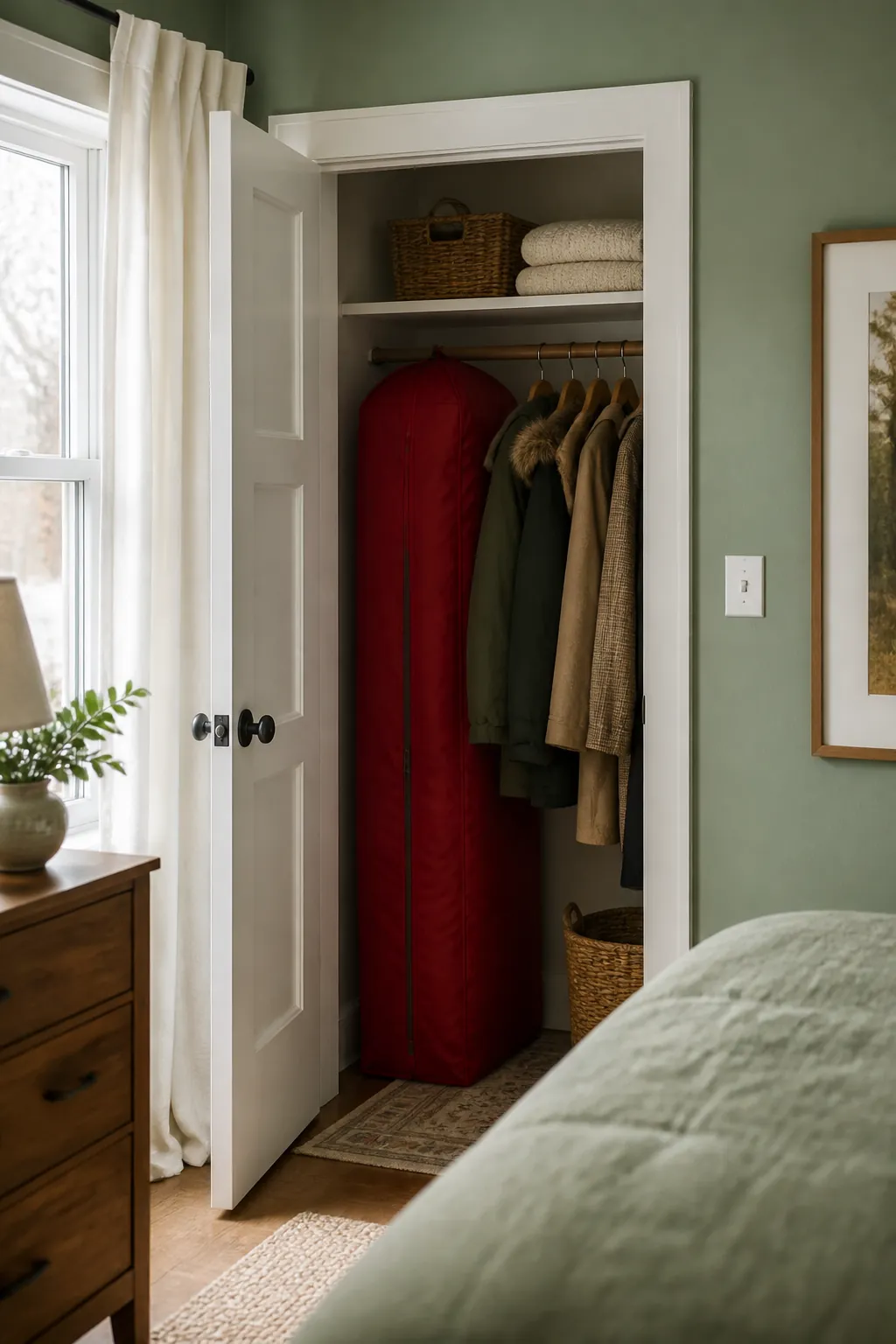
Where the height exists, an upright bag is the tidiest answer, because it turns the tree into something that stands in a corner rather than something you step over. An upright Christmas tree storage bag holds a tree up to nine feet, zips closed around it, and stands on its own, so the tree lives in the corner of a deep closet, ideally one you have already cleared to the back wall, or, with a plain fabric cover over it, in the corner of a bedroom where it reads as a piece of furniture rather than a stored tree.
Be honest about the footprint before ordering. The bag is about thirty-three inches on each side and eight feet tall, and the size is the one thing reviewers disagree about, with some finding it generous and others finding it too big for the space they had in mind. It is the right answer for a deep closet or a spare corner, and the wrong one for a shallow reach-in closet.
6. Lie it flat on the closet floor in a duffel, and move the shoes up
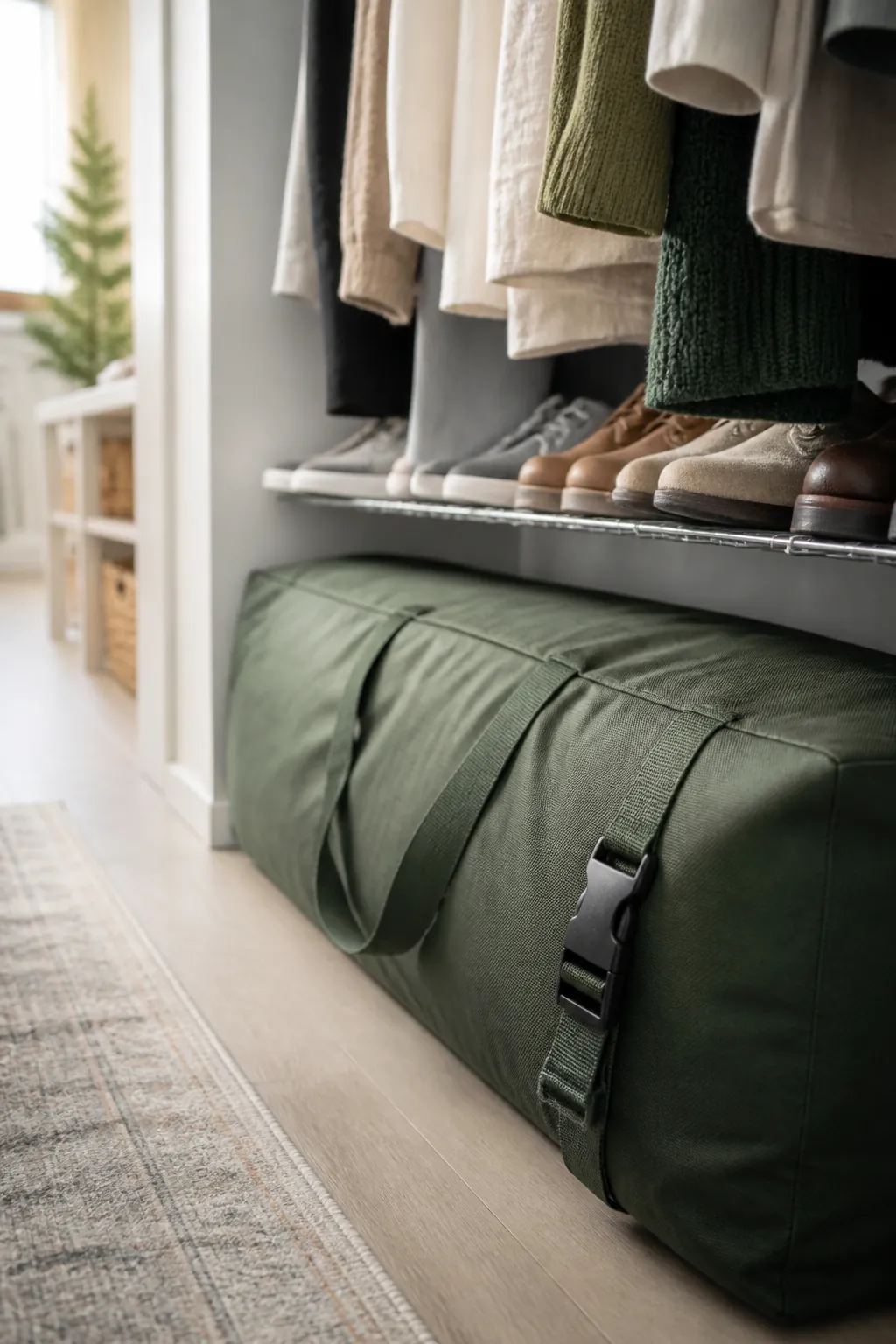
For most small apartments, the tree ends up lying down, and the place it lies is the closet floor. A heavy-duty Christmas tree duffel bag in 900D fabric takes a seven and a half foot tree in three or four sections, plus the stand and skirt, and measures about fifty inches long by sixteen wide by twenty tall. That is the floor of a standard closet, under the hanging clothes, with the shoes that used to live there moved onto a rack or the back of the door. The shoe storage guide covers how to get them off the floor.
Two things worth knowing. Twenty inches is taller than the gap under almost any bed, so under-bed is not an option for a full-size tree, however tempting the empty space is. And the zipper is the part reviewers report failing, so load the bag with the heaviest section at the bottom and the zipper closing over needles rather than over a pole end. If the closet floor is already spoken for, the second-best flat spot is along the wall behind a sofa that sits a little proud of it.
7. Test a pre-lit tree before it goes into storage, and tape the plugs
A pre-lit tree that fails does so in December, when you have no time to fix it, and most of those failures were caused in storage, not by bulbs dying. Plug every section in before you take it down and confirm it lights. Then, as you separate the sections, tape each plug flat against its own pole with painter’s tape so it cannot be crushed against another section or snagged on a zipper.
Never wrap the connecting cords tightly around the trunk. Coil them loosely and tuck them inside the folded branches. A bent plug pin is the most common pre-lit fault there is, and it is entirely a storage injury.
8. Reel the loose lights, do not ball them
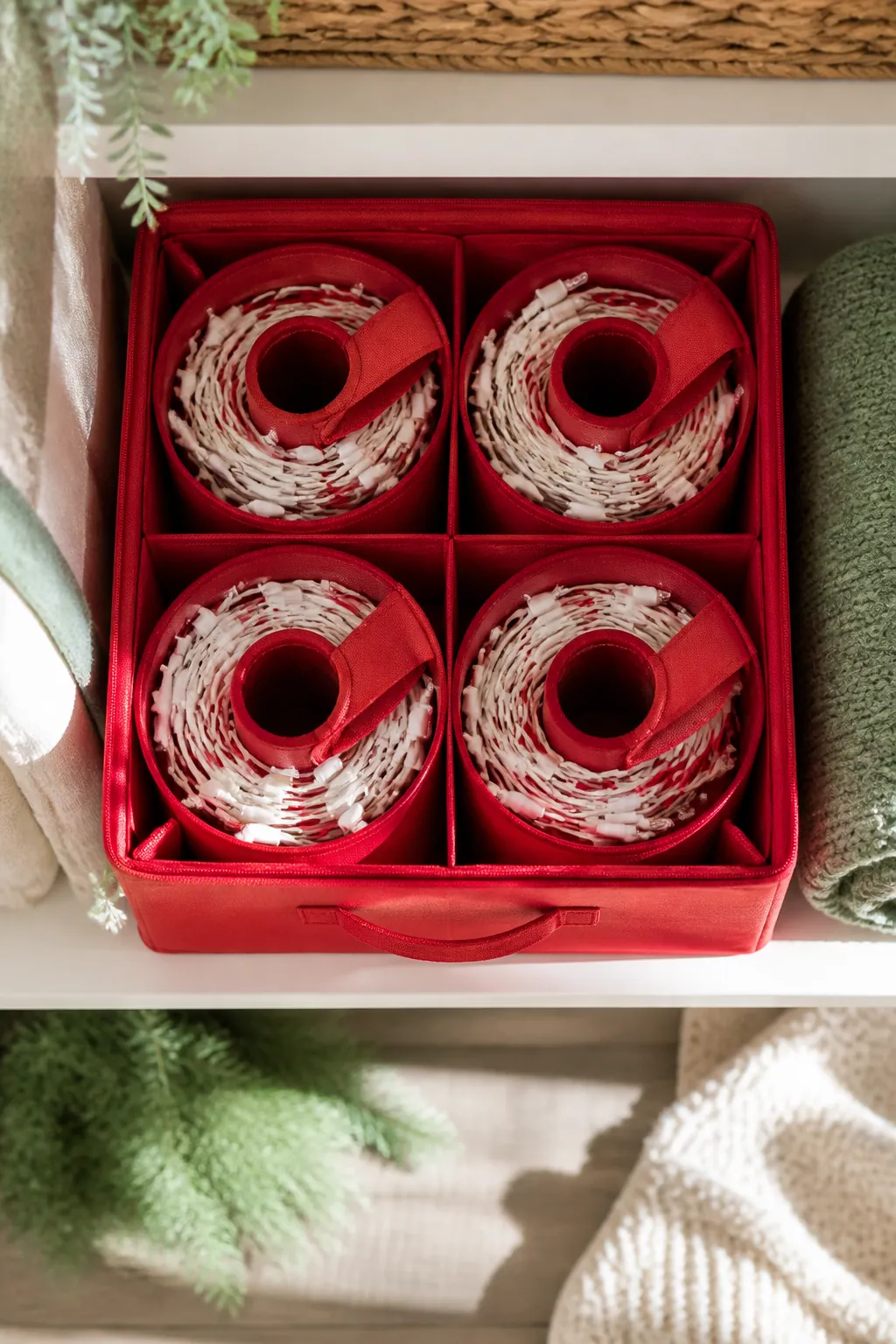
If the tree is not pre-lit, the lights are their own problem, and a ball of lights in a bag is a January afternoon spent untangling. A set of Christmas light storage reels gives each string its own spool, and the spools stack into one box that sits on top of the tree bag or on a closet shelf.
Wind the lights with the plug end on the outside so you can test a string without unwinding it. Reviewers are split on capacity, with some finding the reels hold plenty and others wanting more, so count your strings before buying and treat “holds 800 lights” as a ceiling rather than a promise.
9. If you are buying a tree, buy for the closet, not the living room
This is the idea that saves the most space, and it only works if you have not bought the tree yet. A slim or pencil tree compresses to roughly half the bag of a full tree of the same height, which means it fits a closet floor with room left over, or stands in a corner an upright bag for a full tree would block.
It also looks right in a small apartment in December, because a full seven and a half foot tree in a compact living room eats the room. Choose the tree for the eleven months it is stored, and it will suit the one month it is up.
10. Keep the stand, the skirt, and the topper in the same bag
The tree stand is heavy, awkward, and always the thing that goes missing. It belongs in the same bag as the tree, in the outer pocket if the bag has one and at the bottom if it does not. The skirt folds flat over the top section. The topper, if it is fragile, goes in a small box tucked into a fold of branches, or on the shelf where the Halloween decorations already live, so that seasonal is one zone rather than several.
Then label the outside of the bag on the side you will see from the closet doorway, with what is inside and how many sections there are. “Tree, 3 sections, stand in pocket” is what you want to read next December, standing at the closet with a coffee.
Where to start
Measure first. Find the one gap in the apartment that is either a yard square and eight feet tall, or four feet long and a foot and a half wide, and that decides upright or flat before you spend anything.
Then take the tree apart in marked sections, fold the branches the way they came, test the lights, and put the stand in the bag with it. Recycle the cardboard. If there is no gap at all, that is the answer too: next year’s tree should be a slim one, and the storage problem shrinks by half.