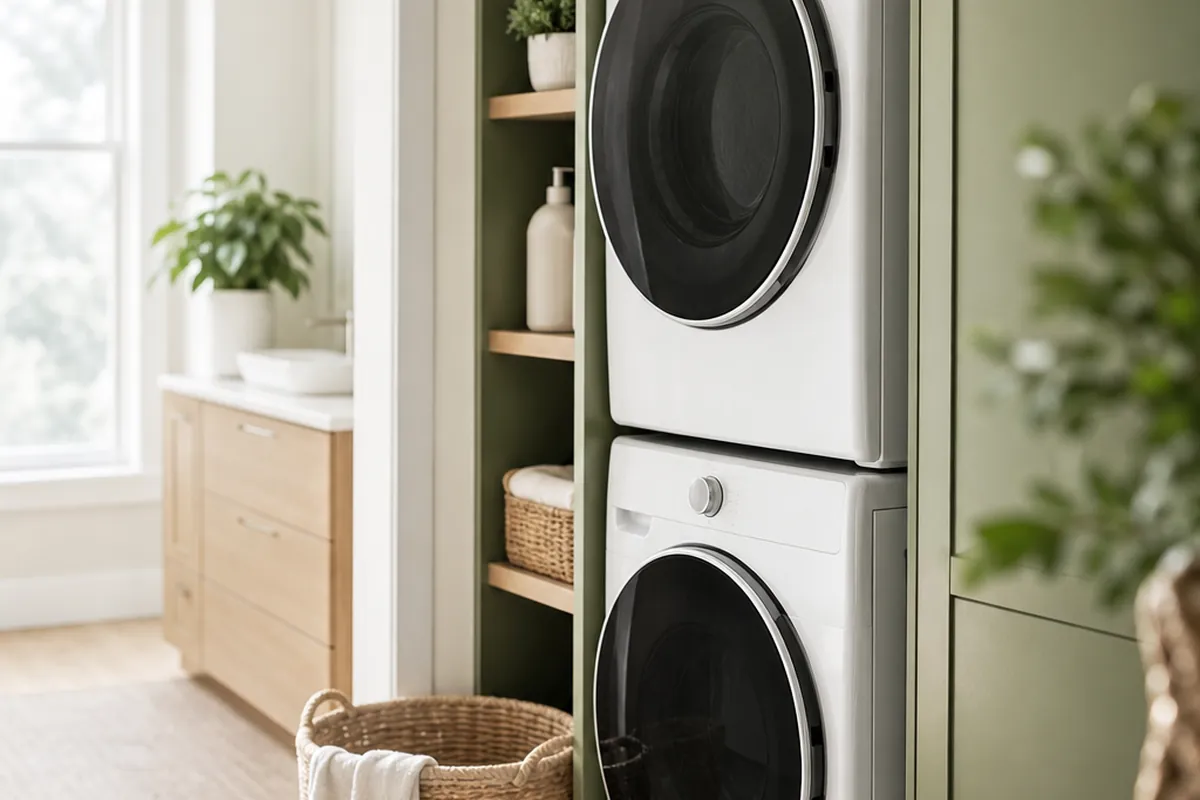
A laundry closet with no shelf is a strange kind of storage problem, because the space is not actually full. There is a washer, a dryer, and then a large volume of air above them doing nothing at all.
The reason it feels full is that the only horizontal surface in the room is the top of a machine, and that surface vibrates. So the detergent lives on the floor beside the door, the fabric softener lives on top of the dryer until it falls off, and the whole closet reads as chaotic despite holding about six objects.
Everything below is about finding surfaces that already exist. Most of it involves no drilling, which matters because a laundry closet is usually a rental and usually has walls you would rather not explain later.
1. Measure the three gaps before you buy anything
There are only three measurements that decide what fits, and they take two minutes.
The side gap, between the machine and the wall. The top gap, from the lid or the top panel up to the ceiling. And the door swing, which is the depth you can use on the back of the door without the door refusing to close.
Write all three down. Almost every failed laundry closet purchase is something an inch too wide for the side gap, or a rack that fouls the door. The closet is unforgiving in a way a room is not, because there is nowhere to put the thing that does not fit.
Take the numbers on your phone rather than on paper. The measurement you need is always the one you left at home, and a laundry closet is the kind of space you shop for while standing somewhere else.
2. The side of the machine is the surface you forgot
The top of a washer vibrates and the floor is already taken. The side panel is neither.
Most washer and dryer bodies are steel, which means a magnet holds on them. Check yours with a fridge magnet before you spend anything, because a small number of machines have plastic or coated panels and the whole idea collapses on those.
Where this wins over a shelf is that it needs no wall, no drill, no bracket and no landlord conversation. It also uses the gap between the two machines, or the outer face of the pair, which is space that is otherwise permanently empty.
3. Put the heavy jug low and the light box high
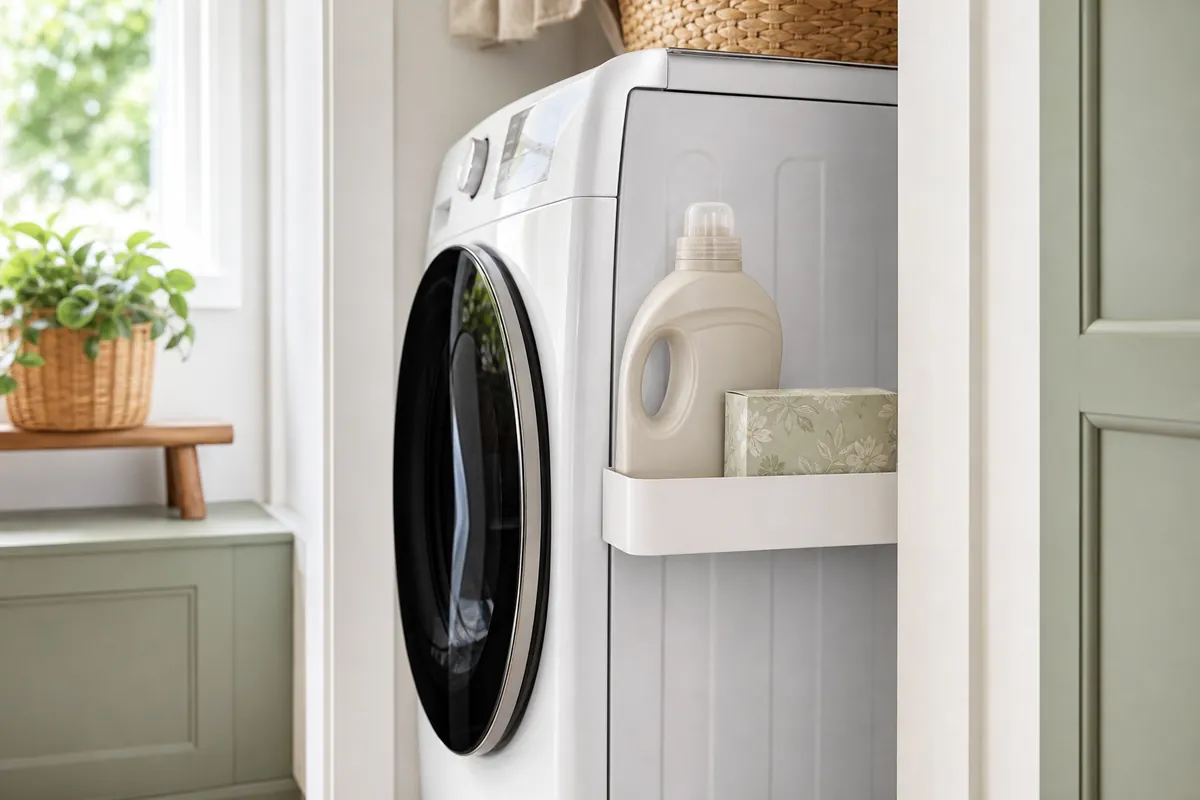
A set of magnetic laundry shelves gives you several small surfaces rather than one big one, which suits laundry supplies better than it sounds. Four shelves means detergent, softener, stain stick and dryer sheets each get their own place instead of sharing a huddle.
Two rules make them hold. Wipe the panel first, because the rated load assumes clean dry steel and lint plus a film of dust is what makes a magnet creep. And put the heaviest thing on the lowest shelf, so that if anything ever does slide it has three inches to fall rather than three feet.
The gap between a side by side washer and dryer is the best spot of all. It is invisible from the doorway, reachable from either machine, and nothing else was ever going to use it.
4. Build over the machines instead of beside them
The largest unused volume in the closet is the column of air above the machines, and it is usually two or three feet tall.
A freestanding rack that straddles the pair turns that column into real shelving without touching a wall. It stands on the floor on either side of the machines, so the weight goes into the floor rather than into a plasterboard anchor, and it lifts out in an afternoon when you move.
This is the single biggest capacity gain available in a closet with no shelf, and it is the one most people skip because it looks like furniture and feels like a commitment.
Stability is worth a thought before you load it. A tall narrow rack standing on a floor that gets damp is not a stable object, so keep the heavy stock low and the light boxes high, and check the feet sit flat rather than bridging a threshold strip. If the closet has a lip at the door, that lip is usually what makes a rack rock.
5. Check the rack clears the lid, not just the machine
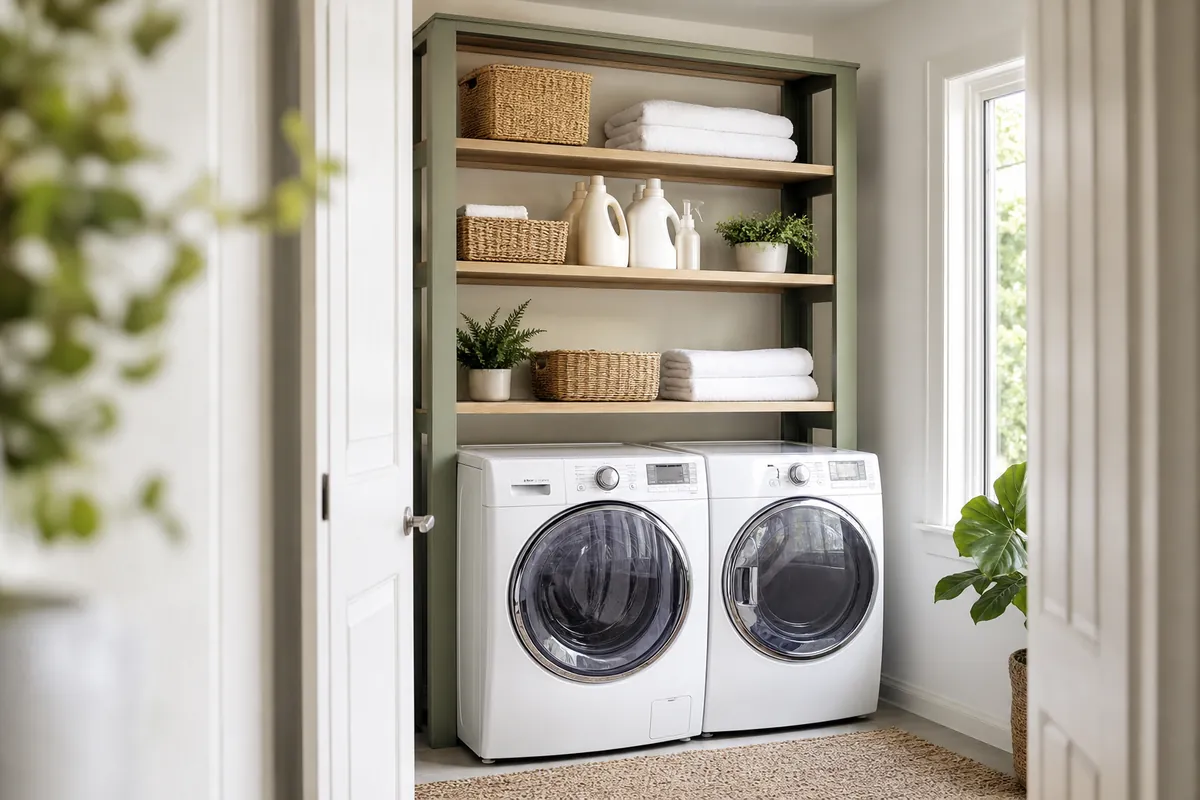
An over the washer shelf unit is the right shape for this, but the measurement that catches people is not the height of the machine.
On a top loader, the number that matters is the height of the lid when it is fully open. On a front loader it is the depth of the door swing. Measure with the machine open, not closed, or you will build a very tidy shelf that stops you loading the washing.
Leave a hand’s width of clearance above the lid as well. A shelf that technically clears becomes a knuckle hazard within a week, and a closet you flinch in is a closet you stop tidying.
6. Decant the bulk jug into something closet sized
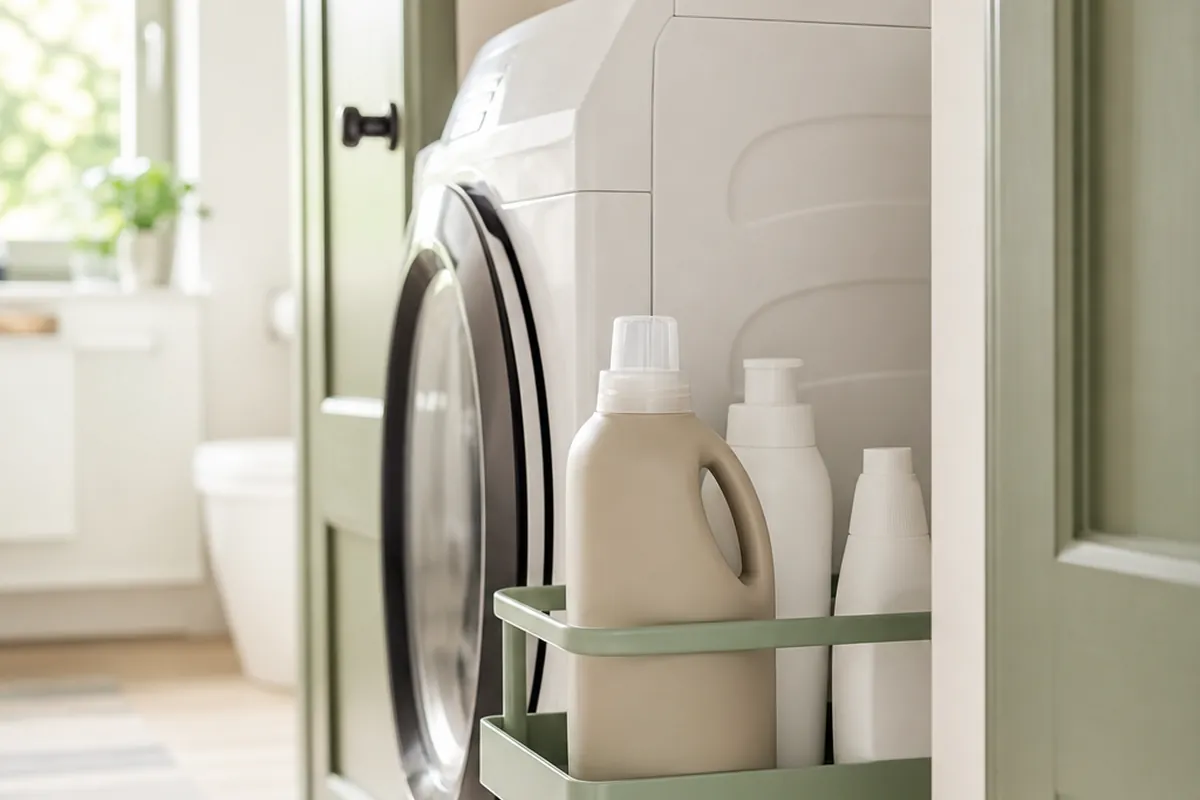
Bulk detergent is priced for a garage and shaped for a supermarket shelf. In a closet it is the single object that ruins the layout, because it is too tall for most shelves and too heavy to sit anywhere high.
Keep buying it if the price is right, then pour two weeks of it into a smaller bottle or a dispenser that fits your actual shelf. The jug goes wherever bulk goes in your home, which is rarely the laundry closet.
The result is a closet organized around what you use weekly rather than around one large object you bought quarterly. That is the same principle behind cleaning supplies organization in a tiny utility closet, where the bottle you reach for daily and the refill you touch monthly should not be stored the same way.
7. Bins for pods and powder, bottles for liquid
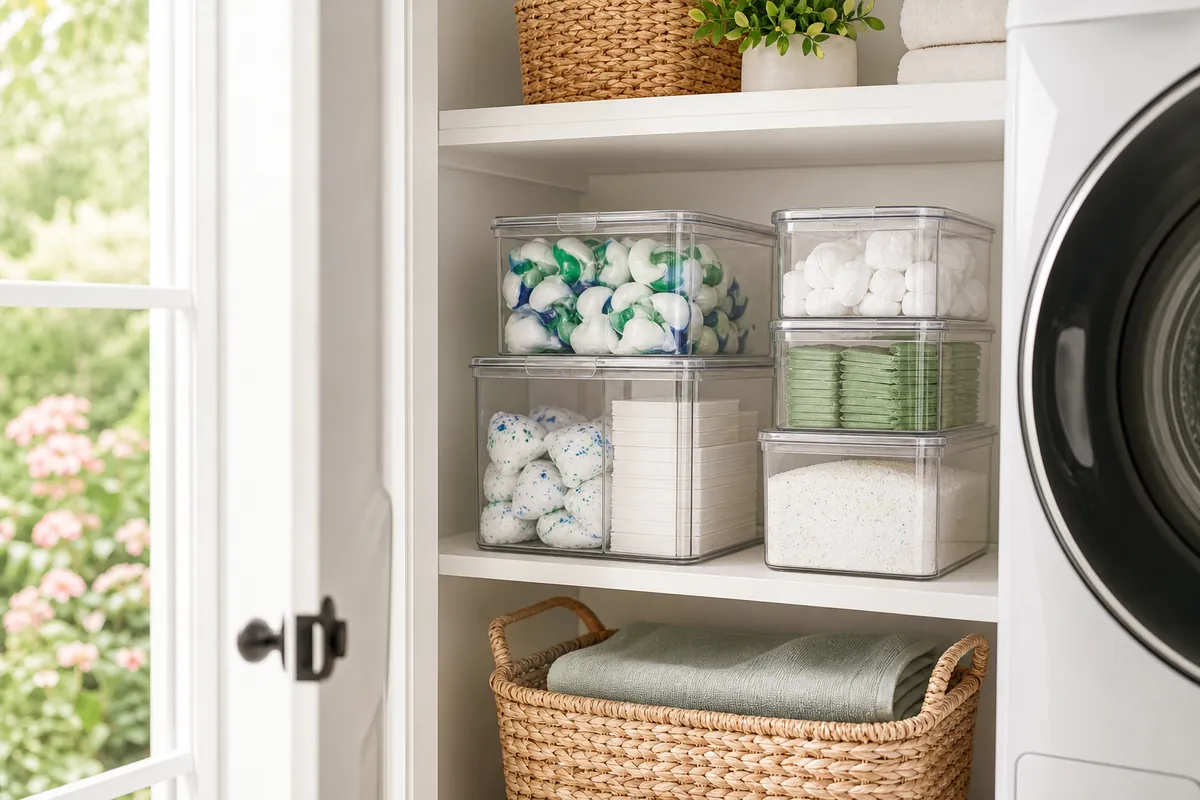
Pods, powder, dryer sheets and stain removers all arrive in packaging designed to be seen in a shop and then to be thrown away. Kept in it, they slump, tear and shed.
A set of clear stackable bins with lids fixes that in one move. Clear matters more than it usually does here, because laundry supplies look alike and the whole point is to see the level without lifting anything down. Lids matter because a laundry closet is a dusty, linty environment and open bins collect it.
Stacking is the real gain though. Two bins in the footprint of one doubles a shelf that you cannot make deeper or wider.
8. Use the back of the door
The door of a laundry closet is a full sheet of unused vertical surface, and unlike the walls it belongs to the closet rather than to the room.
An over the door rack with shallow baskets takes the flat, light things: dryer sheets, stain pens, lint rollers, a spare pack of pods. Keep the depth honest, because anything more than a few inches thick will stop the door closing over the machines.
This is the surface to use for the items you reach for mid cycle, since it swings toward you when the door opens rather than hiding behind a machine.
What does not belong there is anything heavy or anything that pours. A door moves every time you use the room, and a bottle of liquid on a swinging surface will eventually meet the frame. Keep the door for dry, light and flat, and let the machines carry the weight.
9. Stand everything liquid in a tray
The unglamorous one, and the one that saves the floor.
Detergent and softener both creep down the outside of the bottle after a pour. In a closet those drips land in a spot you never look at, and by the time you notice, the floor is sticky and collecting lint in a solid gray film.
A shallow tray or a cheap baking sheet under the bottles catches all of it and lifts out to be rinsed. This is also the difference between a rented closet you get the deposit back on and one you do not, which is worth more than the tray costs.
For the wider layout of a closet like this, small laundry closet organization covers where the basket and the drying rack go once the supplies are off the floor, and laundry room organization ideas for a tiny space covers the same job when you have a room rather than a cabinet.
The shelf was never the problem
A laundry closet with no shelf is not short of space. It is short of surfaces, which is a different thing and a much easier one to fix.
The baskets are the other half of that closet, and laundry basket storage for a small apartment covers the gap beside the machine and how to sort as you go.
The sides of the machines, the air above them, and the back of the door are three surfaces that are already there and already yours. Use those, decant the one object that does not fit, and stand the liquids in a tray. The closet will hold everything it needs to with room left over, and you will not have drilled a single hole.