Most small closets have one shelf above the rail, and in most of them that shelf is doing almost nothing useful. It holds a suitcase, a heap of spare bedding, and a layer of things nobody has looked at since the day they moved in. The volume is there. It is just in a form you cannot use.
The reason is that a single deep shelf is the wrong shape for almost everything you own. It is too tall for one stack and not tall enough for two, too deep to see the back of, and usually too high to reach into without moving something first. Fix those three problems and the shelf stops being a dumping ground.
1. Measure the depth before you buy anything for it
Closet shelves are deeper than people assume, commonly around forty centimetres, and that depth is the reason the back of the shelf becomes a lost zone.
Measure three numbers before you buy a single container: the depth, the width, and the clear height between the shelf and the ceiling or the shelf above. That last one is the one people skip, and it is the one that decides whether a riser or a tall bin will actually go in.
Write them down. Almost every returned closet organizer is a returned closet organizer because it was two centimetres too tall.
2. Empty it completely and sort by reach, not by category
Take everything off the shelf and put it on the bed. This feels like a waste of an hour and it is the only step that reliably changes the outcome.
Now sort by how often you reach for each thing, not by what it is. Weekly, seasonally, and almost never. Most closet advice sorts by category, which is why people end up with a beautifully arranged shelf that they still cannot use: the thing they need every week is behind the thing they need every other year.
The almost never pile is usually bigger than expected, and it is what the top shelf is for.
3. Split the dead air with a riser
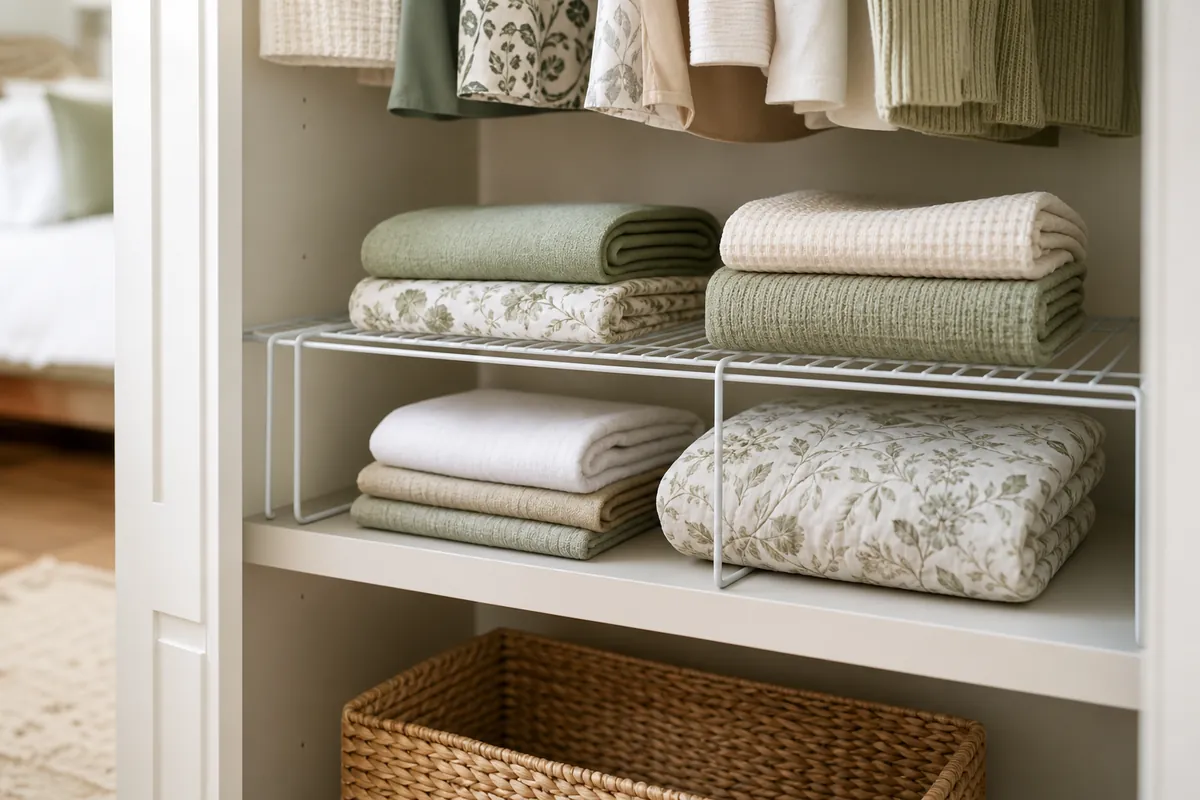
The gap above a closet shelf is often thirty or forty centimetres of nothing, because a single stack of folded clothes stops well short of the ceiling.
An expandable shelf riser turns that gap into a second level. Two shallow layers hold noticeably more than one deep one, and more importantly you can see both, which a single tall pile never allows.
The honest limit is depth. A riser sitting on a forty centimetre shelf still leaves you reaching past the front row to get to the back of the upper level, so it solves the height problem without solving the depth one. It also needs a flat, stable shelf, which some wire shelving is not.
4. Break the run up with shelf dividers

A long open shelf has no structure, so anything folded on it leans, and once one pile leans it takes the next one with it.
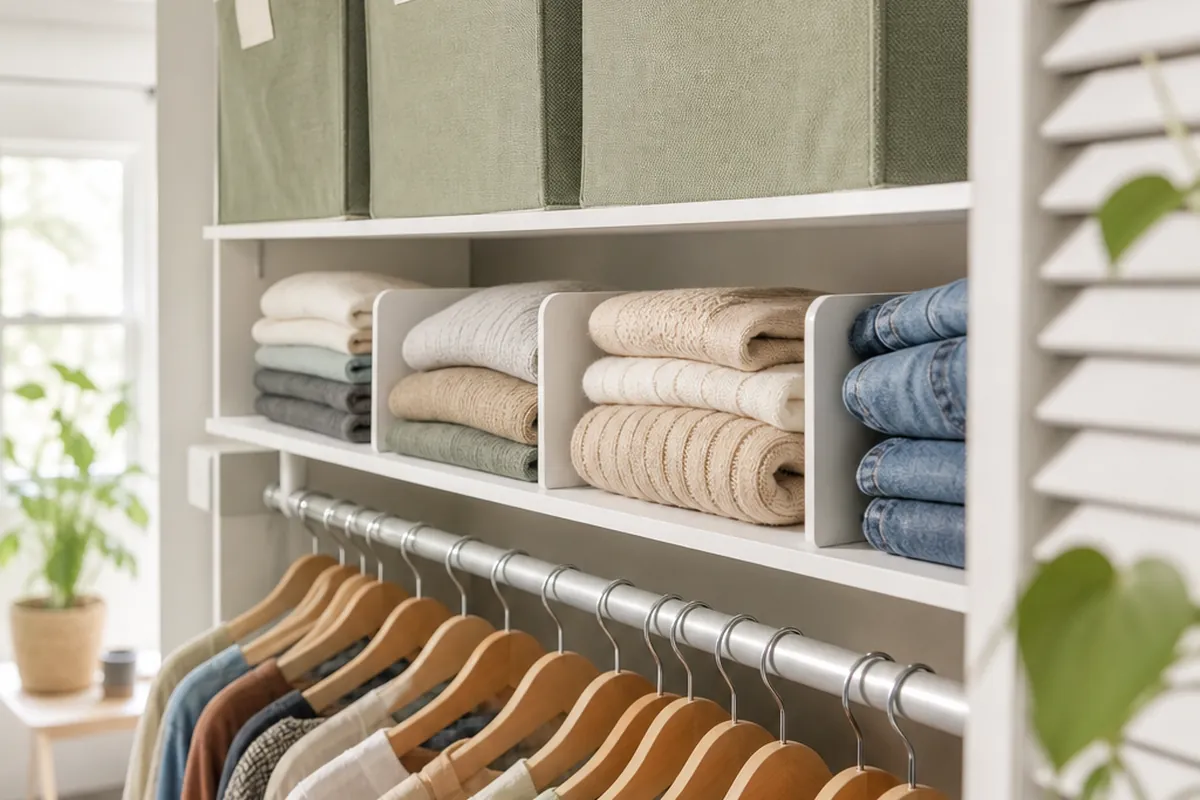
Shelf dividers clip over the shelf edge and split it into sections, so each stack has a wall to lean against. On a wide shelf carrying folded jumpers or towels this is the single change that stops the weekly collapse.
They are worth skipping if your shelf holds boxes or bins, because rigid containers already brace each other. Dividers solve one specific failure, which is soft things falling sideways.
5. Put everything loose into bins with handles
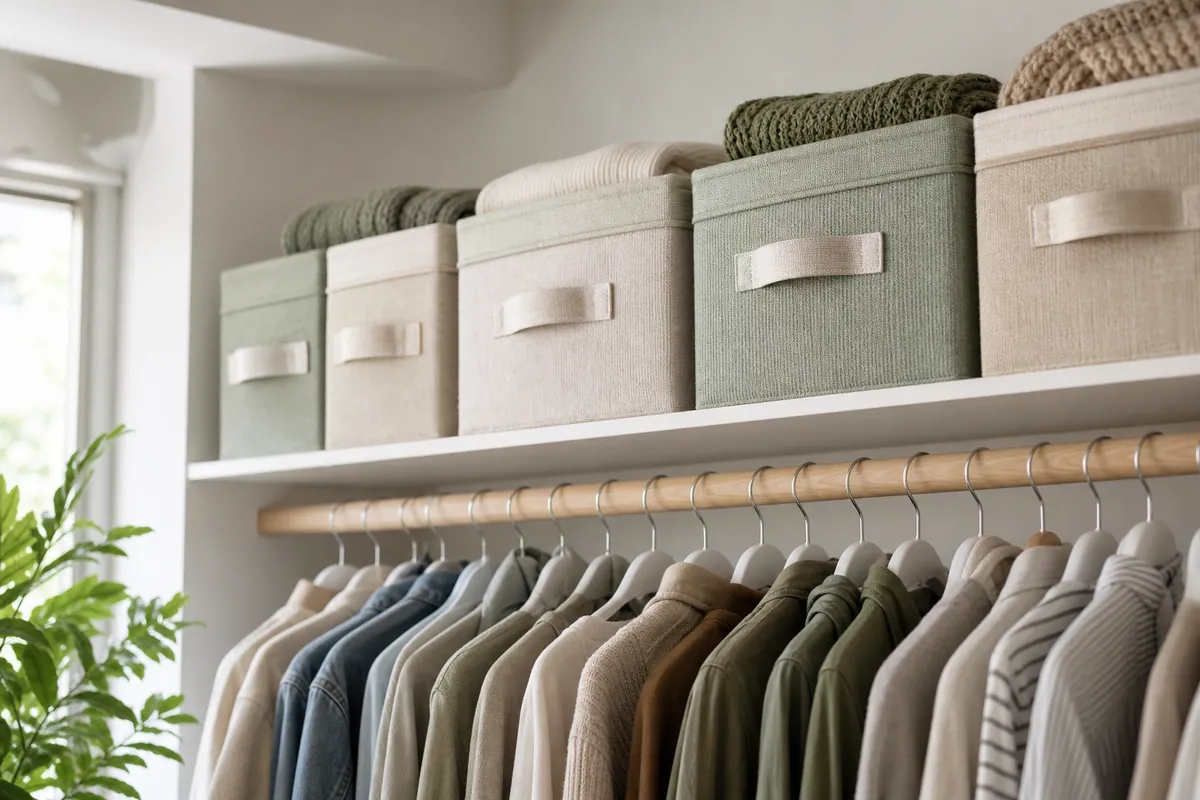
Anything that is not a folded stack or a box will migrate. Hats, scarves, belts, chargers, the spare bulbs. These are what turn a shelf into a layer of debris.
Fabric shelf bins with handles fix this, and the handle is the part that matters, not the bin. On a shelf above shoulder height you cannot see in, so you have to pull the container down to use it. A bin without a handle gets dragged by its rim, tips, and empties itself over you.
One category per bin. A single mixed bin is a box you rummage in, which is where you started.
6. Label the bins on the face you can actually see
Labels on top of a high bin are decoration. From below, you see the front face and nothing else.
Put the label on the short front edge, at the bottom of it where the bin is not shadowed by the shelf above. Write what is in it rather than a category name, because “winter” tells you less than “hats, gloves, scarves” when you are standing on a stool.
If the bins are opaque and stored above eye level, this is not optional. An unlabelled high bin gets opened once and then avoided.
7. File folded clothes upright rather than stacking them
On a shelf, stacks fail for the same reason they fail in a drawer. You take from the middle, the pile collapses, and you never see the bottom third of what you own.
Fold everything to one consistent height and stand the items in rows, so every edge faces out. The stack braces itself and you can see the whole row. This is the same method that works in drawer organizers for folding clothes, and it works better on an open shelf than in a drawer because there is no lid to hide the failure.
Heavy knitwear is the exception worth knowing about. Anything thick enough to lose its shape under its own weight is covered in sweater storage for a small closet.
8. Store front to back, and keep the front row reachable
Deep shelves are really two shelves: the part you can reach and the part behind it.
Treat them differently on purpose. The front thirty centimetres holds anything seasonal or in rotation. The back holds the almost never pile from step two, in containers you are willing to pull the front row down to get at. If you fill a deep shelf uniformly, you get one usable shelf and one archive you have forgotten the contents of.
This is also why the labels matter. The back row is the row you will only find by reading.
9. Put the weight low and the bulk high
Weight above shoulder height is the one genuine safety issue in a closet, and it is easy to get wrong because heavy things are often small.
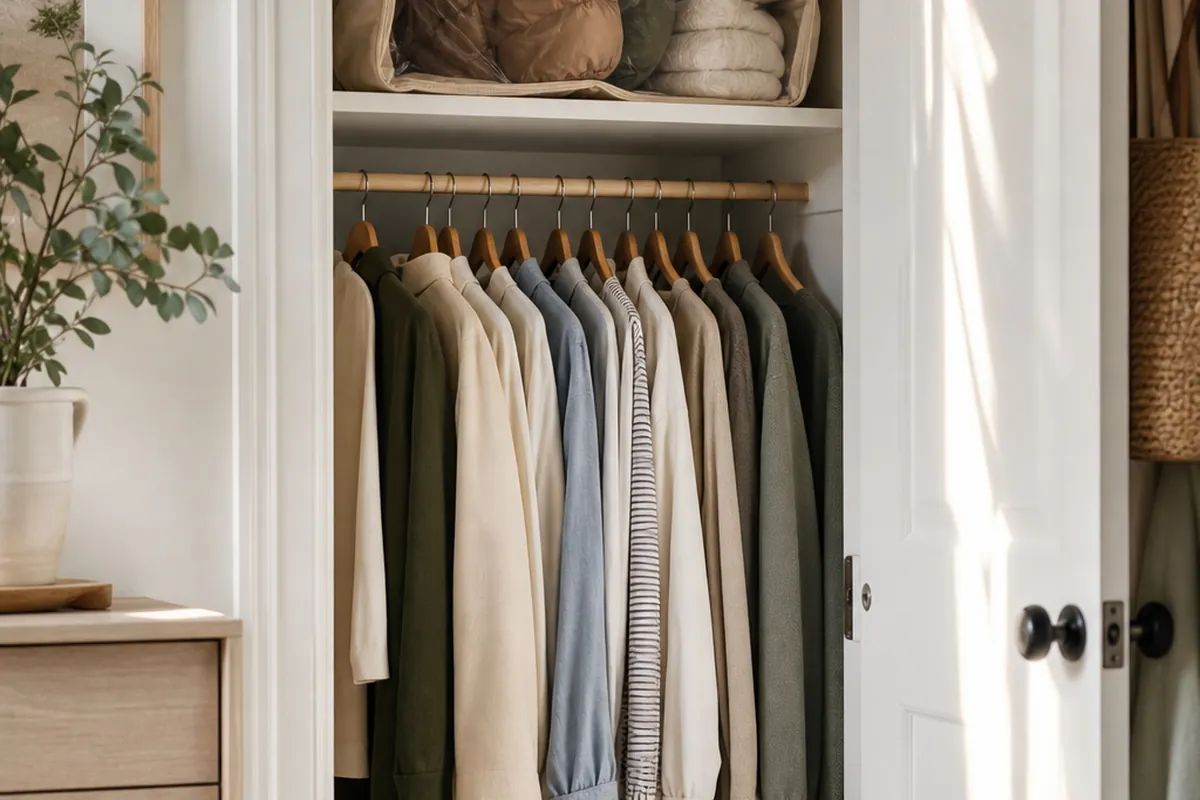
Books, tools, boxed appliances and anything with a hard edge belong at waist height or below. The high shelf takes light and bulky: duvets, off season coats, empty luggage. If you cannot lift a container down with one hand while the other steadies you, it is on the wrong shelf.
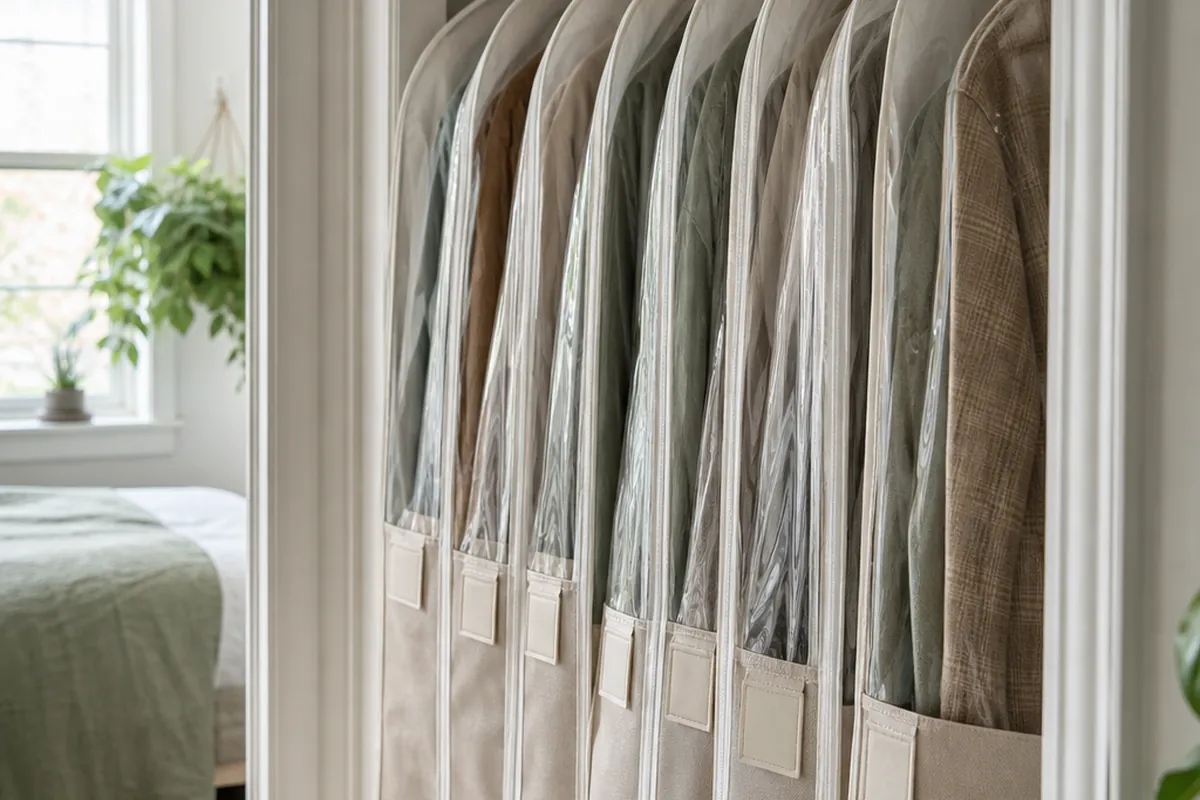
Empty luggage is the best possible top shelf item, because it is bulky, weightless, and can be packed with the off season clothing so the space inside it is not wasted either.
Suitcases are the bulkiest thing most closets hold, and the top shelf is not always the answer. Suitcase storage ideas for a renter with a small closet works through the alternatives.
10. Make the shelf earn its place twice a year
A top shelf is where things go to be forgotten, so it needs a scheduled moment where you look at it deliberately.
Tie it to the seasonal wardrobe swap, which you are already doing if you follow the approach in small closet organization. When the winter clothes come down, everything else on that shelf gets a glance, and anything you did not touch in the last year gets a decision rather than another year of storage.
Two changes a year is enough. The point is not tidying, it is noticing that a third of the shelf is holding something you no longer own a use for.
A shelf that holds what you meant it to
The shelf above the rail is usually the largest unused volume in a small closet, and almost none of that is a storage problem. It is a shape problem: too tall, too deep, too high.
A riser fixes the height, dividers fix the leaning, bins with handles and honest labels fix the reaching, and sorting by frequency rather than category decides what deserves to be up there. Do those four and the shelf holds roughly twice what it did, and you can name everything on it without getting the stool out.
If your closet has no shelf at all to work with, organizing a small closet with no shelves covers the renter friendly ways to add one.