Thirty picture books, one wobbly bookcase, and a floor buried in board books by 7:15 every night. Kids book storage in a small room usually fails for one unglamorous reason: young children browse by cover, not by spine, so a standard shelf becomes a pull-everything-out game instead of a place books live. Fix the browsing problem and most of the tidiness takes care of itself.
What follows are ten ideas that hold up in a room where the bed already eats half the floor. Most are renter-safe, none require building anything, and the first one costs nothing at all.
Start by shrinking the collection
No system survives forty books in a room that can gracefully hold twelve. Before you buy a single bin, sort the whole pile into three groups: current favorites (the ones your kid asks for by name), seasonal or nearly outgrown, and finished.
Eight to fifteen books is the right number to leave in the room. Everything else goes into a lidded bin somewhere else in the apartment, whether that’s a closet shelf, the space under the sofa, or the top of an armoire, and you swap about ten titles every few weeks. Rotation sounds like the kind of habit you abandon by February. In practice it takes four minutes, it makes a book your kid ignored in October feel brand new in January, and it caps how much storage you ever need to buy.
Books that are genuinely done should leave the house. Small rooms punish sentimentality harder than any other space in a home.
Go vertical: wall ideas for kids book storage in a small room
Wall space above the two-foot line is the cheapest real estate in the room, and books are the lightest thing you can hang there. Claim it and you get your floor back.
1. Mount a front-facing sling bookshelf low
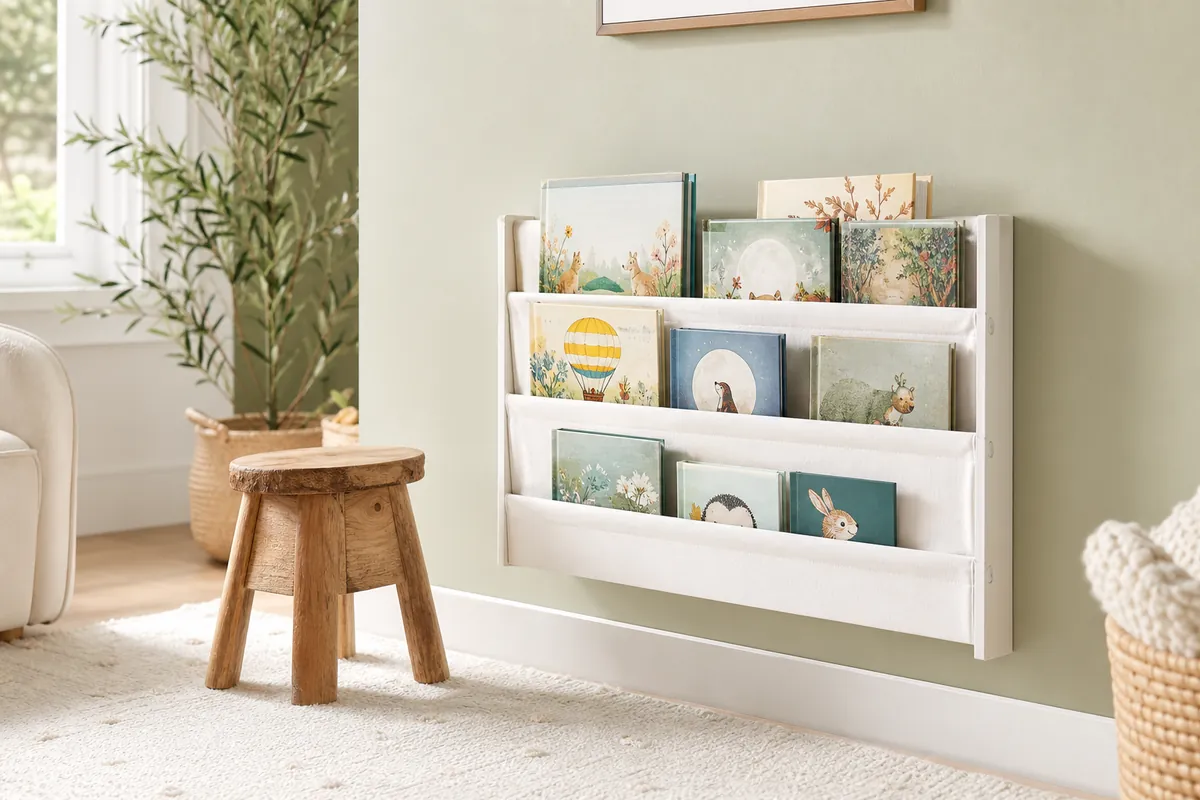
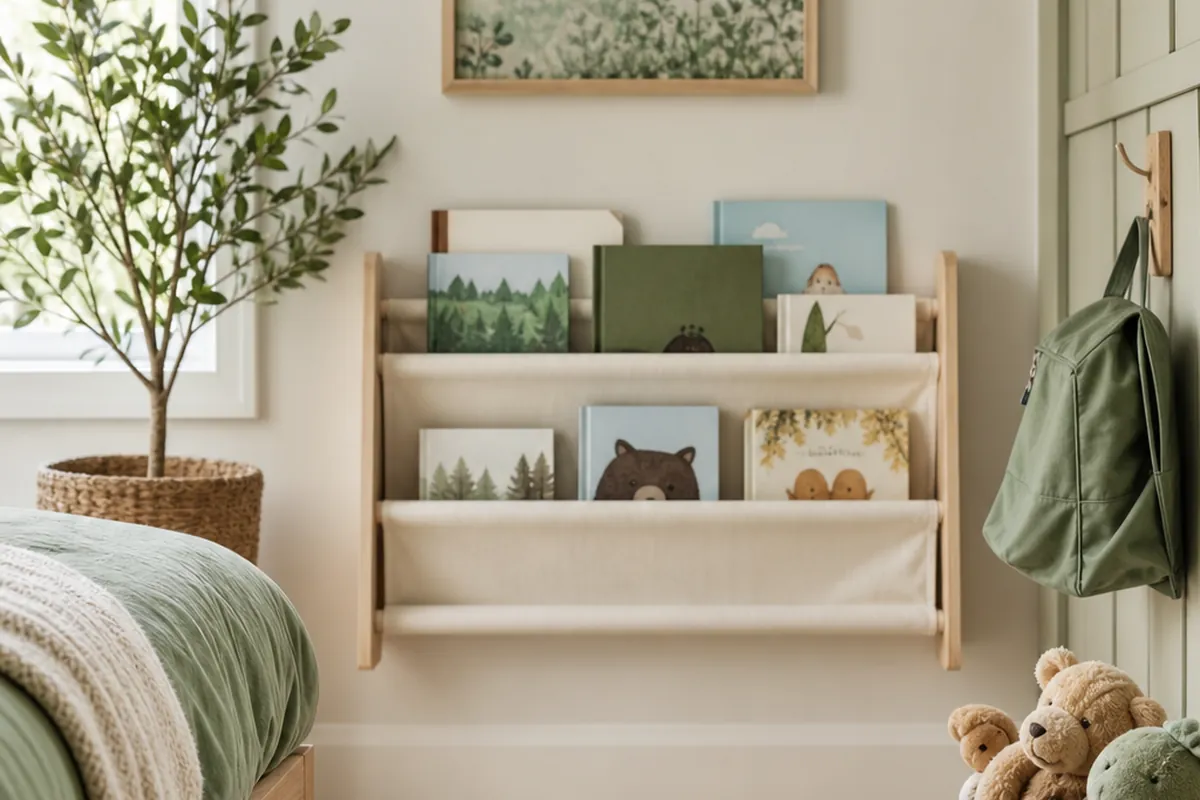
For any child under about six, a front-facing sling bookshelf is the purchase I’d make first. Fabric pockets hold books cover-out at a slight tilt, so a two-year-old can spot what they want and pull it free without dragging six neighbors down with it. Slings also forgive terrible re-shelving, which is the real test of any kids’ system: a book jammed back in sideways still looks fine.
Capacity is the trade-off. Three pockets hold maybe a dozen picture books, and oversized hardcovers will sag the fabric over time. That limit is fine once you’ve committed to rotation and maddening if you’re trying to shelve the entire collection at once.
Hang it lower than feels right. The top pocket should land around your child’s chest height, which for a preschooler often means the bottom rail sits barely above the baseboard. Mount it at adult eye level and you’ve appointed yourself librarian for the next three years. If you’re renting and don’t want a grid of holes, catch one stud and use a single heavy-duty anchor for the second point, then keep only the lightest board books in the top pocket.
2. Run a wall-mounted book ledge above the dresser
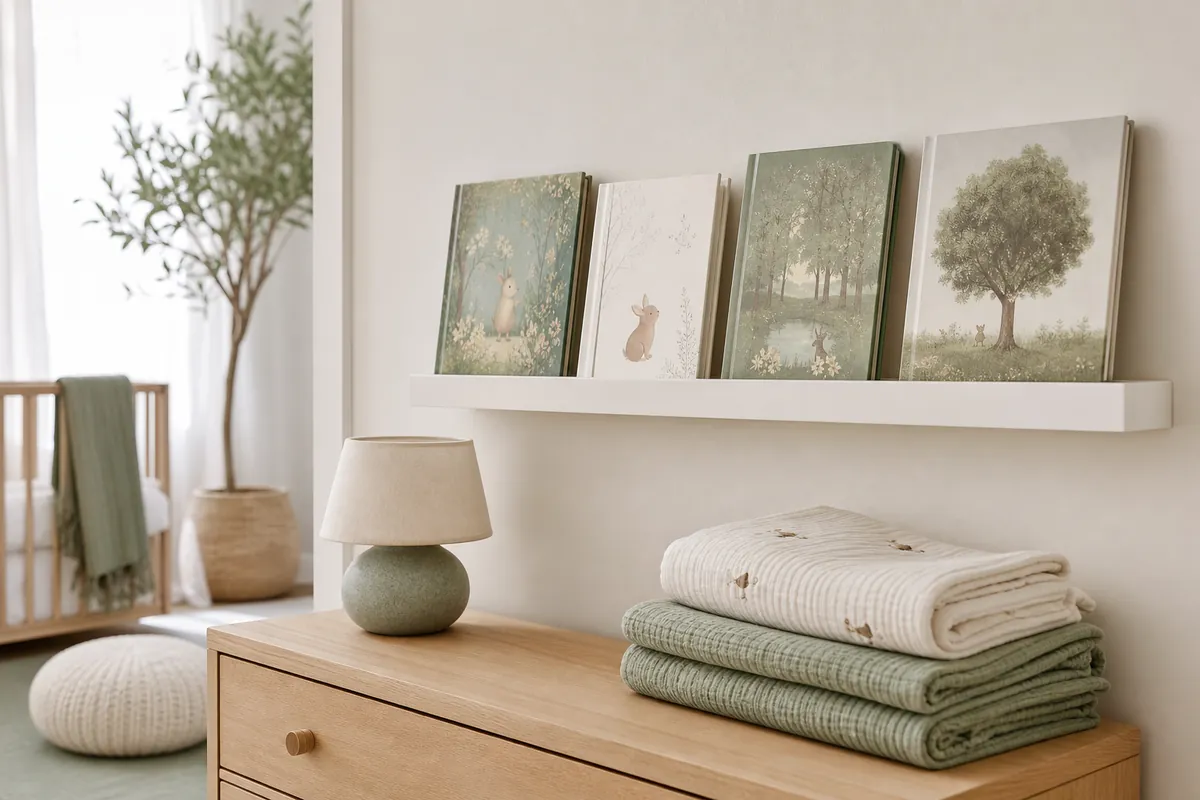
A wall-mounted book ledge is the narrow-profile answer to the dead zone above furniture. Because a ledge projects only a few inches, it can hang over a dresser or a low toy bin without turning that corner into something a kid walks into face-first, and it still shows covers rather than spines.
Two ledges stacked with roughly a hand’s width between them beat one wide shelf, because you can sort by durability instead of by size. Chunky board books go on the lower ledge, where they’ll be manhandled daily. Paper-page favorites and anything with a pop-up flap live above, out of range of a determined toddler.
3. Use the wall beside the bed instead of a nightstand
When the room won’t take a bedside table, hang one slim ledge or a single sling pocket at mattress height next to the pillow. Bedtime books plus a clip-on lamp, and four screws have replaced a piece of furniture. Bunk beds benefit most here: the top sleeper usually has nowhere to set a book down, and a ledge fixed to the wall alongside the mattress is far safer than anything balanced on the guardrail.
Floor-level kids book storage that survives a toddler
Some books need to live where small hands can reach them with no help at all, and that means bins rather than shelves.
4. Treat fabric book storage bins as the library basket
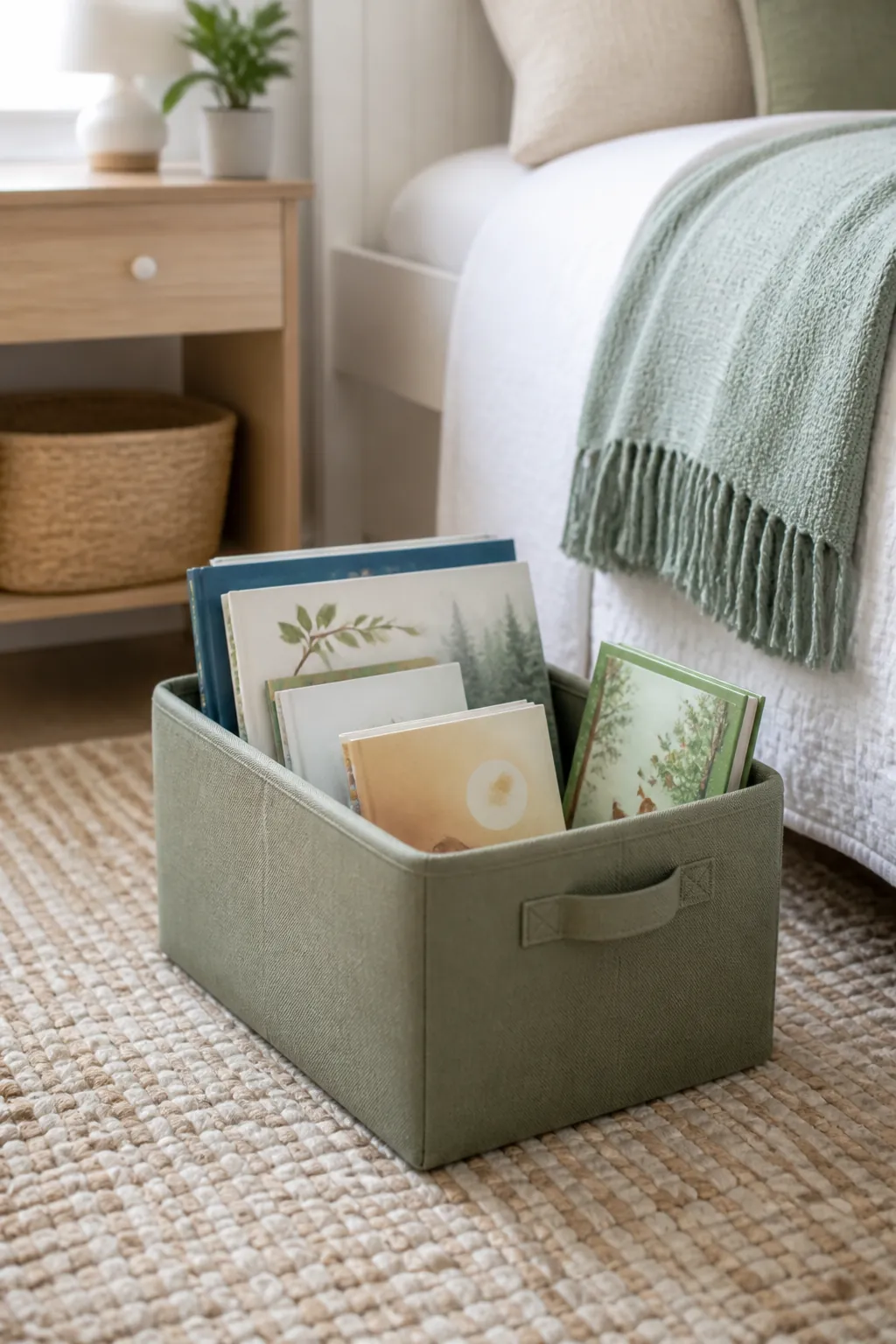
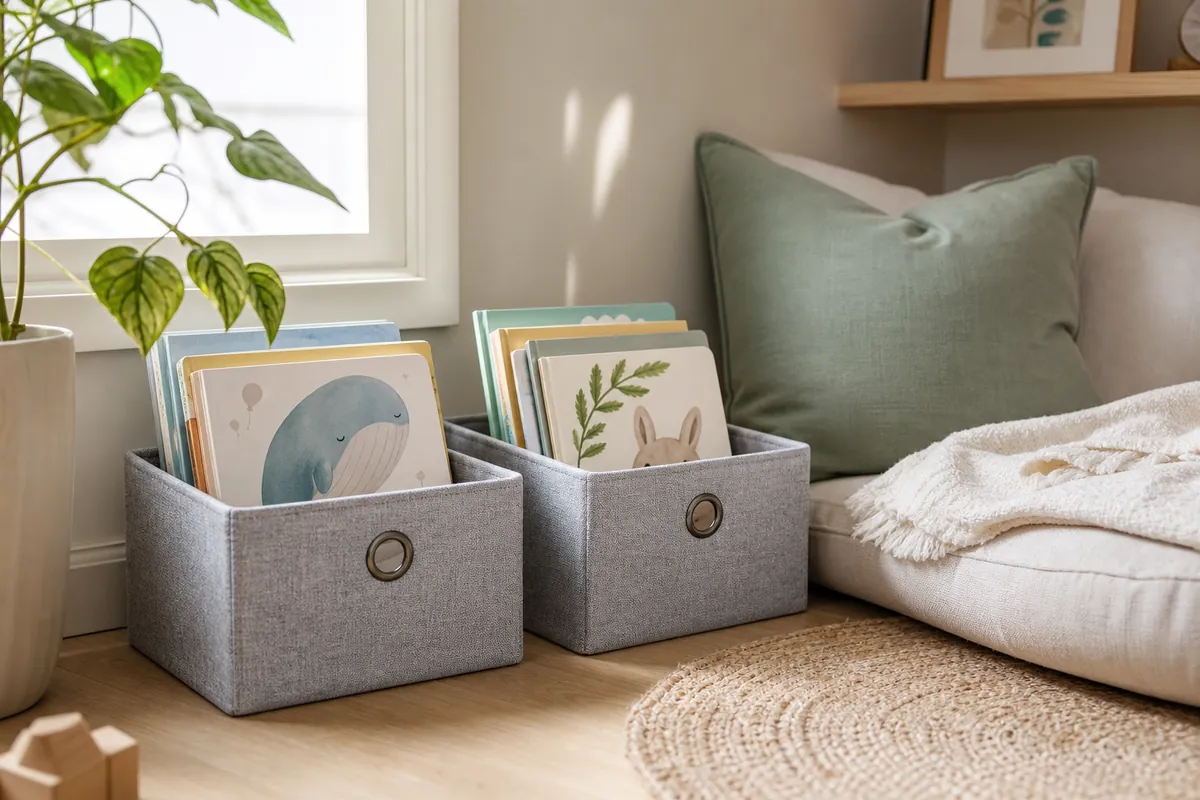
Fabric book storage bins ask the least of a kid: drop the book in spine-down, cover facing up, done in ten seconds. Depth is the detail people get wrong. Choose a bin about as deep as a board book is tall and wider than it is deep, so books stand in a row your kid can flip through instead of compressing into a brick at the bottom. Deep square cubes look neater on a shelf and are close to useless for books.
One bin in the reading corner, one wherever your family actually reads in the evening. Books migrate around an apartment no matter what rules you set, so give them a landing spot in each room instead of fighting the drift. The same logic applies to everything else that wanders; there’s more on that in our guide to toy storage for a small living room.
5. Put the rotation stash under the bed
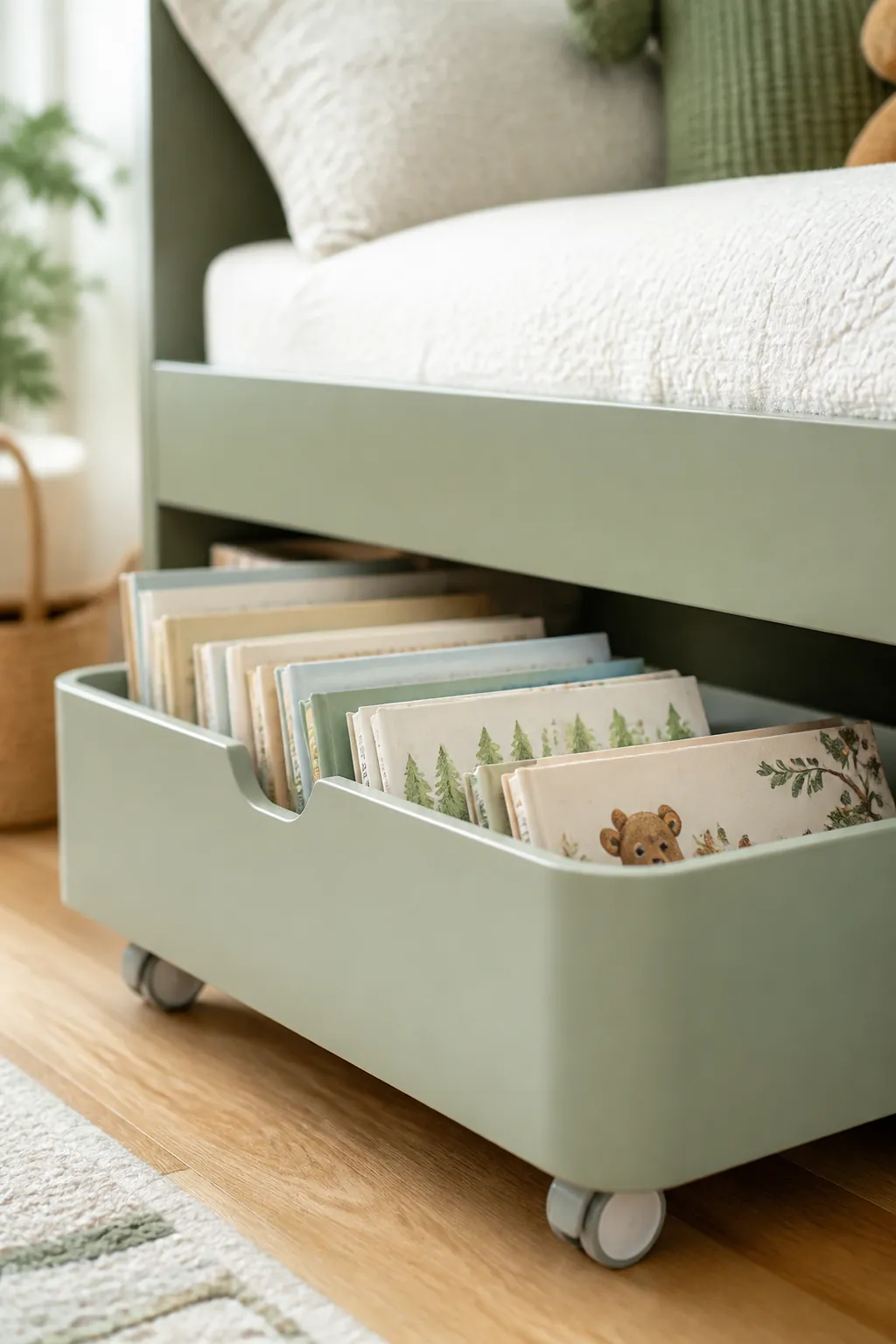
Off-duty books belong under the bed. A low rolling bin or a zippered fabric case slides out on swap day and disappears the rest of the month. Keep it strictly for rotation stock, because the moment it becomes general overflow it turns into the place books go to die.
Measure the clearance under the frame and subtract half an inch before you order anything. Check the casters against your rug edge too; a wheel that catches on the binding turns a four-minute swap into a two-person wrestling match.
6. Add a shallow crate as a reading nook anchor
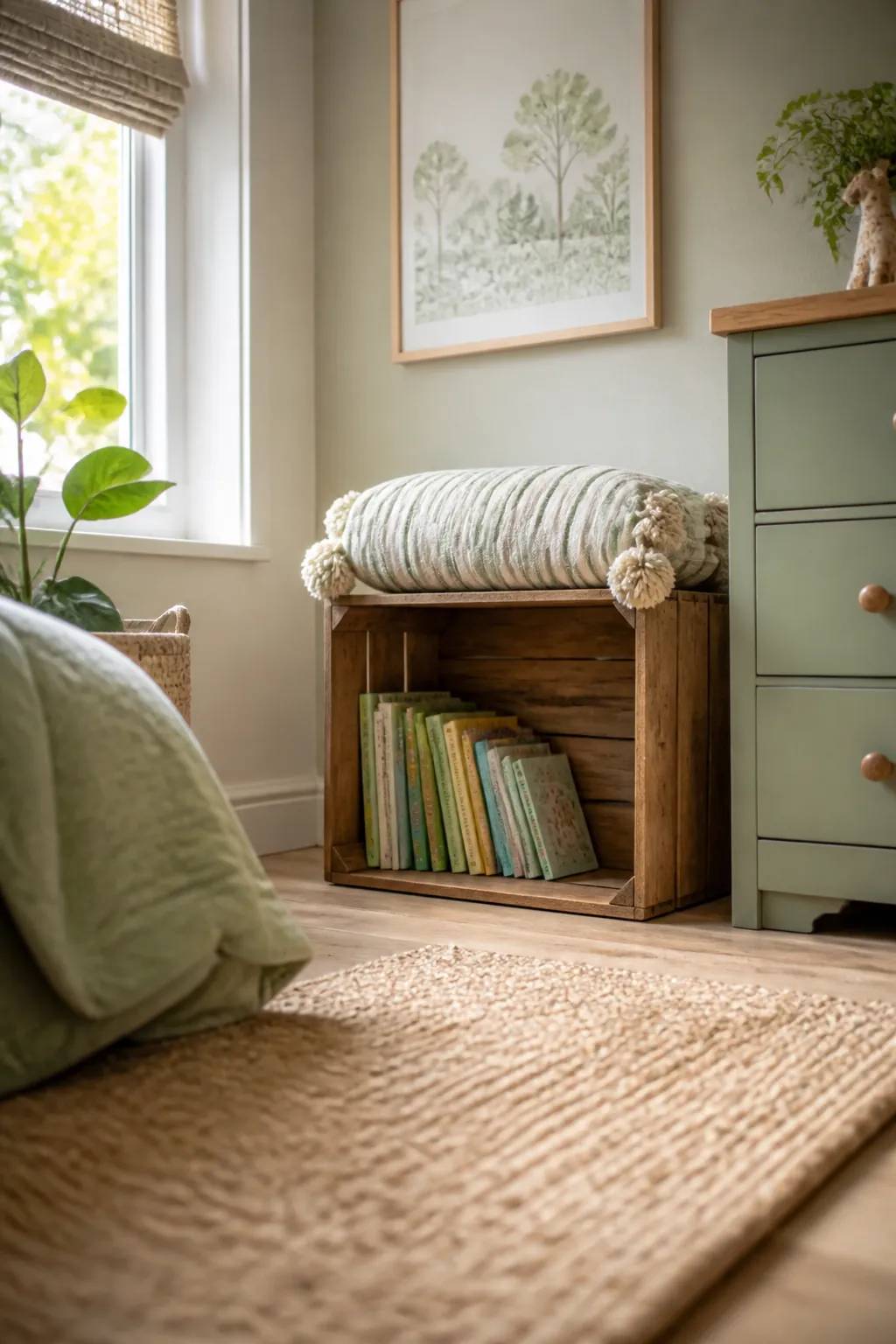
A sturdy crate, or an open storage cube tipped onto its side, gives you a book bin, a seat, and a visual boundary for the reading corner in one object. Load it front-facing so covers show. Defining that corner matters more than it sounds: kids return books to a specific, obvious spot far more reliably than to a general shelf somewhere over there.
Steal kids book storage space from furniture you already own
7. Convert the closet floor
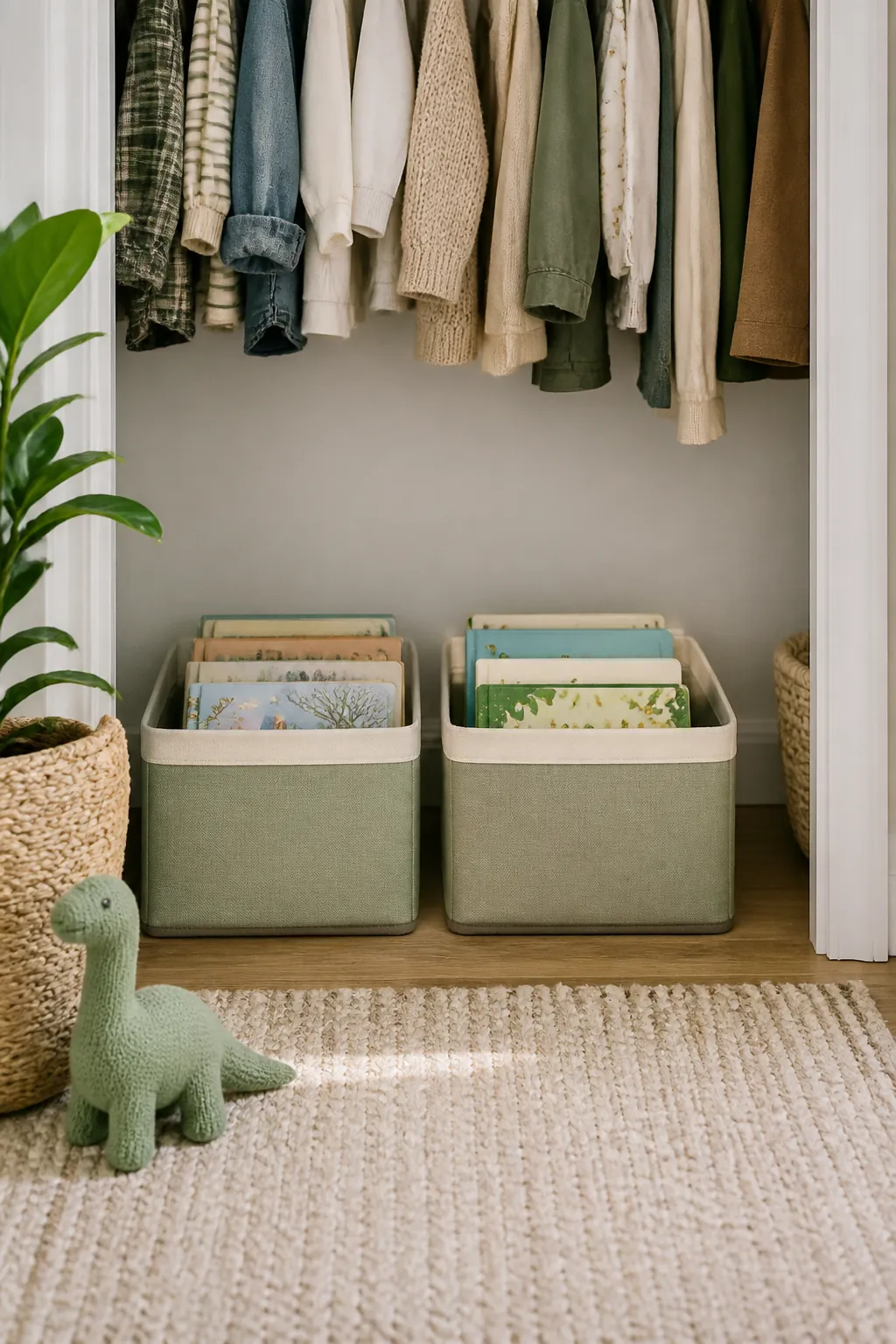
The bottom of a kid’s closet is usually a graveyard of odd shoes and mystery gift bags. Clear the floor strip, line up two fabric book storage bins facing outward, and you’ve added a small library without spending an inch of the room’s footprint. Leave the door open at bedtime and it reads as a browsing station rather than a closet.
8. Use the windowsill, with one rule
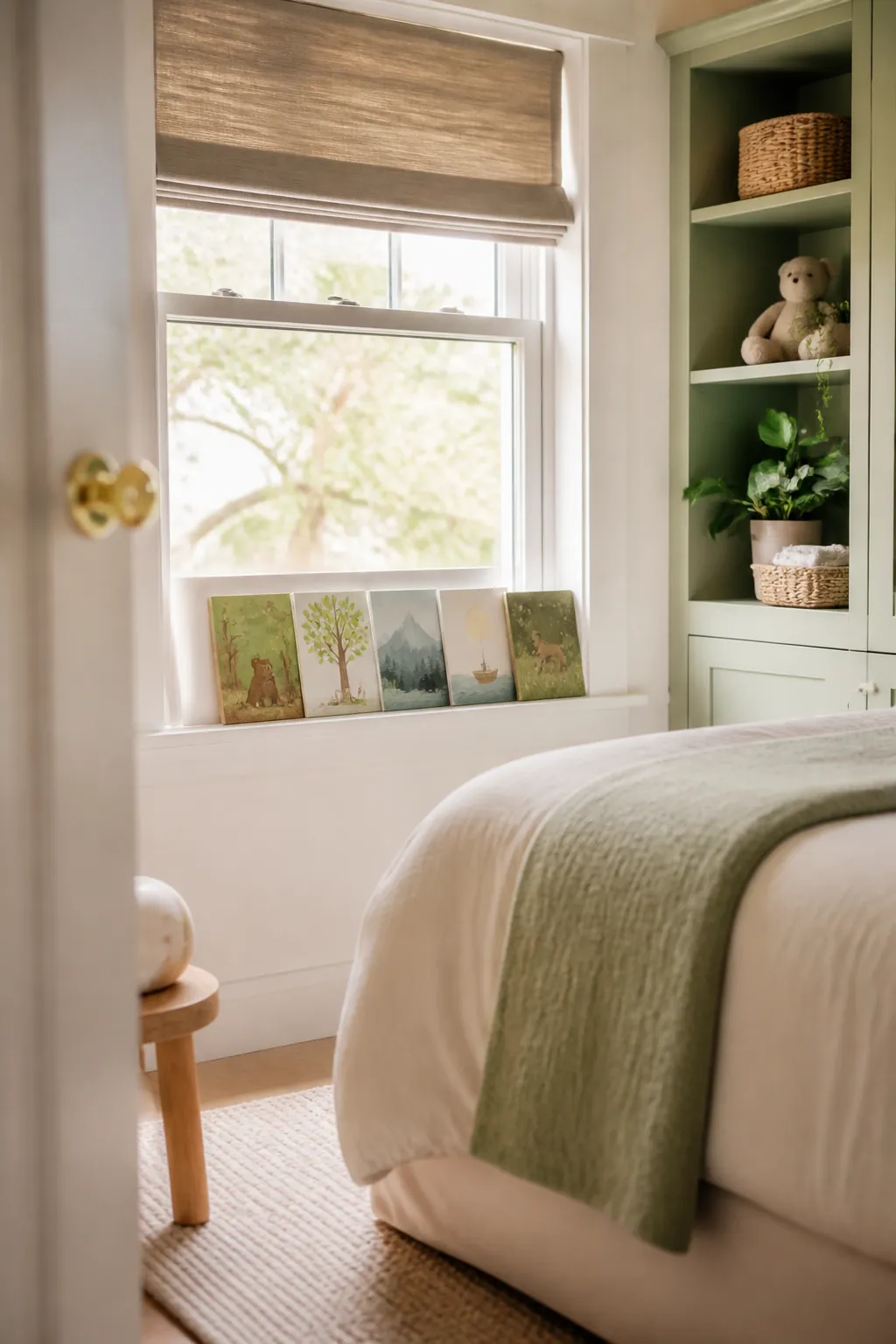
A deep sill holds a short cover-out row beautifully. Here’s the rule: nothing taller than the lower sash, and nothing you’d be sad to see fade. Direct sun bleaches covers within a season, so this spot is for sturdy board books, never the hardcover with grandma’s inscription inside.
9. Hang a pocket organizer inside the closet door
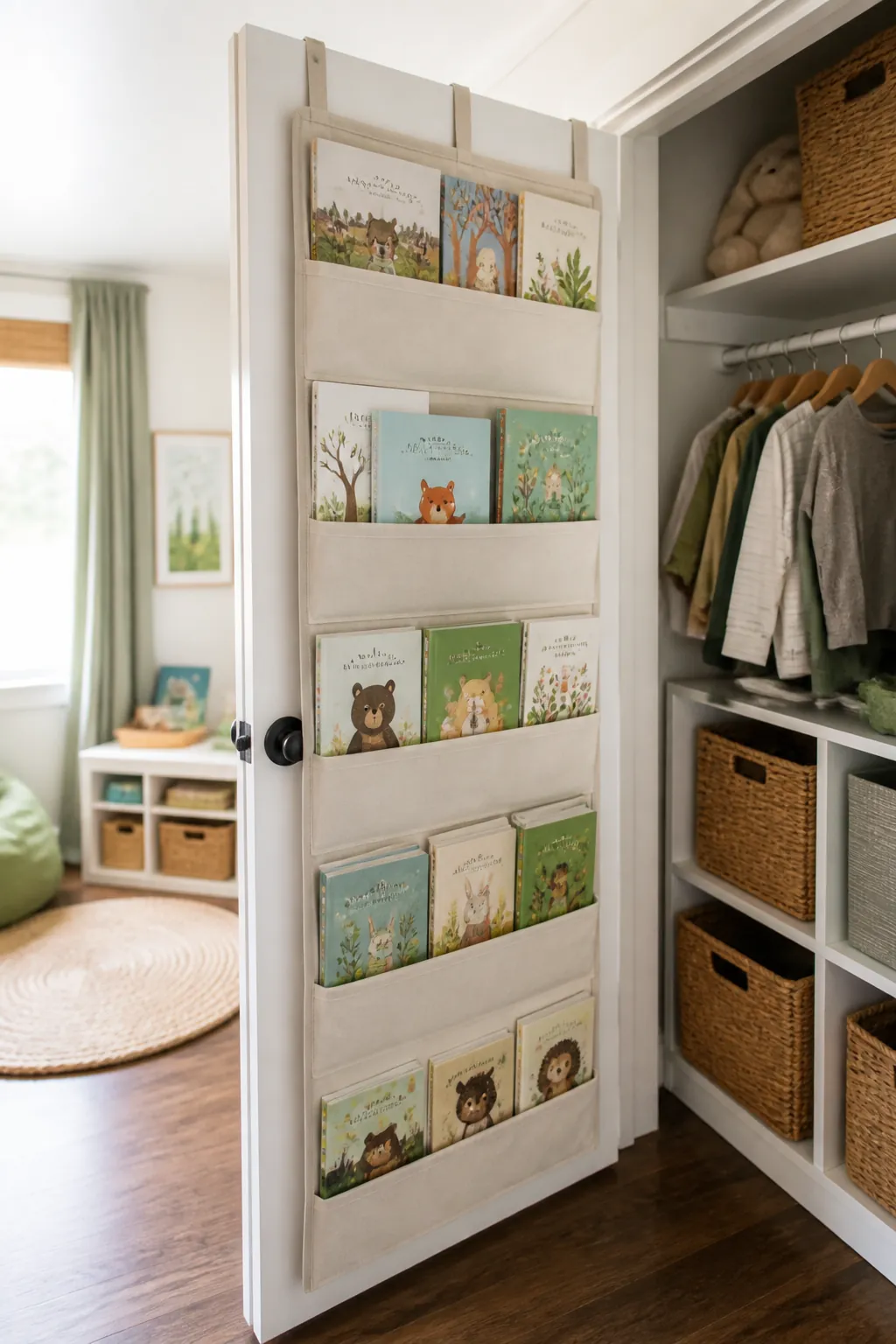
A hanging fabric pocket organizer on the inside face of a closet door holds a startling number of thin paperbacks and early readers, cover-out, at kid height. For a narrow room where every wall is blocked by furniture, this is the best move available, and it leaves nothing behind at move-out. Thick board books won’t wedge into the pockets, so it suits the five-and-up crowd better than toddlers.
10. Give each kid a bedtime basket in a shared room
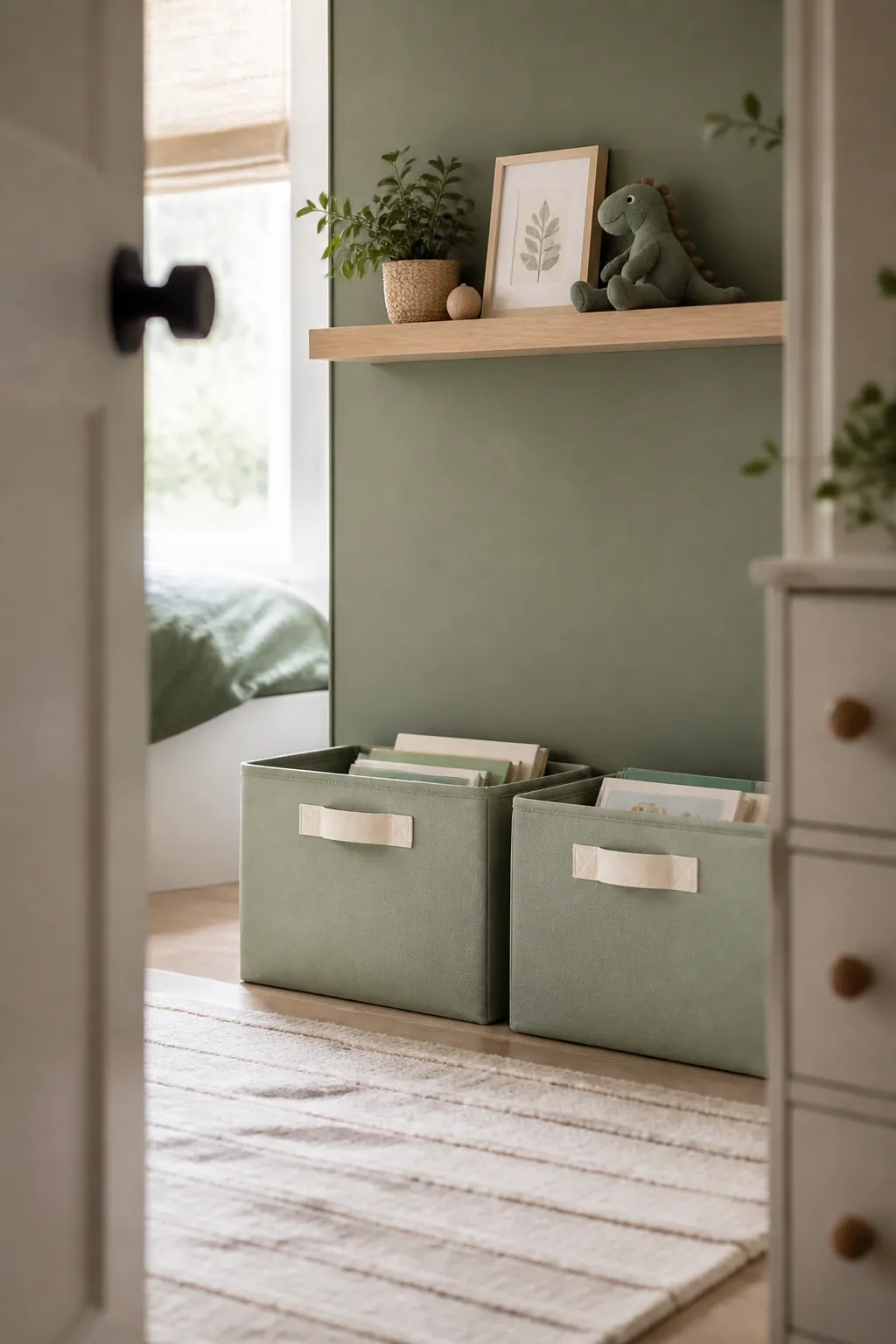
Communal book storage causes more arguments than it settles. Two small labeled bins, one per child, plus a single shared front-facing shelf for the books both of them love, is the arrangement that actually holds. Our shared kids room organization playbook goes deeper on dividing storage without dividing the room down the middle.
Three rules that keep it tidy past week one
Covers out, always. Spine-out shelving only works for people who can read spines. Every book you genuinely want your child to pick up should be visible face-on.
Two or three book homes, not six. A sling on the wall, a bin on the floor, the rotation box under the bed. Scatter storage across half a dozen spots and cleanup stops having an obvious answer.
Height decides who tidies. Anything above your child’s reach is your job forever. Whatever sits at or below shoulder height can truly become theirs, especially bins that require no aim. Setting up for a baby who can’t participate yet? The principle inverts, and our budget nursery organization bins roundup covers shapes that suit that stage.
A 30-minute setup plan
Pull every book in the room into one pile on the bed. Sort into keep-now, rotate-later, and donate, then be ruthless with that third pile. Hang a front-facing sling bookshelf low on the emptiest wall and load it with six or seven current favorites, covers facing forward.
Next, fix a wall-mounted book ledge above the dresser for the titles you’d rather not see chewed. Set one shallow fabric bin within arm’s reach of wherever your kid actually sits to read, which is usually the floor beside the bed rather than the cute chair you bought for the purpose. Whatever’s left goes into the under-bed rotation box.
Judge the result at week three, not tonight. If the floor is still mostly clear by then, it’s because your kid can see the covers and can put books back without aiming. Nail those two things and small-room book storage stops being a nightly negotiation.