A tiny kitchen usually has three or four drawers doing the work of eight, which means every drawer is a compromise between what fits and what you actually reach for. The result is the familiar one: a cutlery tray floating in a drawer two sizes too big for it, with a drift of peelers and bag clips filling the gap around the edges.
Kitchen drawer organization in a small kitchen is less about buying trays and more about deciding what each drawer is for. Eleven ideas below, starting with the decisions and ending with the products.
1. Zone drawers by where you stand, not by category
The most common mistake is sorting by what things are. Sort by where you use them instead.
Cooking tools belong in the drawer nearest the hob, because that is where your hand is when you need a spatula. Prep tools go near the chopping area. Cutlery goes near the dishwasher or the draining board, so unloading is one movement rather than a walk. In a kitchen with four drawers, that assignment does more than any organizer you can buy.
Stand in the kitchen and notice where you actually work before you commit. Most people have one prep spot they use for almost everything, and the drawers around it should hold almost everything.
2. Fit the tray to the drawer, not the other way round
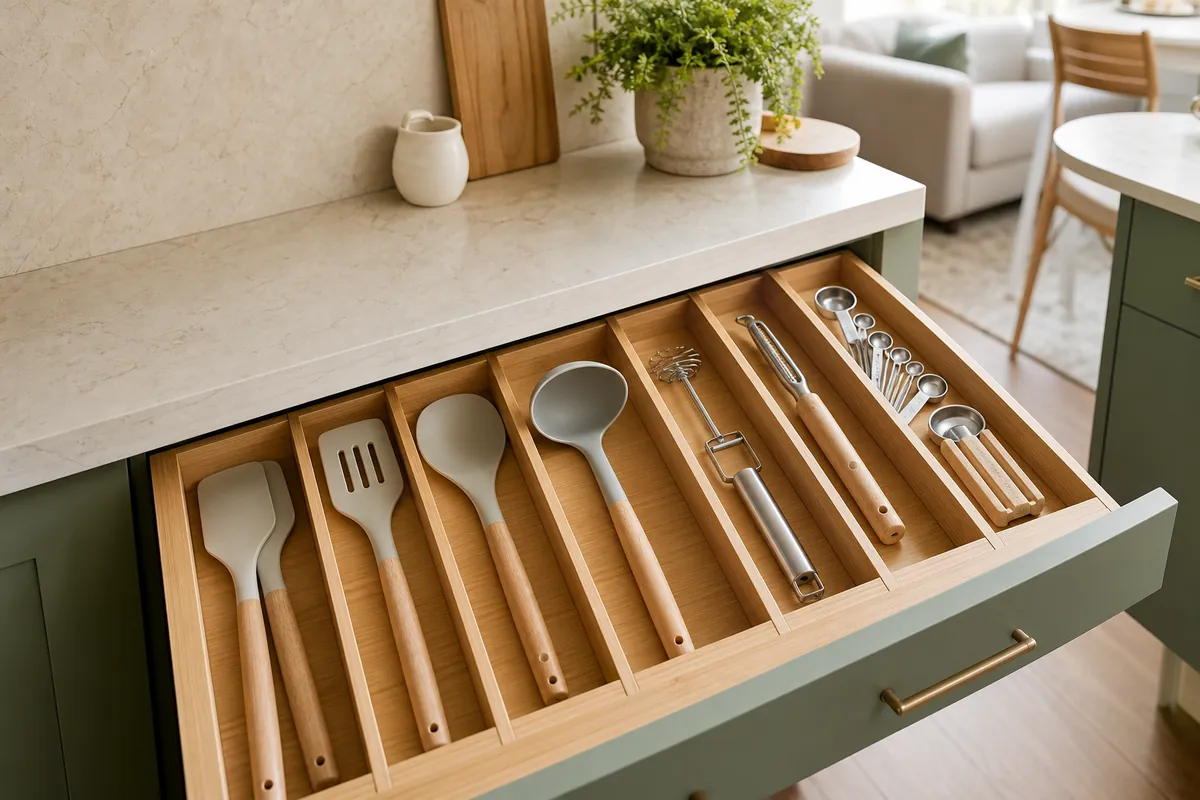
Kitchen drawers come in sizes no organizer manufacturer respects, and a tray that leaves a four-inch gap creates a junk lane along one edge within two weeks.
An expandable bamboo drawer organizer solves this properly because it grows to the drawer rather than sitting inside it. That edge-to-edge fit is the whole point: no gap means no drift, and no drift means the layout you set is the layout you get in six months.
Measure the interior width at the back of the drawer, not at the front. Some drawers taper slightly, and the back is the number that decides whether a tray slides in.
3. Give cutlery its own dedicated tray
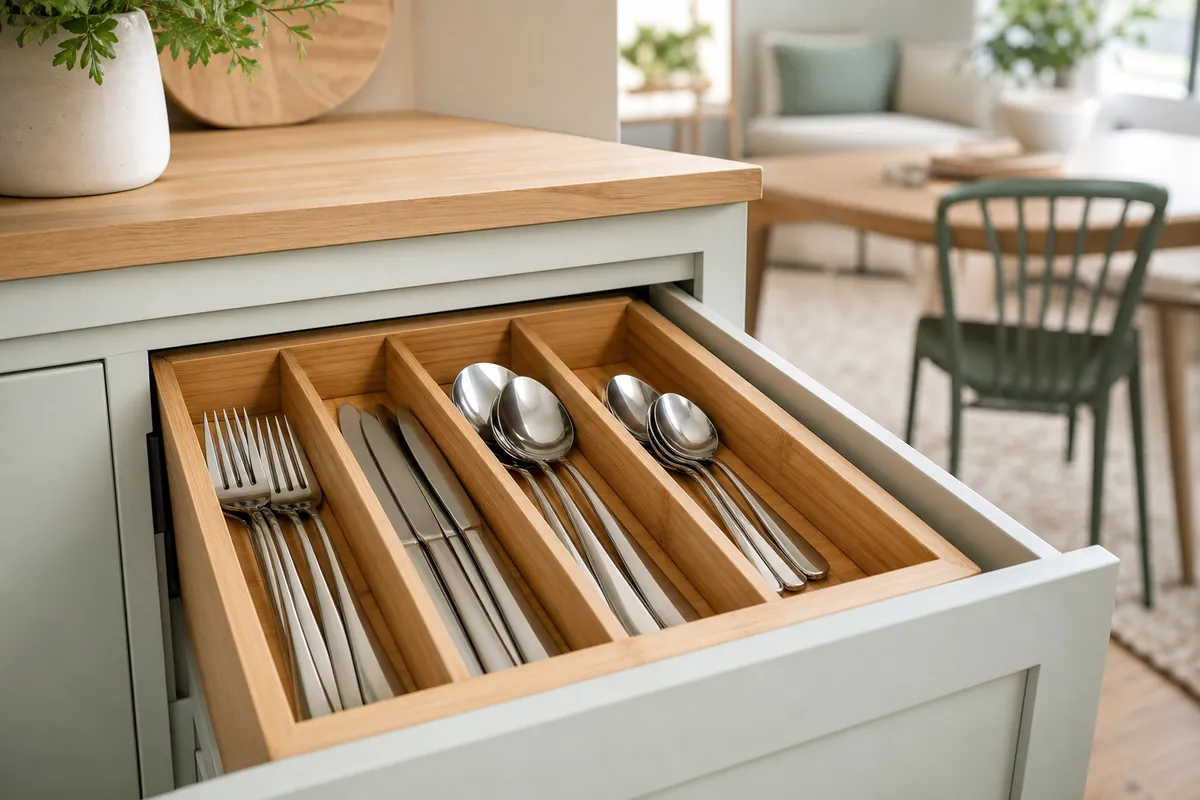
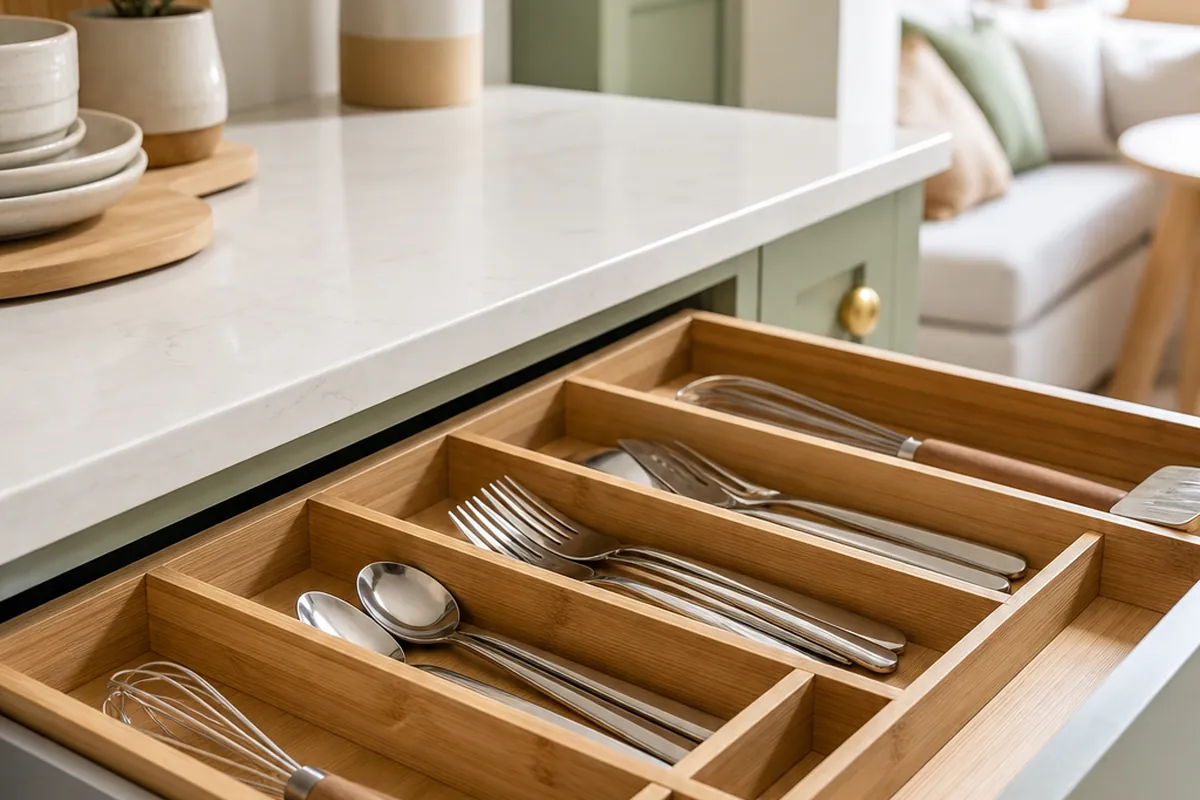
Cutlery is the one category that genuinely earns a purpose-made tray, because forks and spoons nest badly with anything else and there is a lot of them.
A bamboo cutlery tray keeps the four main types separated in lanes deep enough that a handful of forks does not spill sideways. In a tiny kitchen, put this drawer closest to the dishwasher and the arrangement pays for itself every single day.
Resist the urge to squeeze serving spoons and tongs into the cutlery tray. They are longer than the lanes, they sit proud, and they stop the drawer closing smoothly.
4. Use full-depth dividers for everything else
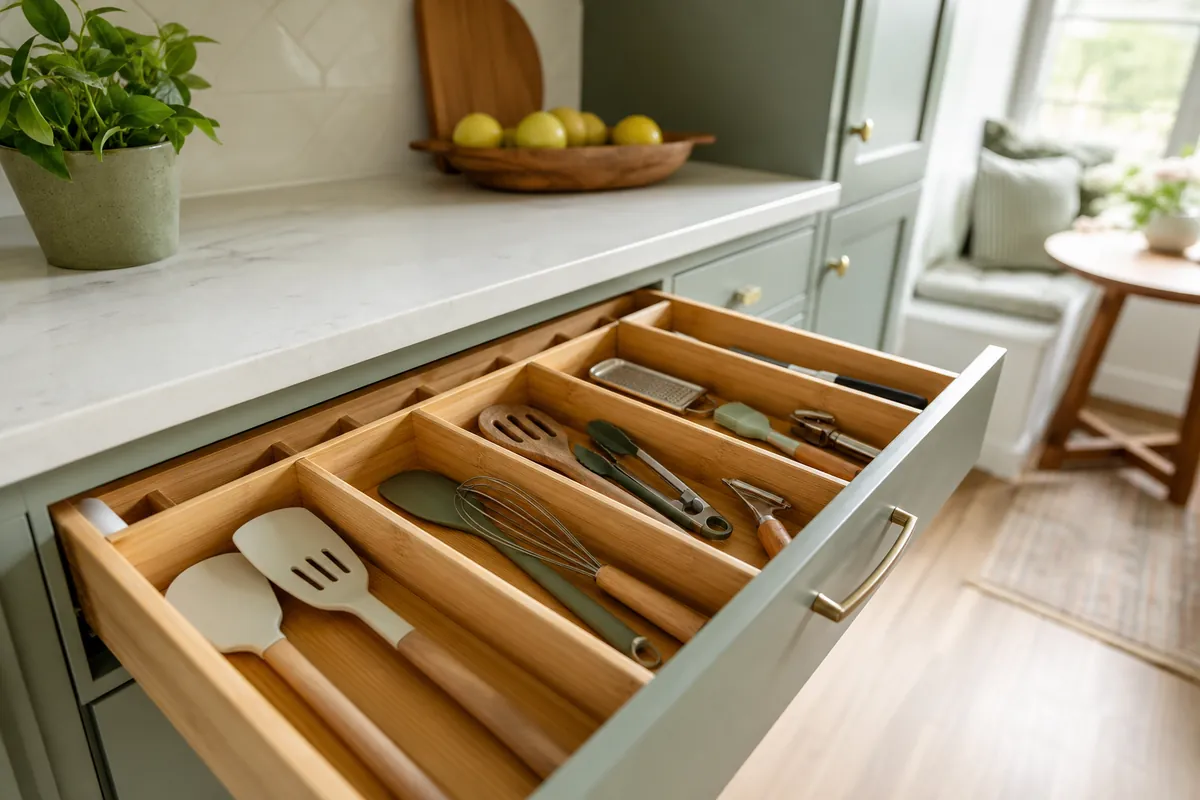
For the drawers that are not cutlery, dividers beat compartment trays, because the contents vary in size far more than cutlery does.
Bamboo drawer dividers with labels let you set lane widths to match what you own: a wide lane for spatulas and ladles, a narrow one for peelers and openers, a square for measuring spoons. Full depth is the important part. Anything shorter than the drawer lets items slip behind it, which is where the mystery gadgets accumulate.
Labels feel excessive for your own kitchen until someone else unloads the dishwasher. Then they are the reason things go back in the right lane.
5. Treat a deep drawer as two levels
Deep drawers are the most wasted space in a small kitchen. People fill them to the brim and then can only use the top layer.
Stand the tall things upright at one end, and put a shallow tray over the remaining area for flat, frequently-used items. You get a proper top level you can see into and a lower level for things like storage container lids that do not need to be visible. It is the same instinct that makes kitchen cabinet organization work, applied sideways.
6. Store knives so they are not loose
Loose knives in a drawer are the one genuine safety problem in this list, and they dull faster too, because blades knock against other metal every time the drawer moves.
An in-drawer knife tray or a slotted block holds each blade separately and lets you pick one up by the handle without looking. If drawer space is too tight, a magnetic wall strip frees the drawer entirely and takes no counter.
7. Keep one drawer deliberately half empty
In a tiny kitchen this feels like heresy, and it is the thing that stops the whole system silently failing.
A drawer with a little slack absorbs the temporary: the gadget you are borrowing, the thing you have not decided about, the packet of skewers from a barbecue. Without slack, those items land in whichever drawer opens, and that is how a zoned kitchen unzones itself.
Slack is also what stops one drawer becoming the junk drawer. If yours already has, these junk drawer organization ideas walk through emptying it, dividing it and keeping it that way.
8. Get the rarely-used gadgets out of the drawers entirely
Most kitchen drawers are storing a handful of things used weekly and a long tail used twice a year.
The melon baller, the second garlic press, the novelty avocado tool: none of these earn drawer space in a kitchen with four drawers. Move them to a high cabinet or a labeled box, or be honest and let them go. The rule that works is simple. If you cannot remember the last time you used it, it does not live at hand height.
The bag stuffed with other bags belongs on that list too, and reusable bag storage ideas for a small kitchen covers where it goes once it leaves the drawer.
9. Put a liner down before you fill the drawer
A thin non-slip liner does two useful things: it stops trays sliding when the drawer opens, and it catches the crumbs and grit that otherwise work their way under everything.
Cut it slightly small rather than trimming it to the exact edge. A liner that curls up the sides traps dirt in the fold, which is worse than no liner at all.
10. Group by the task, not the material
Once the big zones are set, group inside the drawer by what you do rather than what things are made of.
Baking together: measuring spoons, scraper, palette knife. Drinks together: bottle opener, corkscrew, stirrer. This means one drawer opening gets you the whole set for a task, rather than three openings for three items. It is a small thing that you notice every day.
11. Fix the drawer that sticks
A drawer that catches or has to be lifted to close is a drawer people stop using properly, and its contents migrate elsewhere.
Most sticking drawers need cleaning rather than replacing. Empty it, wipe the runners, and check nothing is jammed at the back. If the runners are worn, replacements are cheap and fitting them is fifteen minutes. It is a dull job that quietly rescues a quarter of your kitchen storage.
Kitchen drawer organization that holds
Decide first, then buy. Zone the drawers by where you stand, edit out the twice-a-year gadgets, and only then fit trays. An expandable bamboo drawer organizer handles the odd-sized drawer, a bamboo cutlery tray earns its keep beside the dishwasher, and bamboo drawer dividers with labels give everything else a lane it returns to.
Leave one drawer with a little slack, and re-sort only when something stops fitting. If the counters are the real problem rather than the drawers, kitchen counter organization tackles that side directly.