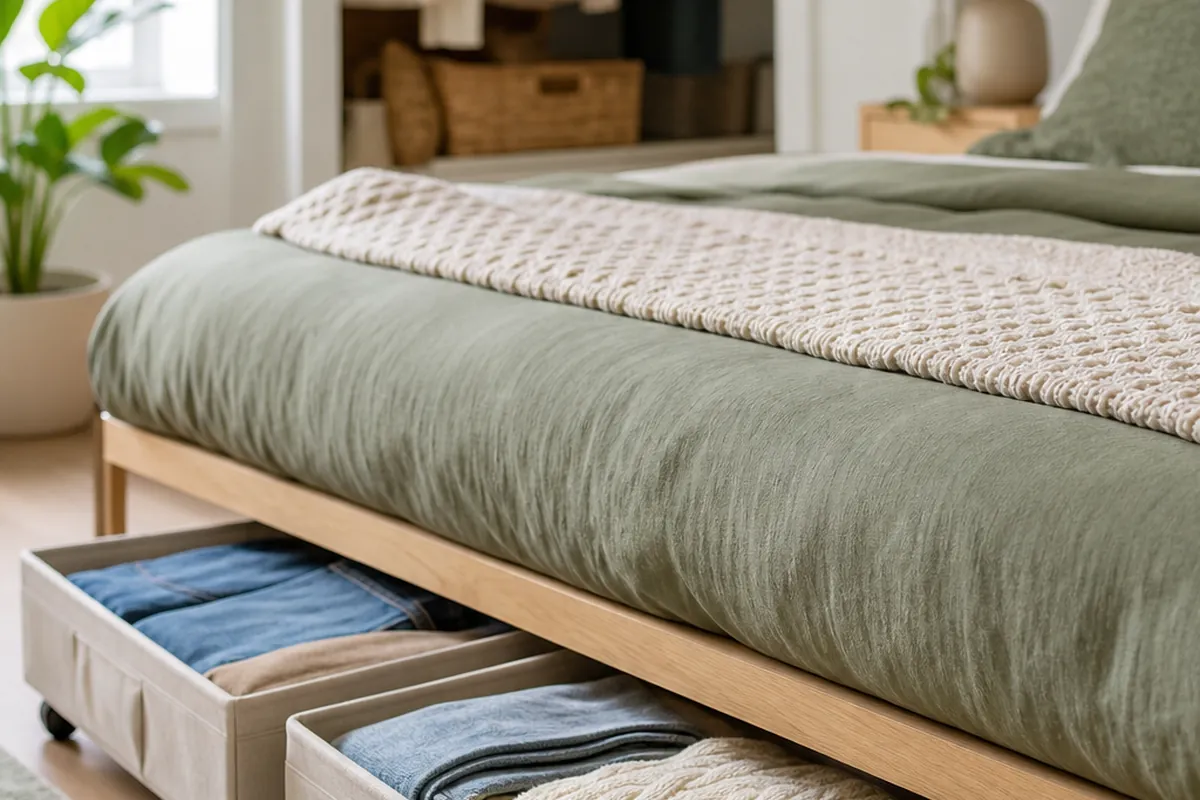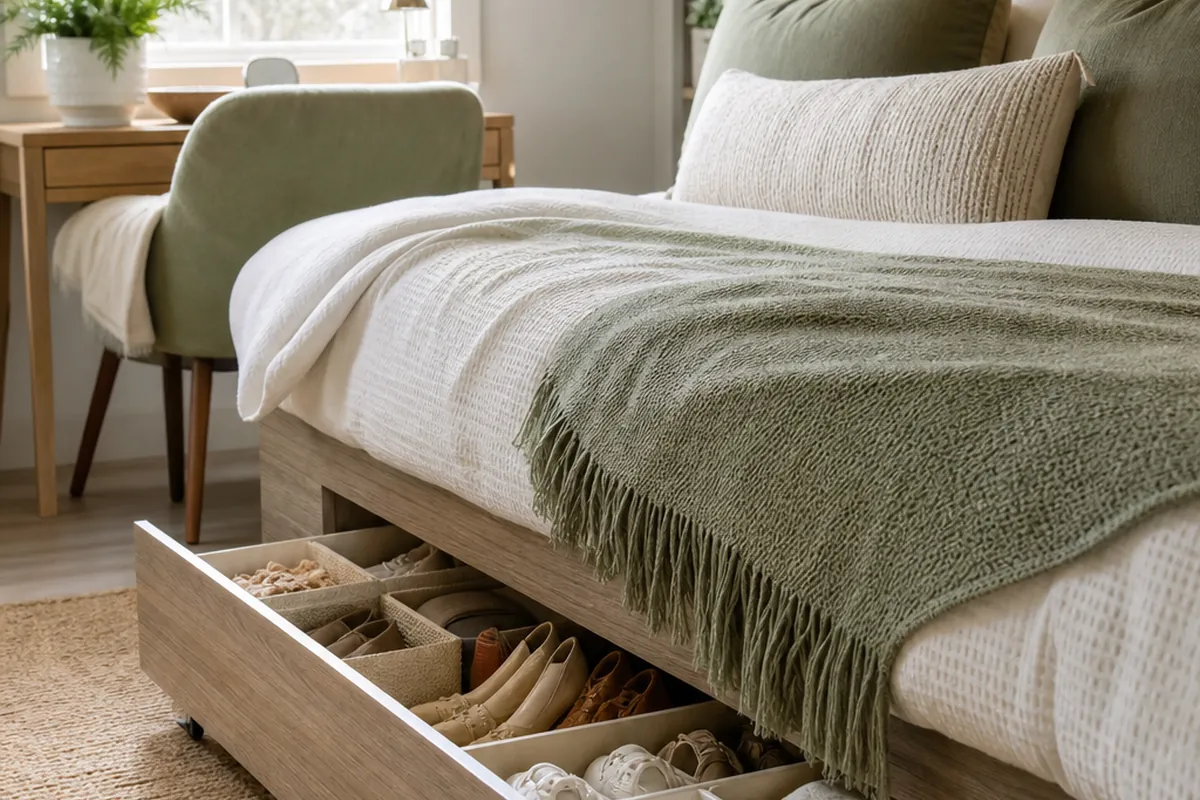
The space under a bed is the largest piece of unused storage most people own, and it is usually holding one suitcase, a shoebox of cables, and an impressive amount of dust. In a small bedroom that is a serious waste, because the square footage under there is roughly the size of the bed itself.
The catch is that under-bed storage goes wrong in a specific way. Things go under, and then they never come out, because retrieving anything means kneeling on the floor and hauling. Eleven ideas below, built around the rule that makes the difference: if it does not slide out easily, it does not belong under there.
1. Measure the clearance before you buy anything
This is the step everyone skips and then regrets, because under-bed containers are sized in a range that has almost nothing to do with your bed.
Measure from the floor to the lowest point of the frame, not the mattress. Side rails, center supports, and slat frames often hang lower than the outer edge, and that lowest point is what your container has to clear. Then subtract about an inch of working room, because a container that technically fits will still catch on the carpet every time.
Most low modern frames give five to seven inches. That rules out the deep bins people instinctively reach for and points you at slim, wide containers instead.
2. Choose wheels over friction
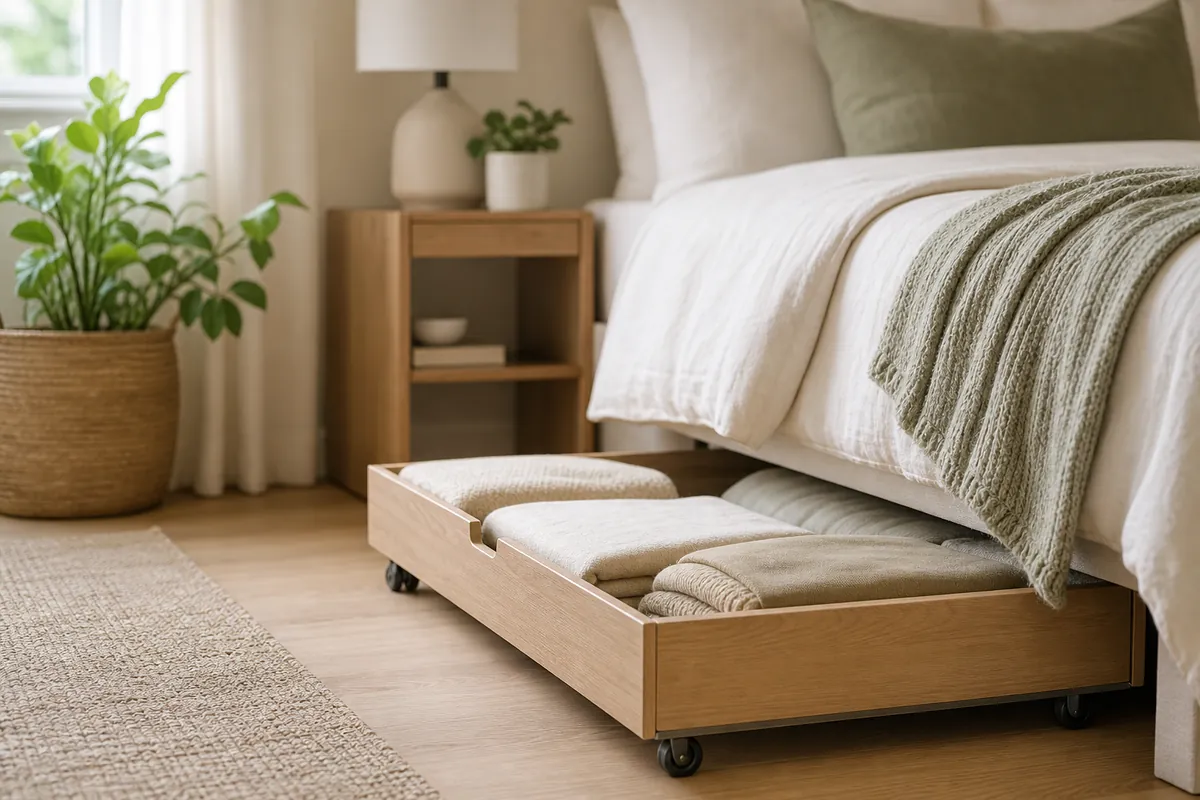
The difference between under-bed storage that gets used and under-bed storage that becomes an archive is whether you can pull it out with one hand while standing up.
Rolling under-bed storage with wheels glides out on carpet or wood without you getting on the floor. On a hard floor a wheeled container is transformative, and on carpet it is the only thing that reliably works, since a flat plastic base and a shag rug are natural enemies.
Look for wheels that swivel rather than fixed castors if you have to angle the container around a bed leg. And pull from the long side, not the corner, or you will wedge it every time.
3. Give the slow stuff a home in lidded containers
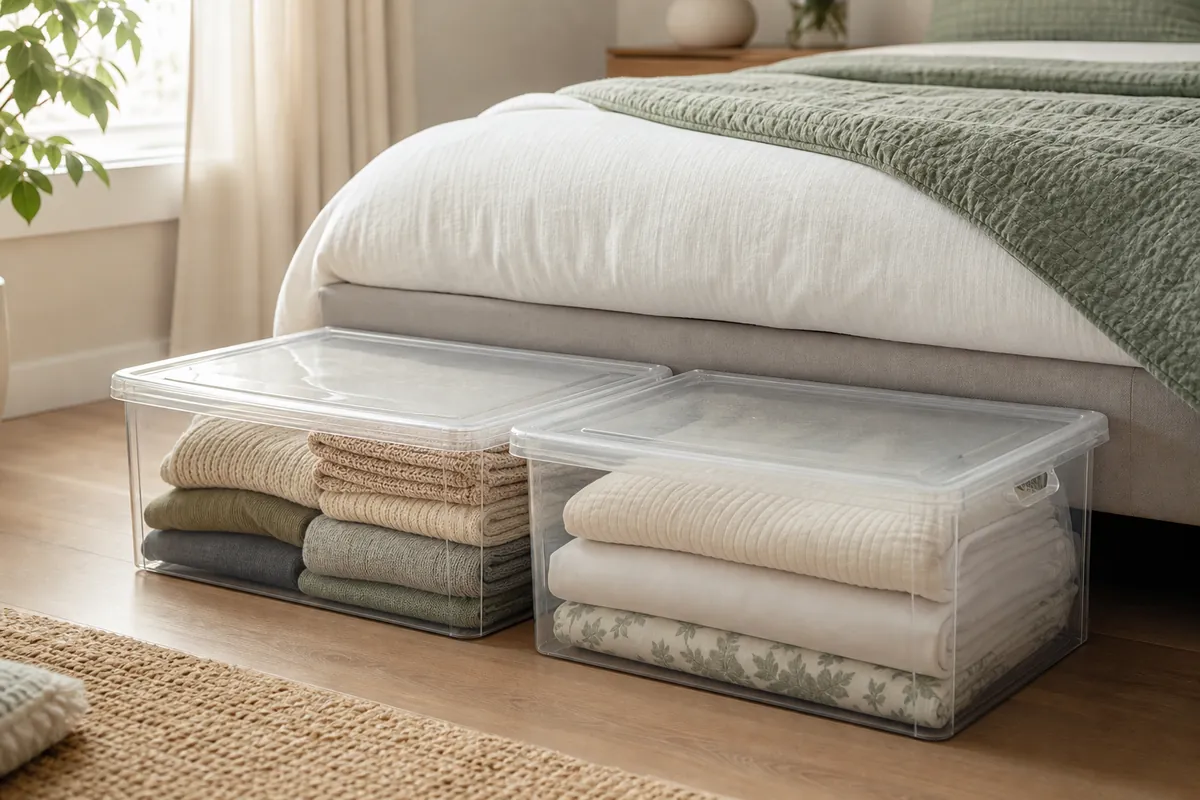
Under-bed space is slow storage. It is where things live that you need a few times a year, and treating it as anything else is what turns it into a mess.
Under-bed storage containers with proper lids keep off-season clothes, spare bedding, and holiday decorations clean and stacked. Lids are not optional down there. An open bin collects dust at a rate that will surprise you, and everything inside needs washing before use.
Clear or windowed containers save you dragging out three boxes to find one jumper. If yours are opaque, a label on the short end you actually see when you look under the bed is worth two minutes.
4. Compress the bulky things with vacuum bags
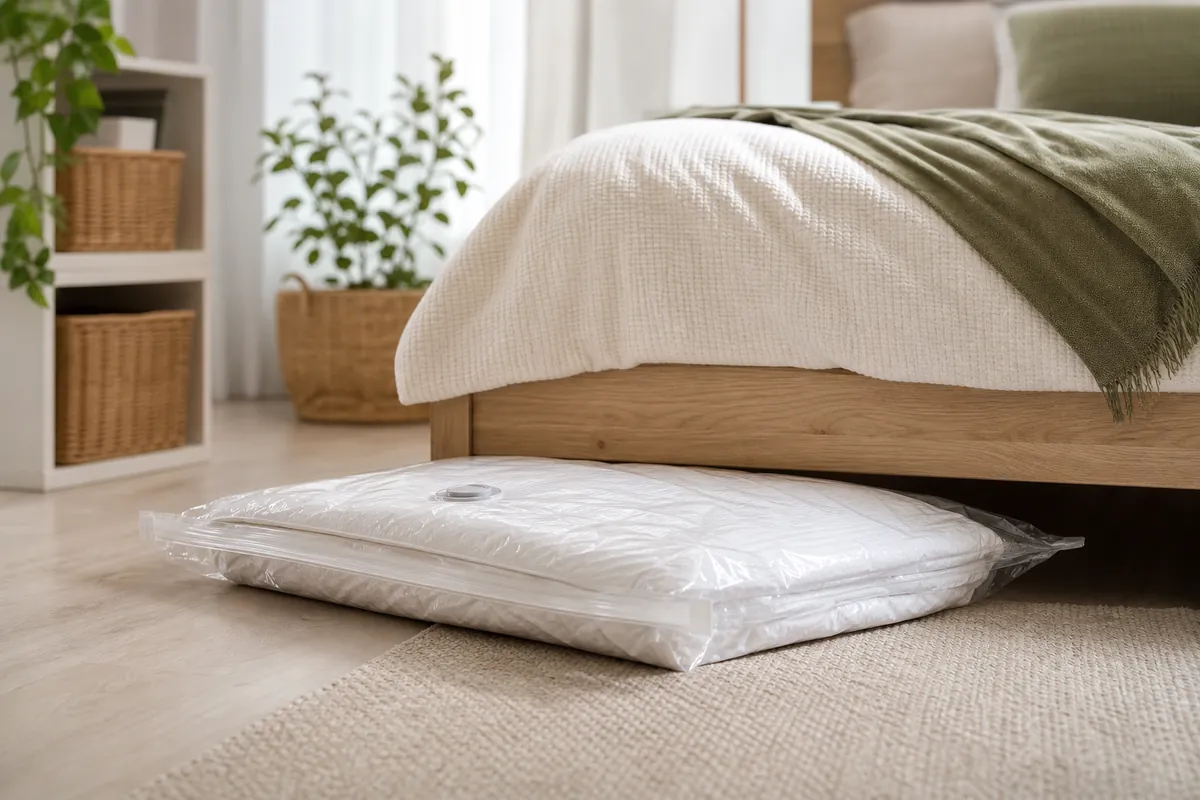
Duvets, winter coats, and thick knits are mostly air, and air is what fills your storage.
Under-bed storage bags and vacuum bags collapse that volume dramatically, which means a whole season of bedding fits in the height a single pillow used to need. For down and synthetic filling this is the single biggest space win available to you.
Two cautions. Anything structured, like a tailored coat or leather, creases permanently under compression, so leave those hanging. And down needs a day to loft back up after it comes out, so unpack the winter duvet before the cold snap, not during it.
5. Raise the bed if the clearance is hopeless
If you measured four inches and despaired, bed risers buy you the storage height without buying a new bed.
Three to five inches of lift is the sweet spot. It roughly doubles usable clearance on most low frames while keeping the mattress at a normal height to sit on. Match the riser cup to the leg shape, and check the weight rating covers the bed, the mattress, and the people in it.
Skip risers entirely on beds with castors, or on any frame that already shifts when you sit down. Adding height to something wobbly makes it worse.
6. Sort by season, not by category
The instinct is to group under-bed storage by what things are. The better system groups them by when you next need them.
One container for the season coming, one for the season just gone, one for genuine long-term storage. That way the container nearest the edge of the bed is always the one you will open next, and the deep ones at the back stay undisturbed for months, which is exactly what you want.
Rotate the containers rather than repacking them when the weather turns. It takes a minute instead of an afternoon.
7. Keep shoes in a flat, divided tray
Shoes are the ideal under-bed item, since they are flat, seasonal, and they take up an absurd amount of floor space in a small bedroom.
A divided tray keeps pairs together and stops the pile-up that makes people give up on shoe storage. Off-season boots and heels are perfect candidates. Everyday trainers are not, because you will want them daily and daily items should not require kneeling.
If shoes are your main storage problem rather than a side note, the ideas in shoe storage for a small space cover the everyday pairs that need to stay reachable.
8. Store luggage inside luggage
A suitcase under a bed is storing air unless you fill it. Nest smaller cases inside larger ones and use the largest as a container in its own right.
Spare bedding, off-season clothes, and camping gear all live perfectly well inside a suitcase, which is dust-proof, already has a handle, and was going under the bed regardless. This one habit often frees an entire container.
If the suitcases do not fit under the bed either, suitcase storage ideas for a small closet covers the rest of the options, including what to do with a hard shell that will not nest.
9. Use the foot of the bed differently to the sides
The space at the foot of the bed is easier to reach than the sides, because nothing blocks it and you can approach it standing.
Put the things you touch most often there, and keep the long sides for the deep archive. In a small bedroom the sides of the bed are often against a wall or an armoire anyway, which makes anything stored there genuinely awkward to retrieve.
10. Add a fabric barrier if your floor is dusty
Old floors, floorboard gaps, and forced-air heating all push dust under a bed faster than you would think.
A cheap fabric bed skirt or a length of fitted fabric across the frame cuts the airflow and keeps the space noticeably cleaner. It also hides mismatched containers, which matters if the bed is visible from a doorway. This is cosmetic and practical at once, and it costs less than replacing containers you got tired of wiping.
11. Decide what does not go under there
Under-bed storage fails when it becomes the default answer for homeless objects, so it needs a short list of exclusions.
Nothing edible, ever, because it invites pests into the one room you sleep in. Nothing you need weekly, because the friction guarantees it ends up on the floor beside the bed instead. And nothing sentimental and irreplaceable, since under a bed is a low spot in a room and low spots are what flood first.
Everything else that survives those three tests is fair game.
Making under bed storage actually work
The system that lasts is simple. Measure first, buy for the clearance you actually have, put the frequently-needed things on wheels, and compress the bulk with bags. Rolling under-bed storage handles the containers you open often, plain under-bed storage containers hold the seasonal archive, and under-bed storage bags shrink the duvets that would otherwise eat the whole space.
The rest is discipline about what earns a place down there. If the bedroom still feels tight once the floor is clear, the wall above the bed is the next place to look, and headboard storage ideas covers that side of the room.