There is a strip of floor behind almost every sofa that nobody uses for anything. It is usually two or three inches deep, sometimes more, and it exists because sofas do not sit flush against walls and nobody pushes them all the way back. In a tight living room that strip is one of the last unclaimed surfaces in the house, and six inches of depth is enough to turn it into real storage without the room feeling any smaller.
1. Measure the gap you already have
Start with what is there rather than what you want.
Pull the sofa forward and measure from the wall to the back of it. Most sit two to three inches off, partly because of the baseboard and partly because nobody bothers to push furniture flat. Then work out how much further forward the sofa can come before it interferes with the coffee table or a walkway.
Those two numbers added together are your working depth. In a lot of rooms it lands around six inches, which happens to be exactly what slim console tables are built for.
2. Six inches is the number to look for

Depth is the specification that decides whether this works at all.
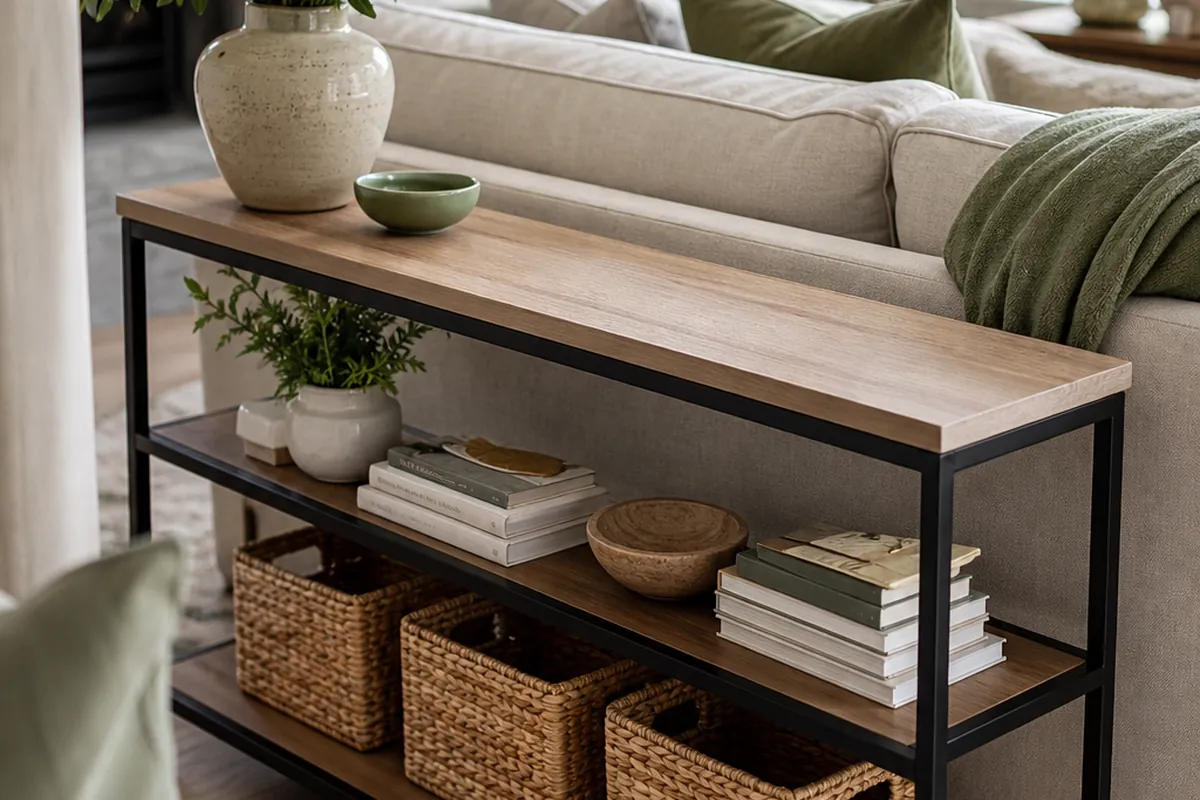
A narrow console table with charging station at around 5.9 inches deep by 47 inches wide slots into that strip and reads as part of the sofa rather than as an extra piece of furniture. Anything deeper starts pushing the seating into the room, which you will notice every day.
Width matters less. Match it roughly to the sofa or run it shorter, but do not run it longer, because the overhang is what makes it look like furniture that wandered in from another room.
3. Keep the top level with the sofa back
Height is what decides whether it disappears or dominates.
Level with the back of the sofa, or an inch below, is right. At that height the table reads as an extension of the seating and the surface is still usable from behind. Taller and it looms. Much lower and it vanishes, which sounds tidy until you realize you cannot see what is on it, so nothing gets put there.
If the sofa back is low, this may not work at all, and a pair of slim side tables at the ends will serve you better.
4. Put the outlets where people sit
This is the upgrade that earns its place in a small apartment.
A console with built-in sockets and USB ports turns the back of the sofa into the charging point for the room. That removes the cable running across the floor to the nearest wall socket, which in a small living room is both the ugliest thing in the room and the thing people trip on.
It also means one less extension lead, which matters in older apartments where sockets are scarce and never where you need them.
5. Baskets below, surface above

The split that keeps it looking deliberate.
The sofa back hides the lower half of anything behind it from everyone sitting in the room. So the lower shelf is the place for small storage baskets holding the things you do not want on display: spare cables, batteries, the TV remote nobody uses, a throw.
The top surface is the only part that shows, so it holds the few things that earn their place. A lamp, a plant, a coaster or two.
6. Shallow things only
The constraint that keeps it working.
A six-inch shelf takes books, chargers, remotes, coasters, small baskets and a lamp. It does not take board games, laundry, boxes or anything with real bulk, and trying to force those in is how the strip becomes a shelf of things balanced on other things.
If something does not fit within the depth, it does not live there. That is not a limitation, it is what stops the surface silting up.
7. Leave clearance if the sofa floats
Different rule for a sofa that divides a room rather than sitting against a wall.
If the sofa floats, the back of it is visible from the other side, and whatever you put behind it becomes part of the room’s furniture rather than a hidden strip. Leave a few inches between the table and whatever is behind it so nothing scrapes, and treat the back of the table as a surface people will see.
In that arrangement the console is also doing a second job as a room divider, which is worth more than the storage.
8. Slim side tables where a console will not fit
Not every sofa suits a full-length table.
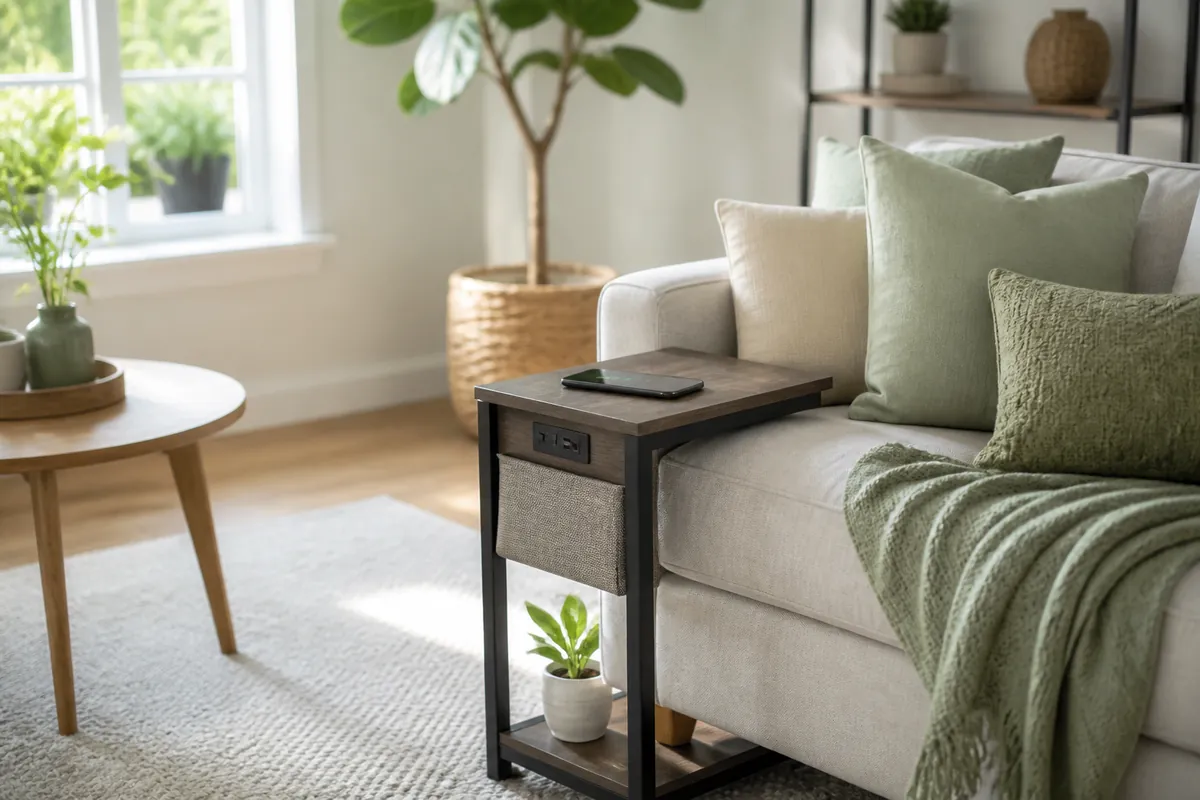
If the sofa is against a corner, has an awkward shape, or the wall has a radiator on it, a slim side table with charging station at one end gets you the charging point and a surface without needing the full run of clear wall.
Two small pieces often fit a tight room better than one long one, and they can move independently when you rearrange.
If the sofa floats and the storage has to sit in front of it instead, coffee table storage ideas for a small living room covers lift-tops, ottomans and how much walkway to leave.
9. Do not block a radiator
The mistake that costs you money rather than just space.
A console table pushed against a radiator traps the heat behind furniture, and in a small apartment that is a measurable difference on the heating bill through winter. It can also warp cheap furniture over time.
If the only clear wall has the radiator on it, use the ends of the sofa instead, or pick a table with an open back and legs rather than a solid panel so air can still move through.
10. Check the sockets you are covering
The last check before you push anything into place.
A long console against a wall will cover at least one wall socket, and often the one you were using. Work out what plugs into it now and whether you can still reach it, or whether the console’s own outlets replace it.
Doing this after delivery means either living with an inaccessible socket or moving the whole arrangement, and moving it usually means moving the sofa too.
Where to start
Pull the sofa out and measure the gap, then measure how far forward it can come. If the total gets you to about six inches, a slim console fits and the room will not feel any different for it.
Put the things you want hidden in baskets on the lower shelf, keep the top for a lamp and a couple of useful objects, and take the charging point with you. The strip behind a sofa is not much space, but it is space that is currently doing nothing at all.