Measure the gap between your bed and the wall. If it’s narrower than a cereal box, no standard nightstand is going in there, and wedging one in means shuffling sideways into bed every night for the rest of your lease. So reframe the problem: a bedside table has one small, specific job, which is holding a lamp, a glass of water, a phone, a book and maybe your glasses. Nothing else. Once you stop shopping for furniture and start shopping for a landing pad at mattress height, the list of nightstand alternatives for a small bedroom gets a lot longer.
Below are eleven options worth recommending, ordered roughly from most floor space saved to least. Trade-offs are spelled out, because a few of these only work with certain beds and one or two are genuinely overrated.
First, decide what has to be within arm’s reach
Spend a week noticing what you reach for in the dark. Most people need three things: a phone, water, and light. Reading glasses and whatever you’re halfway through, fine, add those. A stack of four books, a candle, three lip balms and a decorative tray? That pile is daytime clutter that migrated to the bedside, and it’s the reason you think you need drawers.
Your list sets the surface size. Three items fit on the footprint of a dinner plate, which is why a shelf no deeper than a paperback works far better than people expect. Keep that dinner plate in mind as you read the rest of this.
The water glass rule
One non-negotiable: whatever you choose has to hold a full glass of water without wobbling, and without the glass overhanging an edge. Fail that test and the glass hits the floor at 2 a.m., after which you’ll quietly stop using the thing. A raised lip or a low rail fixes it, which is why the lip keeps coming up below.
Wall-mounted nightstand alternatives for a small bedroom
1. A floating shelf mounted at mattress height
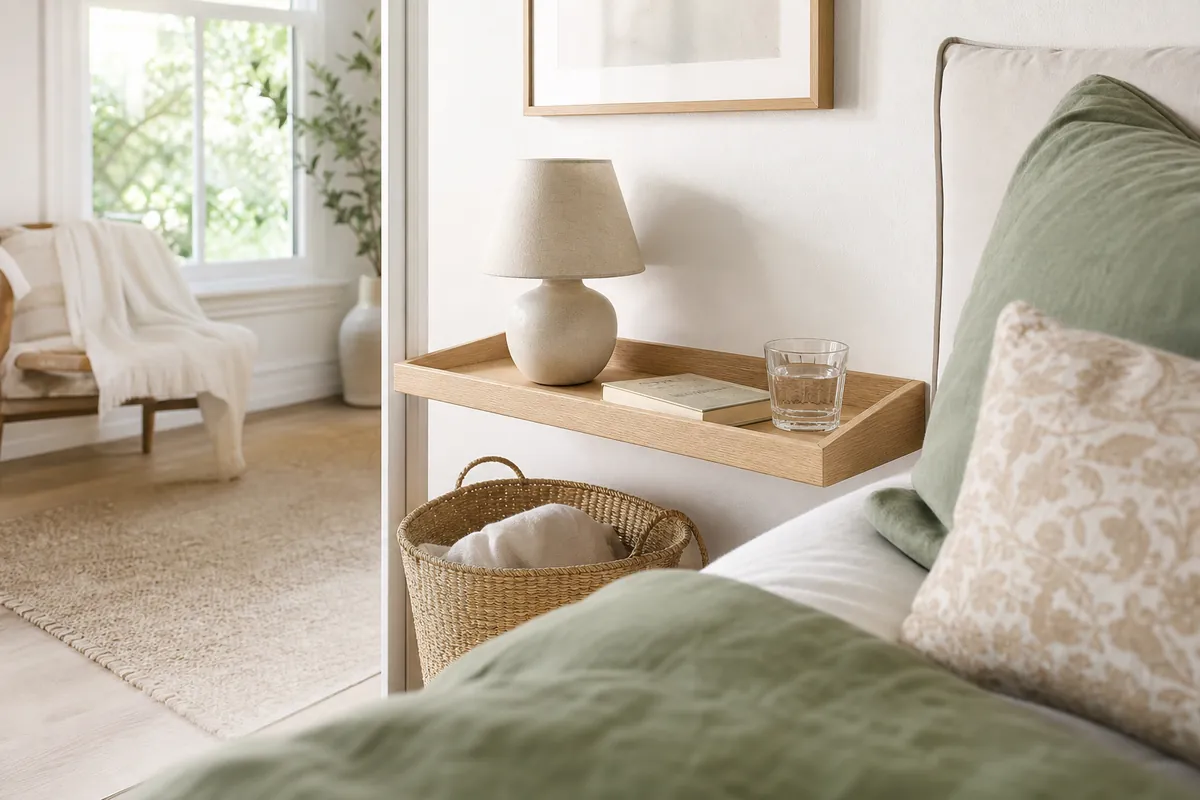
This is my first recommendation nine times out of ten. A floating wall shelf with a front lip gives you a real surface, uses no floor at all, and leaves the space beneath free for a laundry basket or an under-bed bin. The lip does the heavy lifting: it stops a phone or a pen from sliding off and lets you get away with a shallower shelf than instinct suggests. Six to eight inches of depth is plenty for a plate-sized zone.
Set the top surface level with the top of your mattress, or an inch or two above. Higher than that and you’re reaching up over your shoulder while lying down. Lower, and you can’t see what’s on it without sitting up. Depth matters for a second reason too: a deep shelf beside a bed becomes a head-bumping hazard the first morning you sit up fast.
Renting? Find a stud if a lamp is going on there. Drywall anchors handle a paperback and a phone without complaint, but a ceramic lamp base plus a full glass is more than most bargain anchors want to carry. Two small holes disappear under a dab of spackle at move-out.
2. Pair the shelf with a wall sconce or clamp lamp
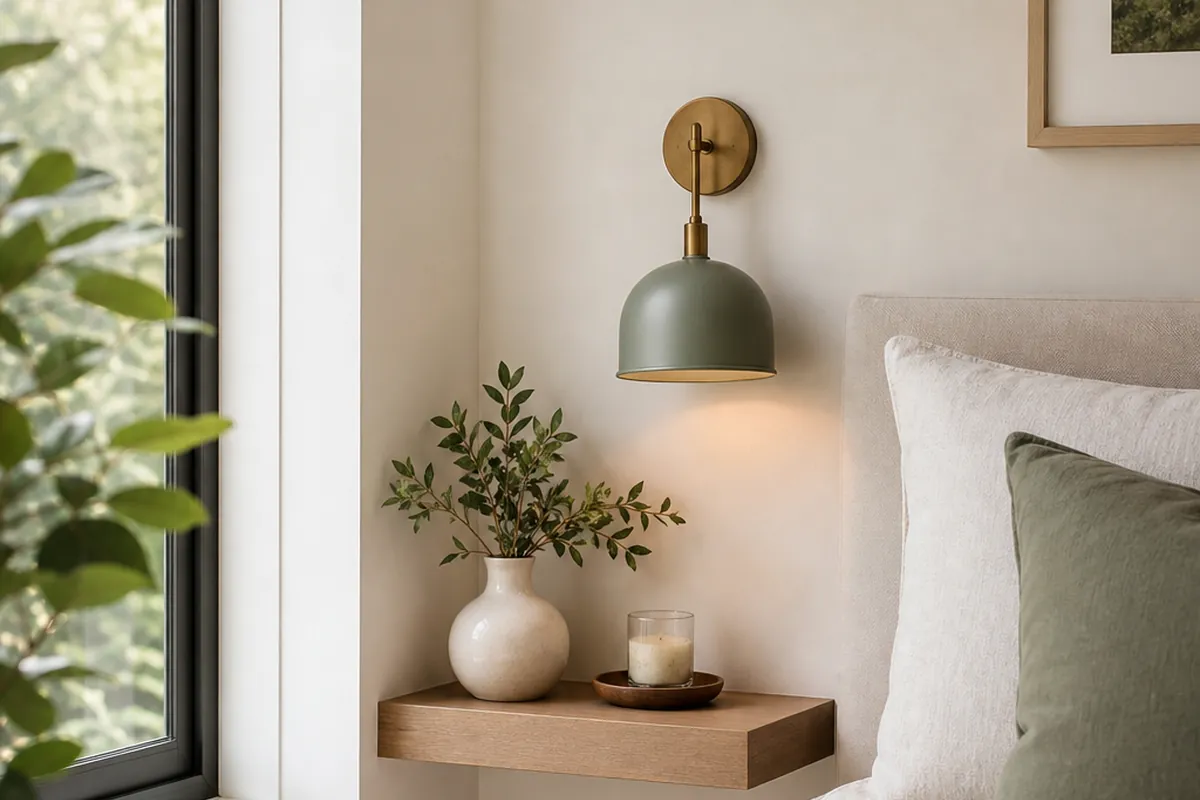
Lamps are the reason nightstands are so big in the first place. Move the light off the surface, onto the wall or clamped to the headboard, and your surface requirement shrinks to almost nothing. Plug-in sconces with a fabric cord need no wiring, and the cord runs down behind the bed under a few adhesive clips. A clamp light is the cheaper route and it swivels, which matters if one of you reads and the other doesn’t.
3. A picture ledge, used sideways
A narrow picture ledge is a shelf with a lip already built in, usually for less money than a purpose-built floating shelf. Too shallow for a lamp, ideal for a phone, glasses and a book laid flat. Use it with option 2 and you have a working bedside for the price of two brackets.
4. A peg rail with a hanging basket
When your bedside problem is stuff rather than surface, mount a wooden peg rail and hang one small basket from it. Chargers, earbuds, hand cream and a journal all live in there instead of on the mattress. It reads as intentional rather than improvised, and it’s the kindest option for walls where you’d rather make small holes than big ones. Pegs also hold tomorrow’s tote or a robe, a real win in a bedroom with no closet.
Bed-attached nightstand alternatives (no wall, no floor)
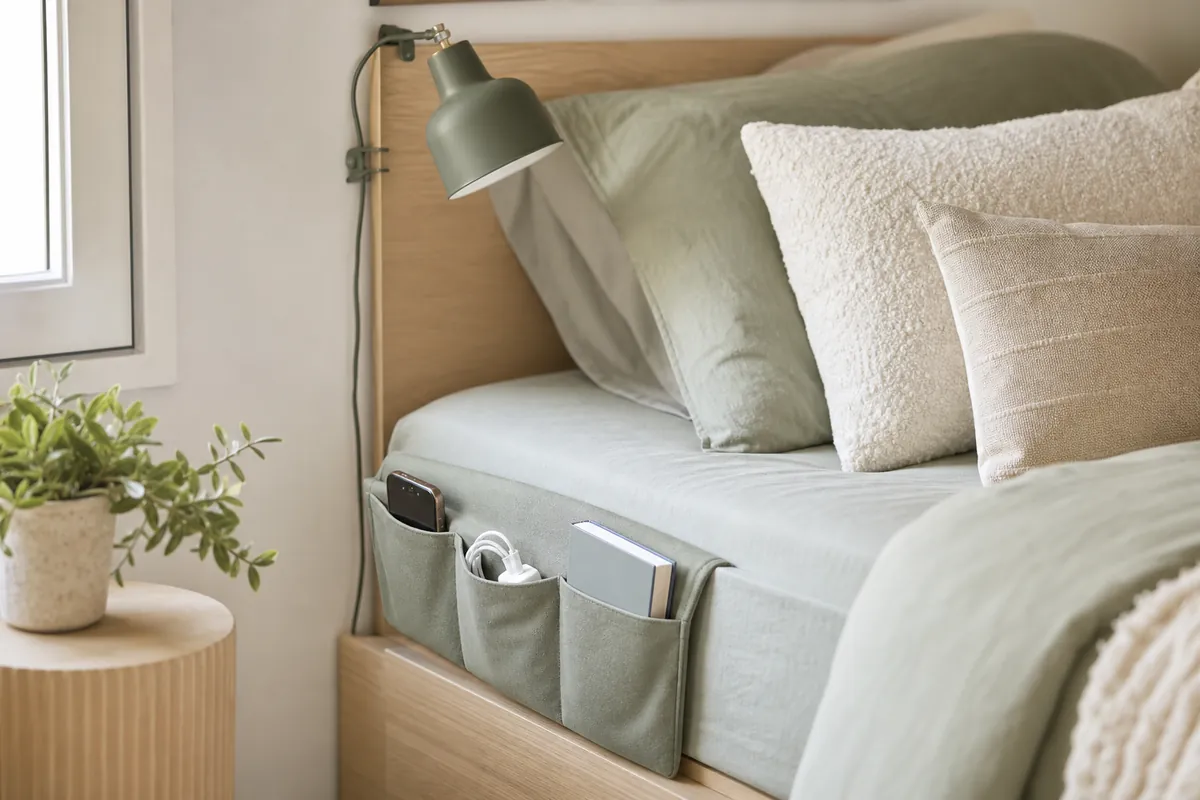
5. A clip-on bedside caddy
Beds shoved into a corner or under a window can’t use the wall, and this is the fix. A clip-on bedside caddy grips the mattress edge or the frame and hangs a pocketed pouch at arm’s reach: phone, remote, book, charging cable, all of it off the floor.
No lamp, no water glass, so be honest about that before you buy. For bunks, lofted beds and any mattress hemmed in on three sides, though, nothing else does the job. It’s also the best bedside fix in a dorm room, which is why it turns up in my dorm storage list.
6. A headboard shelf or bookcase headboard
Already replacing the bed? A headboard with a built-in shelf swallows the nightstand entirely. Two catches: pillows knock things off it constantly, and the space directly above your head is a poor place for a heavy lamp. Books, a phone and an alarm clock, yes. Liquids, no.
7. A fabric sling over the frame rail
Sling-style organizers drape over the bed rail and hide in the gap between mattress and wall for very little money. Best suited to the paperback-and-earbuds crowd. Frames with no rail to hang from can skip this one entirely.
Slim freestanding nightstand alternatives for a small bedroom
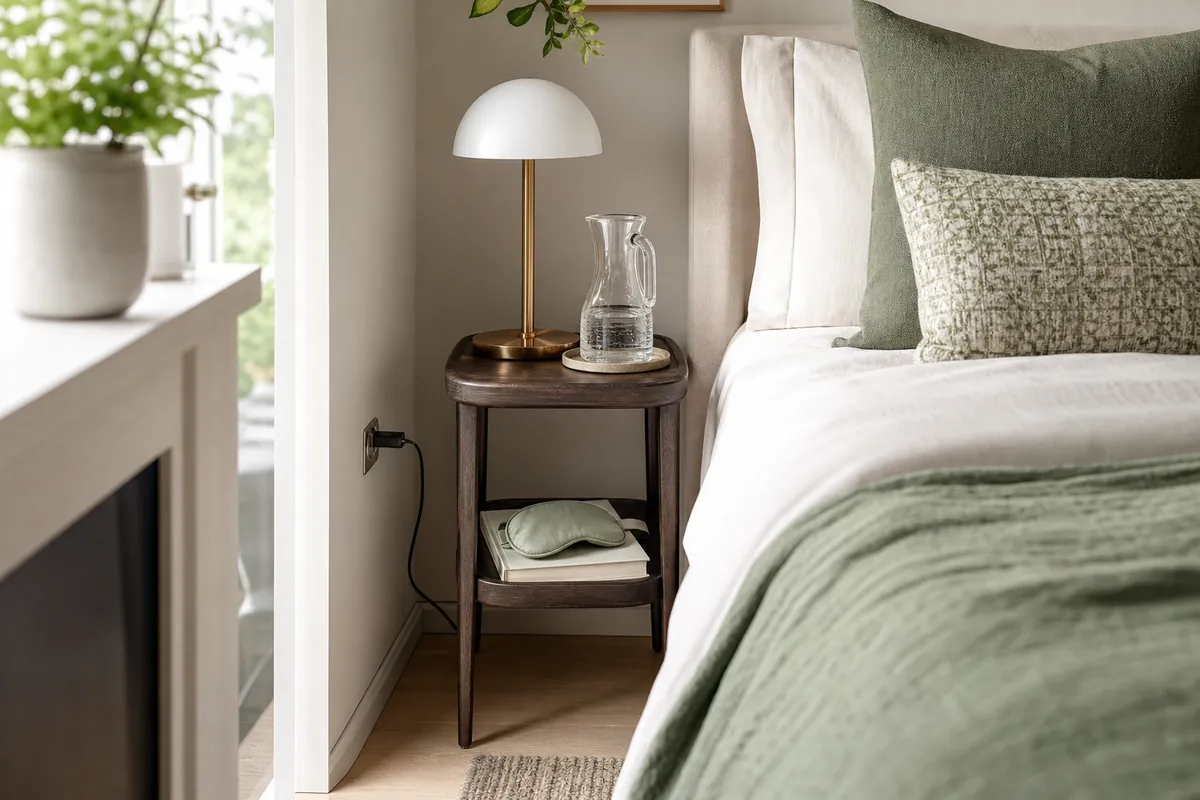
8. A slim side table with a charging station
Four to eight inches of spare floor changes the calculation. A slim side table with a charging station earns that footprint because it solves two problems at once: no surface, and a nest of cables crossing the floor. Built-in USB ports mean your phone charges on the table rather than on the carpet where you’ll stand on it at 6 a.m.
Choose one with a lower shelf. Top surface stays clear for the lamp and the glass; the bottom takes the book and the sleep mask. Two small zones always look tidier than one crowded one.
9. A C-table that slides over the mattress
C-shaped tables have a base that slides under the bed and a top that cantilevers over the mattress edge, so the only floor they occupy is the thickness of that base. Brilliant with beds that have clearance underneath. Useless with platform beds sitting flat on the ground, so get a tape measure under there before you order.
10. A small stool, or a stack of hardcovers
Not a joke. A sturdy wooden stool gives you a plate-sized surface, a smaller footprint than most nightstands and zero assembly, plus you can pull it out to vacuum or drag it over as seating. Stack a few large hardcovers tightly and you get the same surface for free. Cat owners, be warned: those books will be on the floor by Thursday.
11. Reclaim the windowsill
Beds under a window already have a shelf. Add a slim tray to level out an angled sill and you’ve got a defined surface with a built-in edge. Watch for winter condensation, which rules out leaving a book there, and keep candles well clear of the curtains.
Which nightstand alternative should you actually pick?
If you can put two holes in the wall, mount a floating shelf with a lip and hang the light above it. That combination comes closest to a real nightstand without costing you an inch of floor, and it looks deliberate rather than makeshift.
No drilling allowed? A clip-on bedside caddy plus a clamp light on the headboard covers every genuine nighttime need for very little outlay. Where you do have a sliver of floor and can’t stand visible cords, put the money into the slim side table with a charging station instead.
The one option I’d argue against: a full-size nightstand jammed in at an angle so the drawer opens halfway. Half-functional furniture in a small room is worse than none, since it takes the space and gives nothing back.
If there are two of you and only one side of the bed has room, shared bedroom storage ideas for couples covers how to give both people a bedside without both people having a nightstand.
Style the surface so it doesn’t read as clutter
Small surfaces tip into mess fast, so give yours structure. One shallow dish holds rings, earplugs and the charging cable, and everything else has to justify its place. Hold yourself to four items, five if the lamp counts. Think vertically too: a slim carafe uses less surface than a wide tumbler, and a book standing on its end against the wall uses less than one lying flat.
Worth doing whichever option you pick: stick an LED puck or a motion sensor light to the underside of the shelf, the headboard lip, or the bed frame. Soft light at ankle height means you may not need a bedside lamp at all, which frees the whole surface for the things you actually use.
Bedside is rarely the only pinch point in a small room. Same principles apply everywhere else: go vertical, attach things to furniture you already own, and refuse to add anything with a footprint. More of that thinking lives in bedroom storage ideas for when the room is already full.
Start with the shelf. Twenty minutes with a drill, and the moment your phone has a home that isn’t the mattress, the whole room breathes.