Reach for the paprika, knock two jars sideways, watch one roll behind the toaster. That is what bad spice organization costs you on an ordinary Tuesday in a kitchen that came with no rack, no pull-out, and maybe four free inches of counter. A prettier jar set will not solve it. What solves it is committing to a single storage geometry, vertical or flat or spinning, that fits the space you genuinely have instead of the kitchen you wish you had.
Twelve ideas follow, grouped by where the unused space is hiding in a small rental or galley kitchen. Read the first section even if you came here to shop. Culling first is the difference between an organizer that fixes the problem and a half-empty gadget parked on top of the same mess.
Cull first, then choose the organizer
1. Split the collection into first string and second string
Pull every jar out and build two piles on the counter or the floor: what you touch most weeks, and what you bought for one recipe three years ago. Most home cooks run on eight to twelve workhorses. Salt, pepper, garlic powder, cumin, smoked paprika, chili flakes, cinnamon, oregano, plus whatever your household leans on. Those get the easiest-to-reach spot in the kitchen. Everything else goes into a second-string bin that can live somewhere genuinely inconvenient, like the shelf above the fridge.
That split is the whole trick. Give forty jars equal access in a tiny kitchen and you have not organized anything, you have just built a taller avalanche.
2. Rub, sniff, toss
Ground spices go flat long before they look suspicious. Open the jar, rub a pinch between your fingers, and if it smells like dust it is seasoning your food like dust. Whole spices hold on considerably longer, which is one argument for buying peppercorns and cumin seed whole when you can. Being honest at this stage often clears a third of the shelf, and a third is frequently the gap between needing a whole new system and needing one drawer insert.
Vertical spice organization when nothing else is free
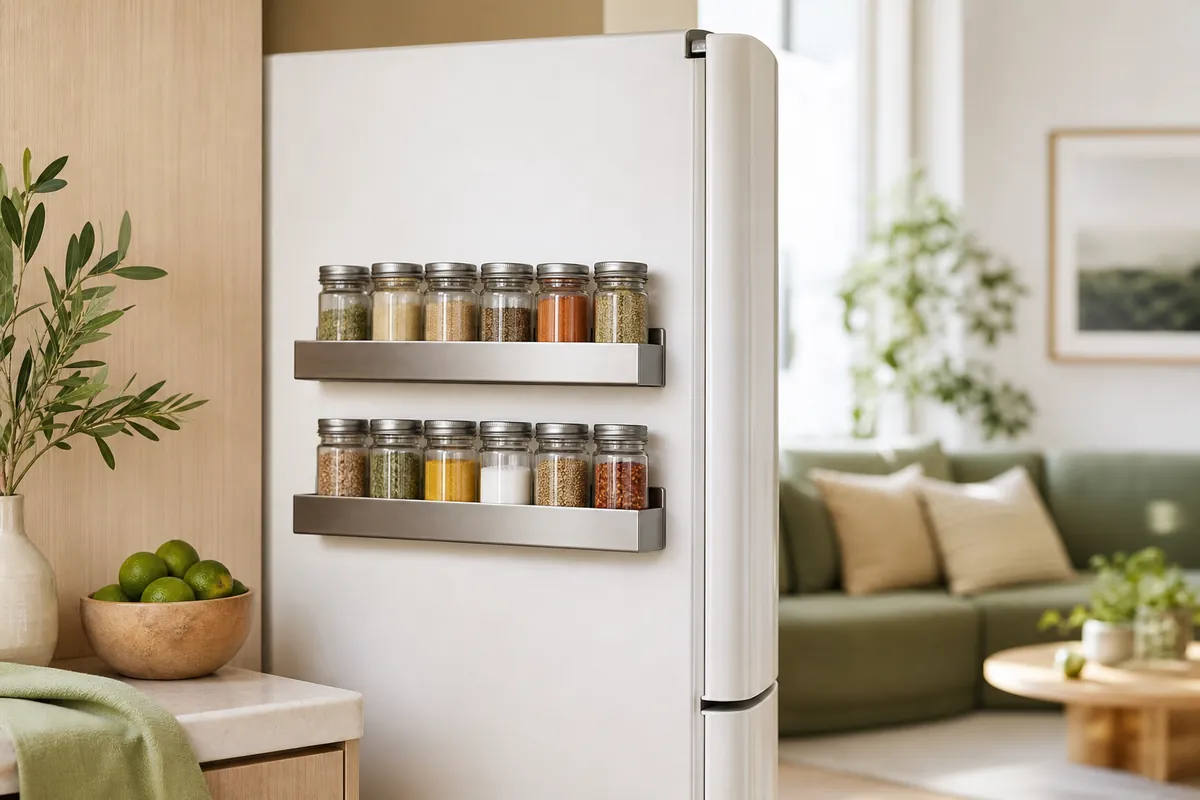
Cabinets full, counters full? Up and sideways is the only direction left. Vertical spice organization means hanging jars on surfaces you currently walk past without seeing.
3. Mount a magnetic spice rack on the side of the fridge
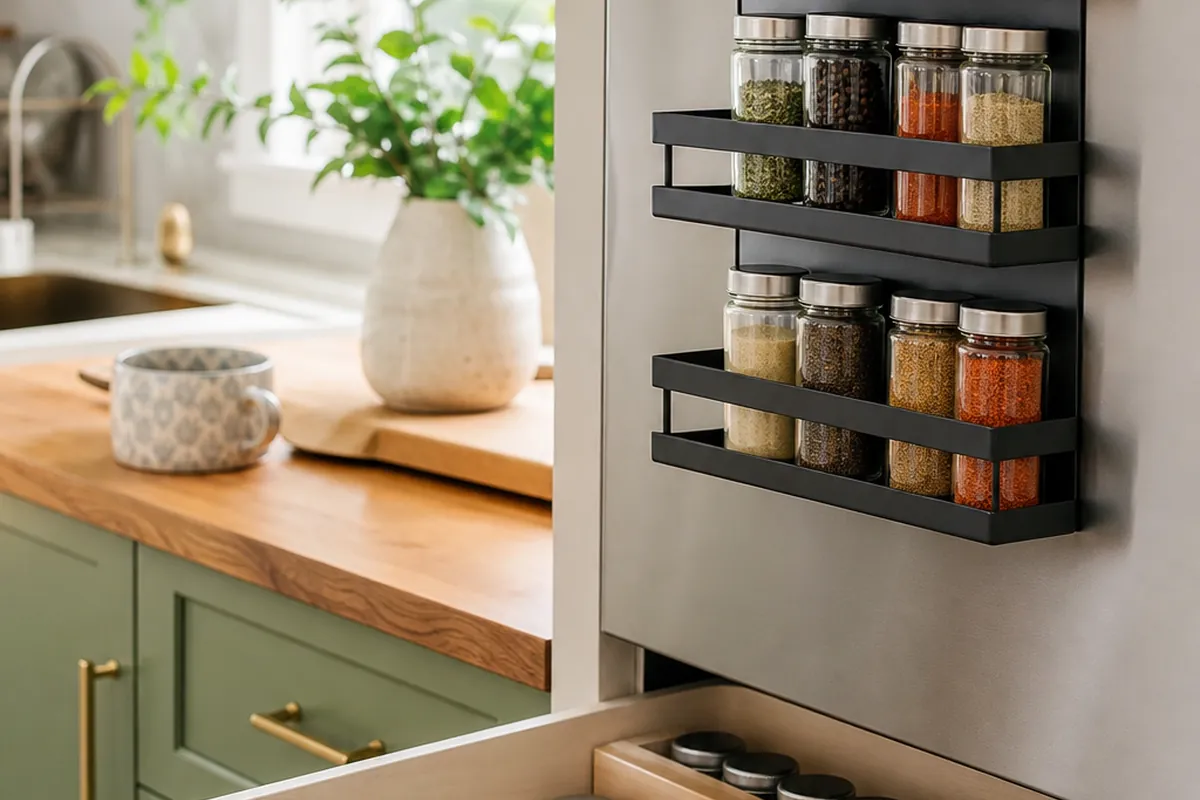
The exposed side panel of a fridge is the most wasted vertical surface in a small kitchen, and a magnetic spice rack turns it into a spice wall with no drilling, no adhesive residue, and no landlord conversation. Jars sit at eye level with labels facing out, and the whole thing lifts off in one piece on moving day.
Two checks first. Many stainless doors are not magnetic while the side panels still are, so wander around with a fridge magnet and test a few spots. Then pick the side away from the range, since heat and steam wreck ground spices faster than anything else in the room. If there is a narrow gap between the fridge and a wall, that gap side is usually ideal: reachable, and completely out of the sightline of the kitchen. Racks with a shelf lip beat bare magnetic tins, by the way, because the lip catches a jar you knock instead of sending it to the floor. While you are working the fridge, these fridge organization ideas for small spaces will get the inside matching the outside.
4. Claim the inside of a cabinet door
The flat panel inside a cabinet door usually offers three or four inches of clearance in front of it before your shelf edges begin. A slim door-mounted rail fits neatly in that dead zone and holds one row of short jars. Measure the gap between the closed door and the front edge of the shelves before ordering anything, then store only jars shorter than that measurement. Get it wrong and the door will refuse to close, loudly, usually while your hands are full.
5. Hang baskets under a shelf you already have
Under-shelf baskets clamp onto an existing shelf and invent a second, lower tier out of nothing. For spices they work best with squat wide-mouth jars, dropped in upright so you can read the lids from below. Tall bottles benefit too: vanilla, sesame oil, and the oversized bulk-store containers stop getting stranded behind the short stuff. Renters like them because they slide off without a trace, the same logic behind most no-drilling renter pantry fixes.
Drawer spice organization beats a rack almost every time
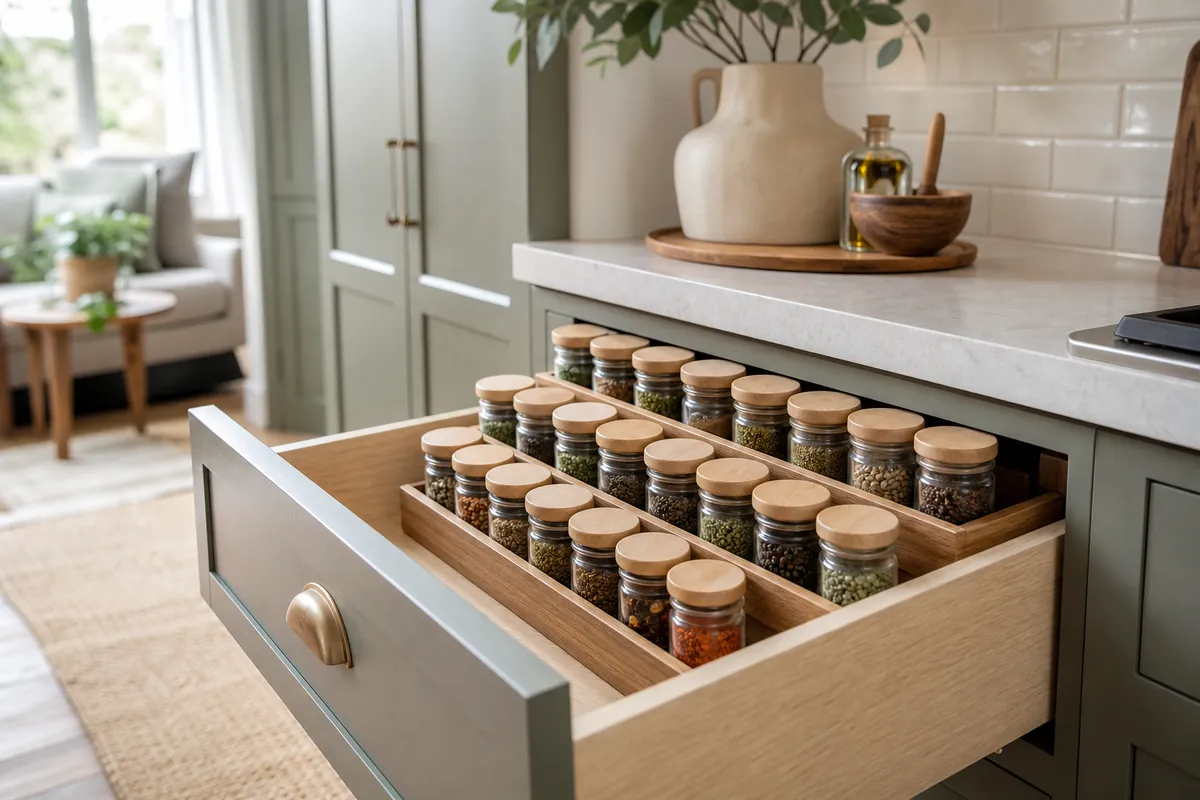
Got a drawer, even a shallow one? This is the layout I push hardest. Lids facing up are the fastest thing in a kitchen to scan and, more importantly, the fastest thing to put back. Systems die at the putting-back stage.
6. Install a tiered in-drawer spice organizer
A tiered in-drawer spice organizer is an angled insert that steps each row up behind the one in front, so back jars stay visible rather than buried. Slide it into a shallow drawer beside the stove and you have a spice cabinet that closes flush and never collects grease dust. Measure the interior depth and, critically, the interior height of the drawer first. Some inserts assume a standard-depth drawer and will sit proud of the opening in a shallow one, which means the drawer jams every time you close it.
Honest trade-off: this eats an entire drawer. In a kitchen with four drawers total, that stings. Then again, a drawer of tangled dish towels is not earning its square footage the way twenty visible spices do.
7. Or lay them flat and skip the insert entirely
No budget? Lay jars on their sides in a shallow drawer, labels up, packed in tight rows so nothing rolls. Wedge a rolled dish towel or a spare divider along the front edge so the first row stops surfing forward every time you yank the drawer open. Less elegant than the tiered insert, and it works this afternoon for free.
8. Take half a drawer with a divider
Cannot spare a whole drawer? Split one. Run a divider across the middle of a utensil drawer, hand the front half to a single flat row of spices, and leave the back half for whisks and spatulas. Ten jars fit that footprint comfortably, which happens to be about the size of your first string.
Cabinet spice organization for deep, awkward shelves
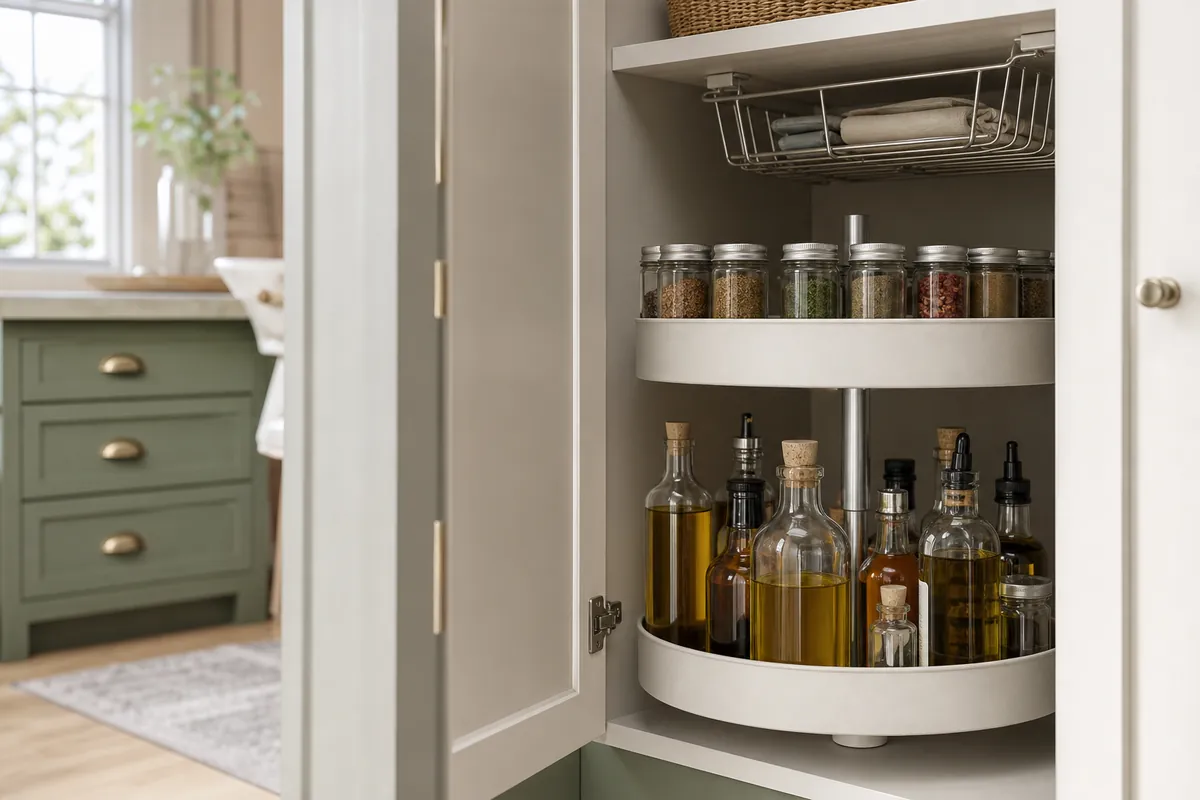
9. Drop a turntable into the deep cabinet
Deep cabinets swallow spices whole. A turntable brings the back row to you instead of making you excavate for it. Size it about an inch narrower than the usable shelf depth so it clears the cabinet frame on every rotation, and insist on a raised outer lip. Without that lip, one enthusiastic spin sends jars over the edge. A standard turntable holds roughly a dozen everyday jars around the rim with a couple of taller bottles parked in the middle.
10. Go two-tier when the shelf gap is tall
Tall shelf gaps, common above a fridge and in older apartments, are begging for a two-tier turntable. Short round jars belong on the top tier where you look straight down onto the lids. Extracts, oils, and big bulk containers go underneath. Spin, grab, done.
11. Exile the backstock
Refill pouches, bulk-trash bags, and the third jar of cinnamon you forgot about have no business in your working zone. Park them in one labeled bin on a high shelf or in the pantry and promote a replacement only when the working jar runs dry. Mixing backstock with daily drivers is the reason cabinets look stuffed when they are actually half air. If surface space is your real bottleneck, pair this with these ways to get counter space back in a tiny kitchen.
Labels and jar choices that make the system stick
12. Label the lids, not just the fronts
Whichever layout wins, write on the caps. Drawers and turntables are both read from above, and any jar you have to lift and rotate is a jar that gets abandoned on the counter mid-recipe. A paint pen or plain round stickers takes fifteen minutes and repays you at every dinner.
On decanting into matching jars: it does look wonderful, and it earns its keep if your current jars are wildly mismatched heights that waste vertical space. It also commits you to transferring every refill and losing the printed date. My rule is to decant only the workhorses you rebuy constantly and leave one-off specialty spices in their original containers. Either way, write the month and year you opened each jar somewhere on it, because “smells fine to me” is a fuzzy standard and a date is not.
Pick one system, not three
Scattering is the classic failure: four jars on a fridge rack, six in a drawer, eight on a turntable, and nobody can find the coriander. Let the room decide the primary home. Drawer near the stove means the tiered in-drawer organizer wins. No drawer but a magnetic fridge flank means the magnetic spice rack wins. Deep cabinets and nothing else means a turntable, with under-shelf baskets catching the tall bottles that refuse to fit.
One home for the daily set, one bin for backstock, labels on the lids. That is the entire system, and it survives a chaotic weeknight, which is the only test worth passing.